
A few days ago, I had a 4-hour phone conversation with a friend. This conversation helped me crystallize a major shift in my perspective on life, a shift that’s been brewing for decades.
I call this shift: going from living “just around the corner” to living on this here street.
Let’s start this story with a day in my life, twenty years ago:
October, 2003
I was in the car of an acquaintance, driving home. I felt butterflies in my stomach. This was the day that the envelope would be coming in the mail. The envelope that carried the verdict of the big project I had been working on for years.
Let me give some background.
In elementary and middle school, I was bullied for being a “loser,” a “freak” and a myriad other not-nice labels. This bullying grew a weed of toxic shame in my soul.
The shame put me in a double bind. I was lonely and wanted friends, but I only wanted to be friends with the cool kids. I didn’t want to be friends with “losers,” because that would mean I was a loser.
But the cool kids were out of reach. In high school, though they no longer bullied me, they didn’t care to give me the time of day.
So, I thought up a different strategy for achieving love and acceptance: I’d try my hardest to “win” at the academic game. If I couldn’t be socially accepted for myself, then I’d work my ass off to be accepted for achieving. Secretly, I set my sights on becoming valedictorian.
The next three years were filled with an insane amount of studying. On most school nights, I’d usually stay up past midnight doing my homework and studying for the next day. On Mondays and Wednesdays, I’d finish my pre-scheduled days at 9pm because of swim practice and then an after-school math program. On these nights, I’d go to bed as late as 4am.
I’d eat my lunches in the library. This killed two birds with one stone: I wouldn’t have to find friends to sit with at lunch (great, for I had none), and I could gain an extra 45 minutes in my day to study. I budgeted my time judiciously, estimating down to the 5-minute mark how long each of my homework assignments would take.
Despite the grueling studying, I didn’t feel depressed. The workaholism was working, at least for a time. If I focused all my attention on cramming information into my head, then I didn’t have time to self-reflect or feel lonely.
All these events led up to that fateful day when I waved bye to my kind acquaintance, opened the mailbox, and saw the thin envelope. I was dying to tear it open and find out if I was valedictorian or not.
Cold rain poured down that day. My acquaintance drove away. I walked to my front door and pushed the handle. It was locked.
No matter. I was dry under the awning. I didn’t care about being locked out. All I could focus on was the envelope. I tore it open. My shaky hands unfolded the paper.
My heart pounded as I scanned the page.
There it was, printed on the top right hand corner of the page: Class Rank 1.
Waves of electricity came over my body. I did it! Three years of too-hard work had paid off. I achieved my goal!
Then I zoomed out. I visualized myself from the outside, standing there all alone in front of my locked house. And a great emptiness descended on my soul.
I’d worked so hard to win this contest. I’d paid for my winnings with stress and sleeplessness and lost opportunities for friendship.
And there I was, alone with my envelope. Locked out of my house, shivering in the rain.
May, 2023
I was walking to the house of my therapist, excited with anticipation. This would be my last therapy session, and we would be doing it at her house. To be honest, I was equally excited to be at her house as I was about our session.
You see, I had subconsciously put my therapist on a pedestal. In my early thirties, I did three years of psychotherapy. The whole time, I thought that my therapist was the picture of psychological health.
I savored the little breadcrumbs of personal information my therapist revealed over the years. One time, I ran into her at a farmer’s market. She seemed so alive and present, talking to a guy selling odds and ends.
I’d only get rare glimpses of my therapist the human. Most of the time, which is totally understandable and what I was paying for, our conversations would focus on me.
The therapy work eventually began to go in circles, and my therapist suggested we take a break. The break turned into stopping therapy entirely. Then, after a few years, I wanted to do a final session for closure’s sake. I texted my therapist to ask her if we could do a session. She said yes.
My therapist had closed her office and had gone into semi-retirement, and so she offered to have our session at her apartment. Hell yes! I thought. I wanted to see the woman I had put on a pedestal in her element.
I walked to her place, knocked on the door and gave my therapist a hug. Then I began what would be two hours of snooping around.
I wanted to learn more about this person whom I had idealized. The more I snooped, the more the idealized woman became real. My therapist liked these particular books. She had these particular kids and grandkids. She was divorced.
The fascinating details of her life were revealed to me through the objects in her place.
At the end of my snoop-fest, I said to her, “You know, I’ve always idealized you as someone who has inner peace.”
She said, “You want to know the truth? Sometimes I feel peace, and sometimes I don’t. When I watch the news or think about the problems of the world, I usually don’t.”
This quote was one of the most important things my therapist ever said to me. By admitting that she had not achieved some permanent state of peace, she stepped down off the pedestal in my mind. And if my therapist did not live on such an “always peaceful” pedestal, then maybe such a pedestal did not exist…
Today
A half hour ago, I took a walk and looked at the amazing contours of the clouds. I emptied my mind and connected with a primordial sense of wonder as I saw the fluffy shapes move in the illuminated sky.
The walk helped me relax and connect with my sense of wonder, which is something I value. The walk put me in a state of awe and flow.
There were times earlier today when I felt tired, annoyed, impatient. Times when I struggled to find meaning.
Ultimately, I don’t believe in any cosmic meaning to my life. I think I’m just an animal thrown into this world, who will be here for a very short time. While here, I have to figure out for myself what is meaningful to me and what isn’t.
For example, I can decide that feeling wonder is meaningful for me. With this insight in mind, taking five minutes to look at the clouds is meaningful. This is an opportunity to connect with wonder, to deepen my capacity to feel it.
I might talk to someone on the phone today. My source of meaning could be to fully accept, listen to, and love the person on the other end of the line. Acceptance, listening, and love are virtues I want to develop in myself. Practicing them is meaningful.
When I feel negative emotions, it’s up to me to connect with my values, and reorient my life. In the words of Modest Mouse, “work a little bit harder, work another way.”
Work to create meaning in the here and now. Not work to get to a fantasy place of permanent bliss just around the corner.
It’s both liberating and painful to let go of “just around the corner” lens on life. Liberating, because it allows me to relax into the moment and accept it, warts and all. Painful, because the belief that this accomplishment, or that experience, or this person will solve all my problems is comforting.
Giving up the “just around the corner” perspective is like giving up a favorite childhood blanket. Yes, it’s necessary to give up the blanket to grow, but the blanket sure was comforting.
Over the last decade or so, I have been an avid consumer of what most people would call self-help. This has come in many flavors: from productivity advice, to courses on improving charisma, to meditation groups to help get in touch with intuition.
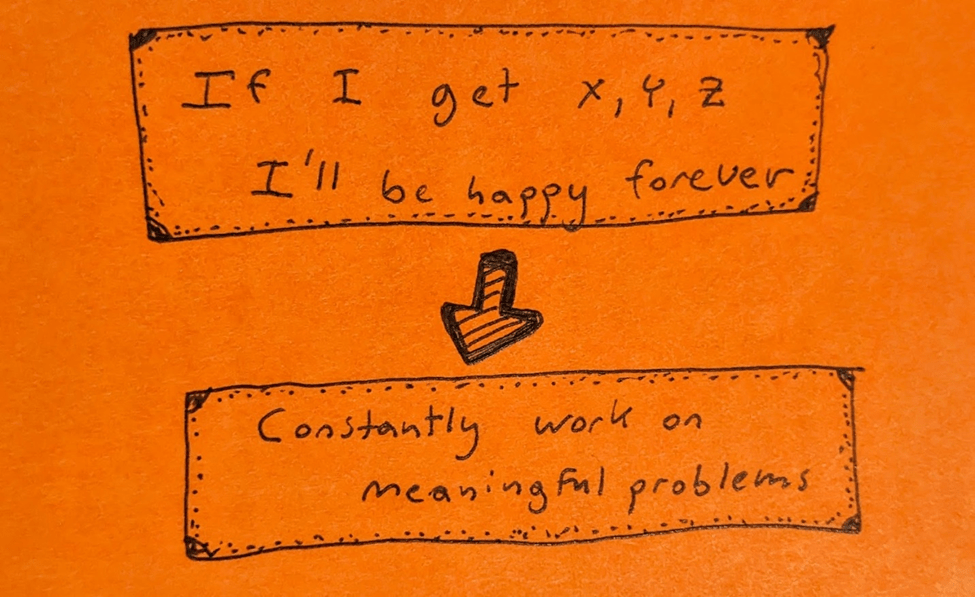
The belief driving this long and winding journey was this:
If only I change X about myself or learn Y skill or achieve Z, then I’ll be done with pain and enter a world of permanent happiness. Just around the corner there is a place where I will be done with feeling bad, and where my psychological needs for love and meaning will be delivered to me by an external source. A state of permanent happiness is just around the corner.
When the self-help flavor du jour failed to get me to permanent bliss, I would move on to the next one in an addictive cycle.
I have Mark Manson to thank for helping me see that there was a dysfunctional perspective driving my self-help addiction. In his writings, Mark points out that the idea of reaching some permanent state of happiness is ridiculous. Happiness is an emotion, and because emotions are always changing, no one is happy all the time.
It’s an appealing notion that permanent happiness is “just around the corner.” This notion drove me to study way too hard in high school and neglect making friends. If I achieve valedictorian-hood, everything will be permanently good, my subconscious thought.
This notion also led me to idealize my therapist. She is someone with ‘good psychological health’ and will fix me, was my dysfunctional thought.
This notion kept me bouncing from one self-help methodology to another the last decade, always looking for the thing that would get me to that place of permanent happiness.
Such a place does not exist.
Meaning and happiness are not permanent things, handed to us on a platter if we achieve X or learn Y. Meaning and happiness can be found right here, right now. Or not.
Not finding meaning and happiness right now is useful information. It’s our brains telling us that we need to change something: either our external circumstances, or our perspective.
In his book Greenlights, Matthew McCounoughey writes that “the record button is always on.”
This is my life. I’m writing this essay, which I find meaningful because it’s helping me understand my life better. I hope it will be helpful to at least one other person who reads it.
Soon, I’ll be going to work and seeing my patients. This evening, I’ll probably go for a run and read a book and talk on the phone and eat dinner.
If these activities are not meaningful to me, then they should be changed, rearranged.
Psychological health is about creating a narrative of meaning in the day-to-day activities of my life.
I’m going to have breakfast now. My meaning for breakfast is that it will improve my health and enable me to serve my patients. This meaning took some effort to create.
Instead of spending my effort on always running somewhere into the future, I want to spend my effort on working on meaningful projects in the here and now. Even if they are as mundane as cutting fruits, and mixing them with yogurt and granola.
Thank you to Thomas and Dr. Paull for feedback on this post.
There are times when the ‘poor me’ mood is upon us; we’re overwhelmed by all the troubles we have to face. This is especially likely to happen when we have begun to change our thinking about ourselves and our relation to others. We may, at first, become too analytical and try to solve too much at once. For this frame of mind there is an almost infallable prescription: to empty our minds of all thoughts but one — today and how to use it. This day is mine. It is unique. Nobody in the world has one exactly like it. It holds the sum of all my past experience and all my future potential.
Miriam Luby Wolfe
 danscreativeoulet