

Raising a puppy has been a learning experience. Here are three surprising things I’ve learned, so far.
Culture determines what we see as weird
In Cosco the other day, I saw the following product for sale:
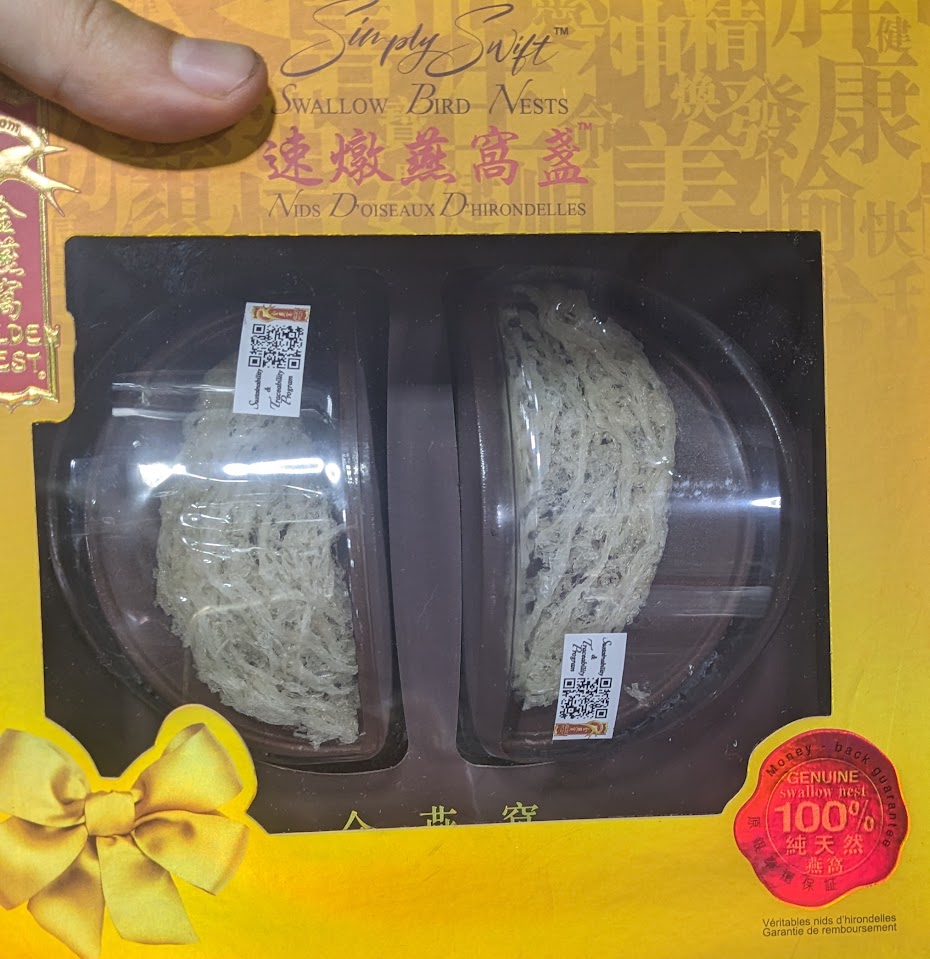
Birds nests for bird’s nest soup. Weird, I thought.
Next, I passed an isle selling snack foods. Oreos, Pop Tarts, the like. My “weird” detector did not go off. My girlfriend, however, had the opposite reaction. She thought the Pop-Tarts were weird and the bird’s nests were normal. She comes from a culture where bird’s nest soup is eaten, but Pop Tarts aren’t.
Wait a second, I thought. Pop Tarts are weird. They are this completely artificial food-like thing made in a factory with tons of obscure ingredients.
Raising a puppy is teaching culture. For example, a puppy doesn’t know that chewing shoes is bad, and chewing a toy is good. You have to teach this.
Being a “cultural teacher” has made me to see that culture is not objective truth. Just like I am teaching the puppy that toys are for chewing, American culture has taught me that Pop Tarts are for eating, and bird’s nests aren’t.
At one point, slavery was normalized in society. How could people not see that it was wrong?
There seems to be a quirk in our brains that once we are taught that something is normal, like eating Pop Tarts, it becomes hard to see it as weird. And vice versa.
Another example: We had to be taught, by advertising campaigns, to throw away plastic packaging, because this went against the culture of thrift that had developed during WWII and the Great Depression.
What else has my culture taught me, that’s actually kind of weird, which I see as completely normal?
This question isn’t easy to answer because culture for a person is like water to a fish. It’s so ubiquitous, we don’t see it. By stepping out of our culture, or by becoming a cultural teacher to another being, we can become aware of its tremendous power.
A good life is simple, not easy
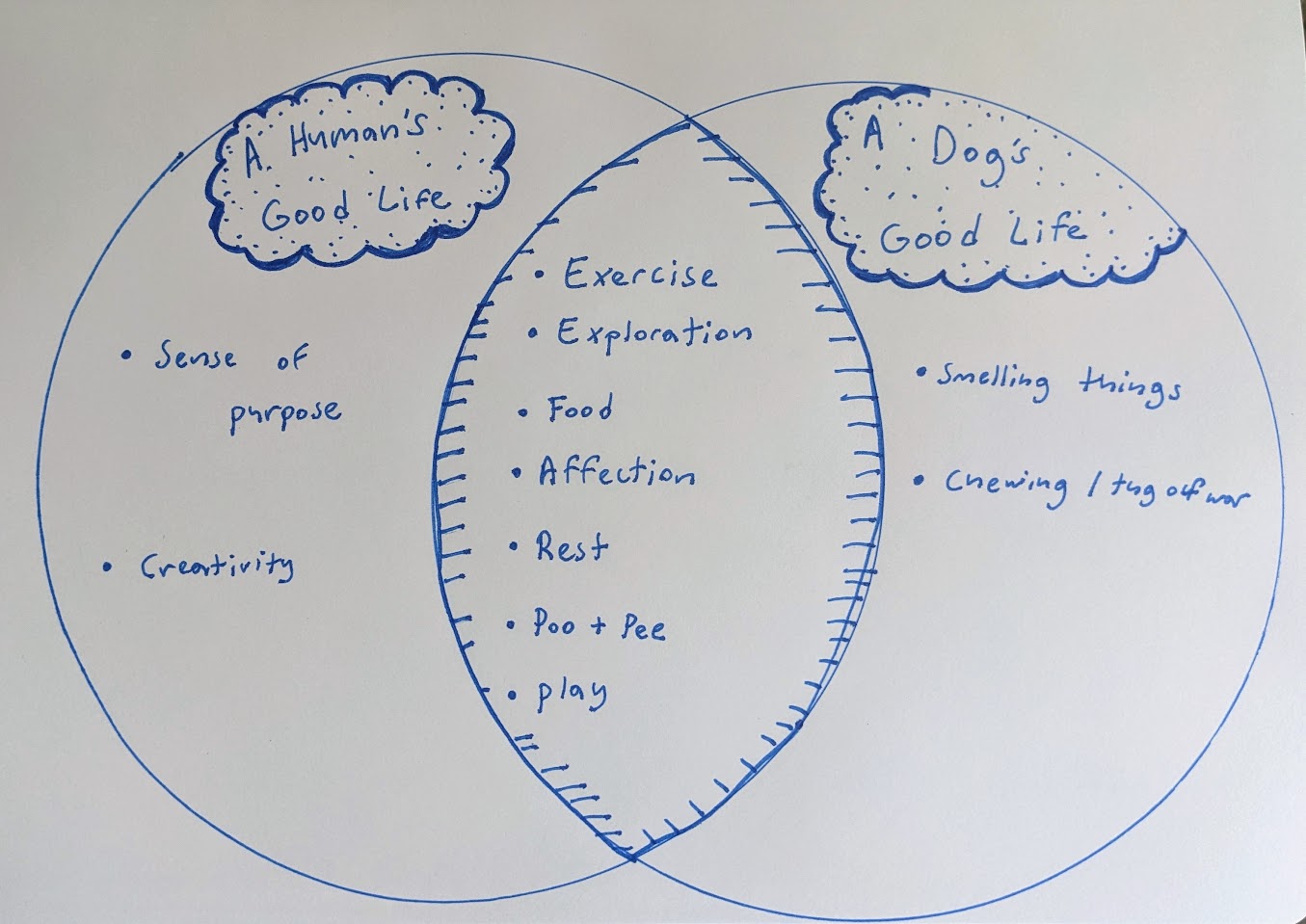
Dogs need a few simple things: exercise, exploration/learning (preferably in nature), food, affection, rest, toileting, and play.
This list is useful, because if the puppy isn’t happy, I can go to the above list and try to find which thing or things are missing.
When I wrote this list, I had a little epiphany. I realized that humans need the same exact things!
Distinct from dogs, humans also need a sense of purpose (a feeling that they are serving something valuable which is bigger than themselves) and a connection with creativity (this can mean creating something yourself or appreciating music, art or beauty).
Distinct from humans, dogs need to engage their nose and mouth, through smelling and chewing.
Here’s a Venn diagram summary:
So, just like I can “problem solve” our puppy’s needs by going to this list when he’s not happy and asking myself “what’s missing?”, I can do the same for myself. If I’m feeling exhausted, burned out, irritable, empty inside, I can look at the above list and think about which needs are not being met for me.
How to love more universally
In childhood it is easy to make friends. You only have to laugh with someone once and immediately you are friends. Children do not ask about each other’s race or profession. The main thing is that the other person is a human being like us and we relate to him or her.
The Dalai Llama
Walking the puppy down the hiking trail, he greets everyone. As my friend, a fellow dog owner said, “They give everyone a chance.”
The puppy doesn’t discriminate based on race or social status.
Spending time in the presence of a being with this simple loving attitude towards everybody is good for my soul. It brings me back to the state of mind of childhood, which the Dalai Llama describes in the quote above.
From my perspective as a neurologist, I can see that the brain is really the organ that makes us human. Our race is external appearance, not who we are most deeply. Our culture is learned from our environment. All other organs support the brain, but if you lose a chunk of any other organ except the brain, who you are as a person doesn’t change. If you lose a chunk of brain, you may become quite different.
Religions speak of souls. Neurologists speak of brains and nervous systems. I think they are one of and the same. Brains and souls are the deepest things that we are. Do we identify a person with his or her wrapper: culture, external appearance? Or do we identify a person as soul, spirit, consciousness, brain? The deepest things that we are.
Dogs and children and spiritual teachers, they all have a naturally ability to hone in on soul. And to love all souls indiscriminately. I’m lucky to be living with a spiritual teacher, in the form of a puppy.
 danscreativeoulet