

The above photo shows the only two bumper stickers I have. These stickers capture two identities I keep:
- A person who will die (symbolized by the Grateful Dead sticker)
- A creature on a marble floating in space (symbolized by the In This Together sticker)
These are the things I’m most certain about in life.
I was unable to fall back asleep the other night, so I downloaded the audiobook At Work in the Ruins, and pressed play.
The author described a lecture he gave to university students. The students were expecting his predictions about the future, and so, he displays a PowerPoint slide with just these words: YOU WILL DIE.
This is the only prediction he can make with certainty. Maybe the environment will collapse and we’ll end up in dystopia, with humans going extinct. Maybe, after humans go extinct, in many billions of years, new intelligent life emerges vastly wiser than humans. Maybe we redirect our extractive culture and pivot towards a more beautiful world:
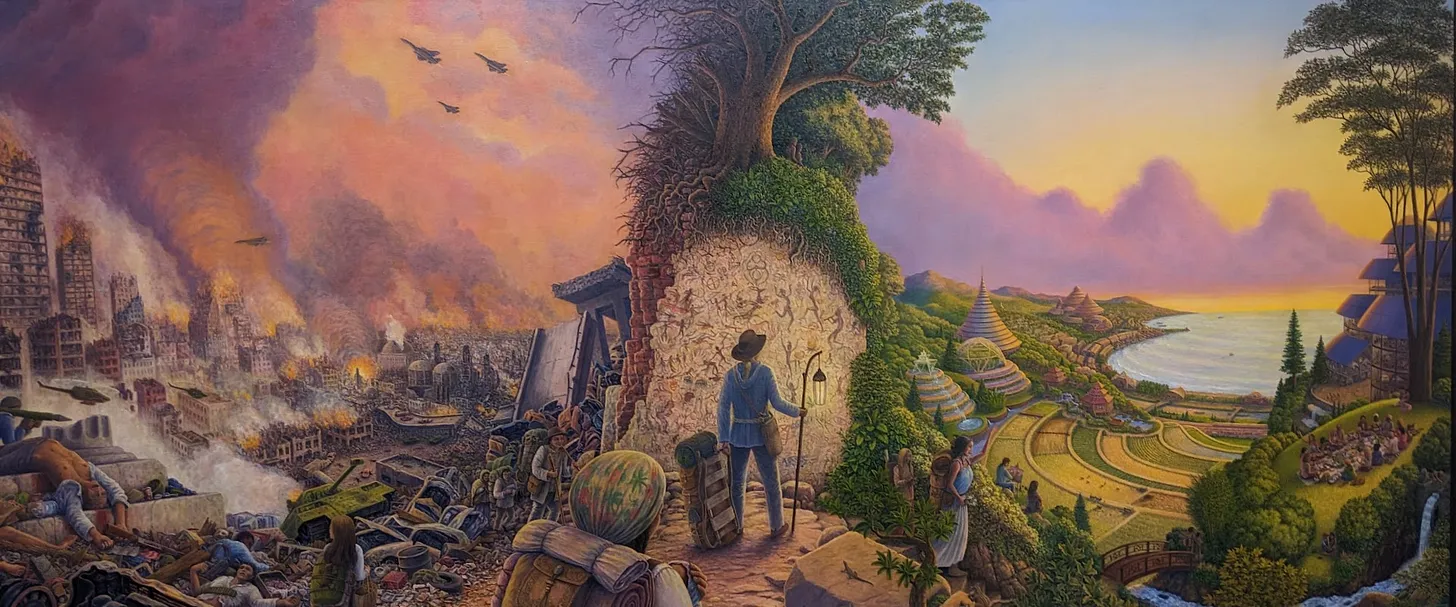
Regardless of which of these scenarios happens, it’s best to bet on mortality: just like all humans before me, I will die.
In my life, I’ve worn many hats: writer, neurologist, tea lover, AcroYogi, Jew, Buddhist, environmentalist, clown. While these hats all fit, to one extent, or another, I feel most free and open when I start my days hatless. When I wake up in the morning with a sense that I’m free to discover who I will be.
On the flipside, aspirational identity can be a useful tool for living well. For example, identifying that I want to be an empathetic, competent doctor helps me to focus my f*cks (to use the words of Mark Manson). At work, I could give a f*ck about many different things (e.g. pleasing all people, making sure my paperwork is 100% up to date all the time). Yet, pleasing all people and being really good at paperwork doesn’t make me an empathetic, competent doctor. So I can let go of these things and focus on being present with my patients or reading to improve my knowledge-base — two things that do help me embody the qualities I value.
Some other thoughts on identity:
- Identity is best thought of as a verb: you have to keep acting it out, in daily life. I’m writing now. Later on, I’ll be eating. At some point, due to aging or disease, I’ll likely be unable to write, or eat. That’s OK and natural. Our identities are impermanent.
- Group identities can close us off to learning new information. When we identify as part of group X or Y, we become less open. Yes, there are times when we should take a stand with a group (e.g. supporting the Allies rather than Axis powers in WWII). Yet for most of life, it strikes me that rigidly holding onto group identities is unnecessary and can do more harm than good.
The only tattoo I have is this little one:

The emptiness of the tea bowl represents maintaining openness to life.
For me, identity is a Goldilocks kind of thing. Too much identity and I’m rigidly boxing myself in. Too little identity, and I don’t know what I want out of life. Identity is about balancing openness with intentionality.
Here’s my best crack at describing my identity, today: I’m a mortal (identity #1), earth-creature (identity #2) who works to embody his values (identity #3), in different areas of his life.
 danscreativeoulet
This is a gem of of point: “Too much identity and I’m rigidly boxing myself in. Too little identity, and I don’t know what I want out of life. Identity is about balancing openness with intentionality.”
And I dig the identity of “works to embody his values,” which evolve as you do.
A great balance of what Robert Pirsig called “Static vs. Dynamic Quality.”
I feel like an earth-creature too!