
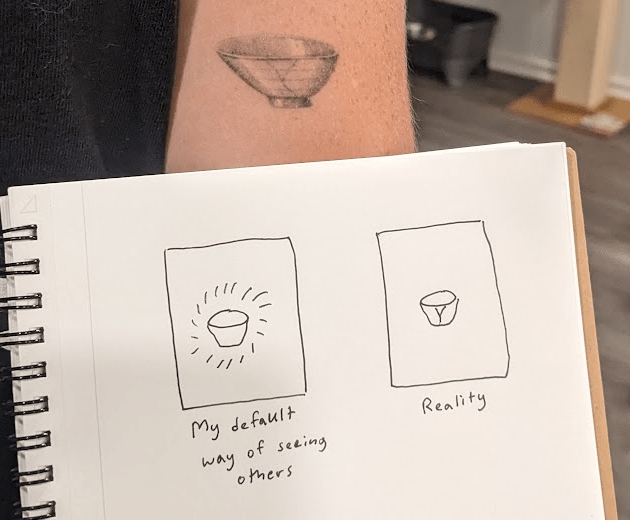
I’ve noticed, of late, a rather brutal habit of my mind. I’ll look at someone in the world — let’s call them person X — and paint them as a paragon of perfection.
My brain will then compare this perfect person X with my imperfect self, and flood me with shame: “You are broken. You are alone in your brokenness. You are inferior to person X.”
This habit likely started with bullying that I experienced when I was growing up. The bullies said: you don’t belong, you are inferior. Over time, I internalized these words. And so began the savage habit of bullying myself. I started to feel like I would forever be locked outside the party of life, where all the perfect shiny people were dancing.
The first noble truth of Buddhism is that suffering is a part of life for all people. I’ve known this for years, intellectually.
In the past few months, I’ve gotten to know this in a deeper way. This has been thanks to two investments of my time: 1) going to a men’s group, and 2) getting into the writings and podcasts of Cheryl Strayed. Also, over the past year or so, I’ve had some conversations which have helped me to see that my challenges are by no means unique.
Men’s Group
Men’s group begins with a ritual of smudging each other with smoke. After the opening ritual, we open up to each other.
I notice that when I first meet someone new in the group, my mind will often paint a picture of them as perfect. “Look at that guy,” my mind says. “They are a cool dude, good looking, fit, able to surf, with an attractive partner, better than me.”
Then then sharing begins…
I won’t discuss details of what people share, but suffice it to say that life isn’t all roses for these men who, on the surface, seem perfect to me.
Dear Sugar
The “Dear Sugar” advice columns, written by Cheryl Strayed, have also helped me undo my sense that people “out there” are perfect. Strayed connects the issues people are having to stories from her own life. What emerges is a sense of common humanity: You are struggling with this. It’s something I struggle (or struggled) with too, Strayed says, in so many of her responses.
Mark Manson describes Strayed’s work like this:
There are two ways to help people in this world: 1) give them specific, tangible advice on what they should do to fix their problems, and 2) normalize their suffering to simply remind them that they are not as alone or as hopeless as they think they are.
Strayed’s work here is light on the first and heavy on the second. But she’s an expert at the second…
Often what we need the most is not more “tools” and “tips” to get through our hardest hours. What we need is someone who simply understands our pain, and is able to clearly and beautifully articulate that it will one day be OK again.
Conversations
In a similar vein, conversations with friends have helped me feel less alone. I recently spoke with someone who grew up with a similar family dynamic to mine. “Wow!” I thought. Other people go through similar things as me.
A friend of mine recently moved cities, and was having some trouble moving on from his former life. I’ve been going through the similar feelings, having moved a year ago from NYC to Hawaii. We supported each other in our commitments to appreciate the place where we are now. And he also shared feelings of loneliness growing up, which I resonated with. From afar, when I first met this friend, I thought of him as one of those “shiny perfect people.”
Another friend I’ve known for over a decade opened up to me about his struggles last year. Holy moly, I thought. I had always thought of him has “having it all together.” Who else in my life is like this? Who have I painted as a shiny perfect teacup in my mind, when in reality they are cracked, just like me, just like all people.
For years, I had put my therapist on a pedestal, thinking of her as someone who’d achieved “inner peace.” When I visited her home, I realized that she’s a human with struggles, too.
Also, my own life, from a distance (or on social media) may seem devoid of suffering, to a distant onlooker. In reality, I’m human like everyone else.
In sum, these experiences have helped undo my sense of aloneness. They’ve worked to counter the brutal voice in my brain.
I’m sure that the voice will continue to pipe up (it’s a habit, after all). But now, I’m more aware. I can recognize when it comes on-line. And I don’t have to believe it.
If the voice tells me I’m broken, I can remind myself that I can learn and grow and behave differently in the future. I can repair the crack in my teacup, like the Japanese art form of kintsugi.
If the voice tells me that I’m alone and inferior, I can think back to conversations with friends, or to men’s group, or to Dear Sugar, and feel, deep in my bones, that though I might be suffering, I’m part of the human condition, I’m not alone, there are lots of other folks with similar struggles. If this weren’t true, Dear Sugar wouldn’t have much of an audience and there wouldn’t be men’s groups.
Ultimately, suffering is the compost from which the flower of compassion can grow. I think that’s what makes Cheryl Strayed such a good advice columnist. She’s suffered a lot herself, so she can relate to the suffering of others. Similarly, because I’ve suffered in various ways, I can see the cracks in the teacups of others, and react with compassion rather than judgement.
That’s the kind of person I want to be.
 danscreativeoulet