
‘Cause it’s getting kind of quiet in my city head
It takes a teenage riot to get me out of bed right now–Sonic Youth, Teenage Riot
A few years back, I went to Wonder Wander, a gathering of people who I hadn’t met before. At the end of the event, we were sitting around, basking in the collective buzz of each other’s company, savoring the last few moments with one another before we disbanded.
One of the guys had a plane to catch, yet he wasn’t in a hurry. He was just sitting there, chatting, as if he had all the time in the world.
My heartrate quickened. I fidgeted in my chair. Why the hell wasn’t he getting on the road?
I realized something, in that moment: even though I was freaking out, it wasn’t my responsibility to make this guy catch his plane. If he chose to miss the plane in favor of more time with folks, then that was his choice.
It took being in an environment of strangers to see my caretaker part in action, and realize, that maybe, just maybe, I didn’t have to be that good.
As Mary Oliver beautifully writes:
You do not have to be good.
You do not have to walk on your knees
for a hundred miles through the desert repenting.
You only have to let the soft animal of your body
love what it loves.
Last night, I had a great chat with someone who had grown up as the caretaker, the “golden child.” In this role, many of the things she did were either for other people, or to maintain the image of herself as perfect. I resonated a lot with her story.
I never had much of a teenage rebellion/experimentation phase. In fourth grade, I distinctly remember wanting blue hair. But I didn’t do it. Only at age 36, did I gather up the gall to dye my hair a vivid rainbow. Better late than never!
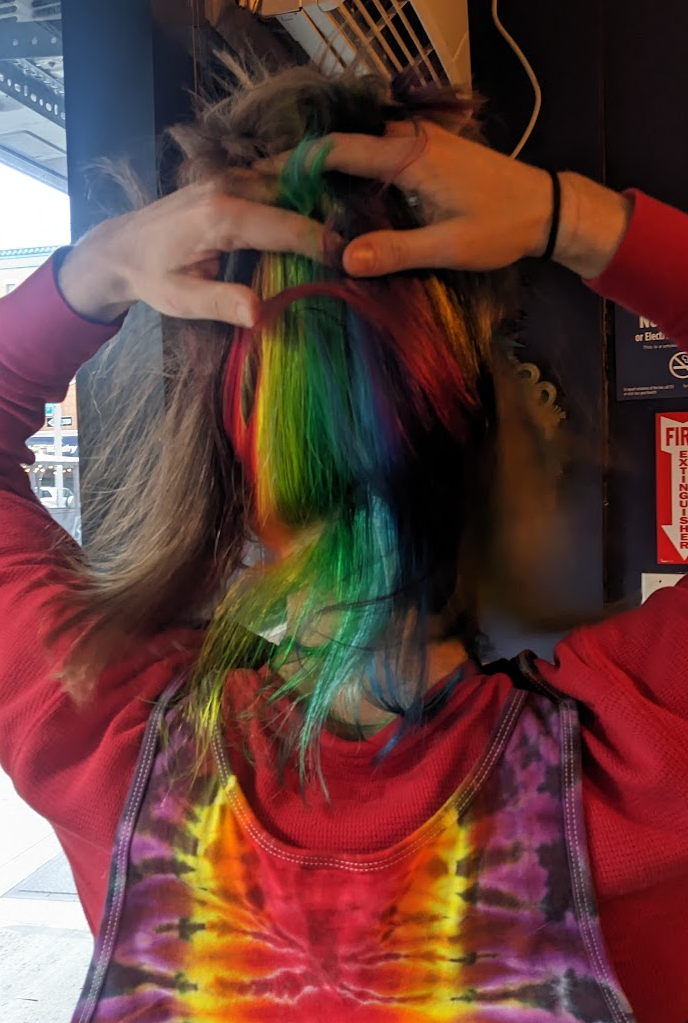
The recovering “golden child” I spoke with also had a delayed experimentation phase. During this time, she was intentionally single and traveled the world. Now she’s in a relationship. This period of doing things for only herself was good for her.
“These days, I’m very clear when I do things whether I’m doing them for me, for us, or for you,” she said.
Occasionally, I encounter a question, a lens on life that suddenly makes things a lot more clear.
“Am I doing this for me, for us, or for you?” is one such lens.
Looking back at the anxiety I felt about the guy catching his flight, I realize that my car was stuck in the YOU gear. It’s not bad to do things for others. It’s great, in fact. But it can be harmful when it’s compulsive, when it’s the only gear you know how to drive in.
A year-and-a-half ago, I took a sabbatical. During this time, I prioritized my interests above all else. Now that the sabbatical is over, I realize that the healthiest thing is to integrate sabbatical energy into my life. One way I do this is a practice called the artist date.
An artist date involves doing something alone just for the joy of it. My most recent one involved going to a cafe, reading a book, and then taking myself vintage shopping.
Periods of self-discovery, experimentation, me-focus, artist dates — these help us differentiate, know what we like.
They can look like teenage rebellion.
They can look like intentionally-single world travel.
They can look like a mid-30s sabbatical involving clowns, eco-villages, and rainbow hair.
As Grandma Tala sings in Moana: “Once you know what you like / Well there you are.”
After going on my journey of self-discovery, I realized that I don’t have to drive every dude to the airport. And if I do decide to drive the dude, then it’s good to know why I’m doing it.
Sometimes, driving the dude to the airport is for him.
Sometimes, it’s for both him and me — for us. A case of “be selfish, help others,” as the Dalai Llama puts it.
Sometimes, it’s just for me. Now, I realize that my motivation for driving him to the airport was coming from some deep conditioning. You don’t intentionally miss planes, I thought. This is a waste of money.
Yet he didn’t care. He was choosing to miss his plane. My impulse to drive him, my impulse to “help,” was really all about me. It was about relieving my anxiety about him wasting money. It wasn’t about helping him, because what he wanted — expressed through his actions — was to miss his plane and have more time to hang out.
A good life, I think, is about balancing me, us, and you. The first step to attaining this balance is a clear awareness of my true motivations. The me/us/you question is a flashlight to shine on my blind spots. I will be keeping it alive on my journey ahead.
Sometimes we live no particular way but our own
Sometimes we visit your country and live in your home
Sometimes we ride on your horses, sometimes we walk alone
Sometimes the songs that we hear are just songs of our own–Grateful Dead, Eyes of the World
 danscreativeoulet