
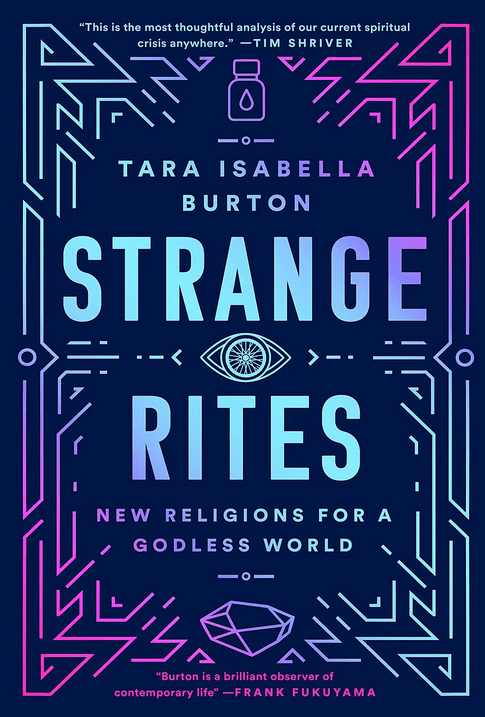
Yesterday, I finished reading the book Strange Rites which makes the case that there are lots of new secular religions cropping up in America.
Among them:
- Fan fiction
- Followers of Jordan Peterson
- Social justice activists
- Techno-utopians
- Men’s rights activists
- Modern witches
- Alternative sexual communities
- Wellness culture
A religion, according to the author, provides its members with:
- a worldview
- a purpose for their life within that worldview
- a community
- rituals
The four categories above could equally apply to other groups not covered in this book, like environmentalists, or political tribes. The author describes how increasingly, Americans are “remixing” religion. I know that I am.
“There is no such thing as an atheist,” David Foster Wallace famously said. Through the lens of this book, I take this quote to mean that humans have psychological needs for:
- a worldview that explains things, gives a sense of meaning to an otherwise chaotic universe
- a purpose which gives one a direction for the future, guidance about what to do with one’s life
- a community to fulfill the human need for belonging
- rituals to help foster states of collective joy (“collective effervescence” in the language of sociologist Durkheim), help structure time and mark life transitions
I grew up partaking in Orthodox Jewish communities, of the Chabad flavor. There was a clear worldview within this community: the world was created by G-d, and the Jewish people had a covenant with G-d. There was a clear purpose for life: to follow the 613 commandments (mitzvot) so that one day, the Messiah would come. There was a strong community and rituals.
There was “collective effervescence.” The first time I got drunk was during the festival of Purim at age ten. I drank an entire bottle of 5% Manishevitz sweet wine, while spin-dancing arm-in-arm with rabbis to raucous Klezmer music. It was so much fun!
I fondly remember warm Shabbat dinners during college. Every friday, we sat elbow-to-elbow in a crowded attic, eating delicious food, conversing, and giving toasts. Occasionally, we’d interrupt the conversation to sing a Shabbat song while pounding our fists on the table. These weekly dinners gave me a sense of community during an otherwise lonely time.
There’s a lot of good in traditional religions. I wonder whether the new, remixed and secular religions above will be up to the challenge of meeting our human needs.
P.S. Thanks to Ethan for lending me this book, and being my co-traveler on the pathless inter-spiritual path!
 danscreativeoulet
Great synopsis of the book, Dan!I believe as time progresses, more and more will identify as religiously remixed as many are but have never heard of the term!