
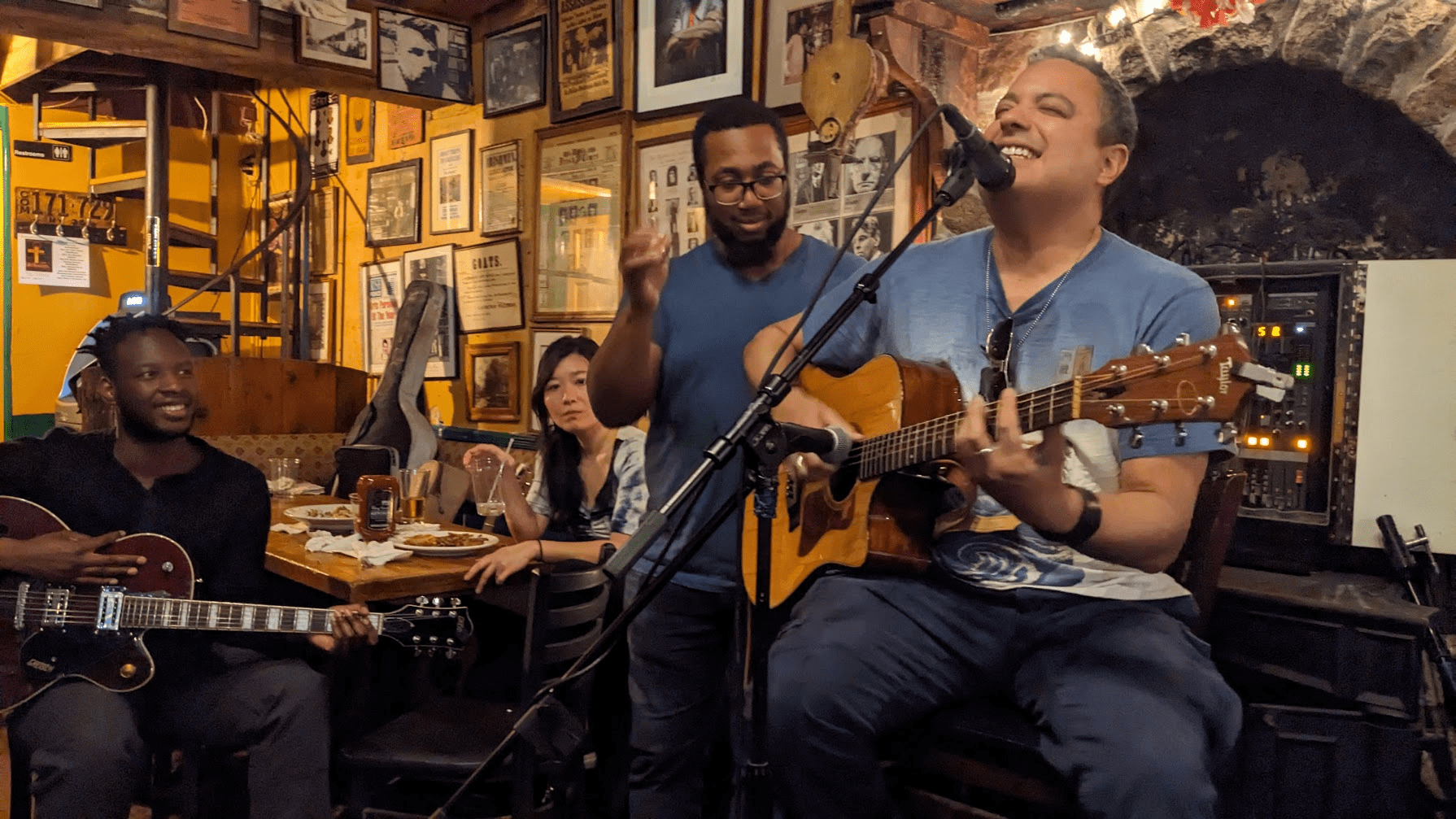
After driving home from work in New Jersey back to the Bronx, I would often feel an impulse to go hang out at An Beal Bocht, our neighborhood Irish Pub. Over the years, An Beal grew to be my favorite bar in the whole world.
I didn’t know why I was drawn to An Beal, but it just felt stifling to go directly from work box to car box to home box. It wasn’t the alcohol I longed for. It was the people, the stories, the decor, the music and dancing, the vibe. An Beal was filled with art, character and characters. Through its frequent live music and open mic nights, theater productions, and just by being a space for all manner of people to gather, An Beal made our neighborhood feel like a community.
Recently, I came upon the term “third space.” This term was coined by sociologist Ray Oldenberg: the first space is the home, the second is work, and a third space is a community space like a coffee shop, church, rock climbing gym, park, or bar, where people can gather. In other cultures, bath houses and saunas serve as third spaces (we have a little bit of this with places like the YMCA).
This idea of third spaces made me realize that I needed them. After learning the term, I’ve been consciously seeking third spaces out. For instance, today my brother and I are going to a rock climbing gym, for the exercise, sure, but also to get a little of the serendipity and magic of community.
There is a loneliness epidemic happening in the USA. Let’s create more third spaces for people to gather!
—
Here are some other names for things that have helped me see the world more clearly:
Values / Alignment – Underneath our language, our thoughts, our actions, and our emotions are our values. Such a simple concept, but seeing life through the lens of values has been quite useful. A related term is alignment — how closely am I living by my values? (Credit to Mark Manson)
Mimetic desire – People naturally want what other people want. This isn’t always bad, but can lead to pursuing things not aligned with my values. For example, in college, there was a period when everyone seemed to be finding a job in investment banking or business consulting. And guess what? I applied for jobs in consulting, even though I had no inherent interest in this field. Thankfully, I wasn’t successful! (Credit to Rene Girard)
Scenius – A portmanteau of scene and genius. We don’t have to go it alone, self-disciplining ourselves into excellence. Excellence can be simply the product of community support. This idea is ancient. In Buddhism, one of the jewels is the sangha, the community of practitioners. It’s a lot easier to meditate in a group rather than alone. (Credit to Brian Eno)
Flow state – A state of state of presence and aliveness that comes from being challenged a little, but not too much. Since learning about flow-states, I’ve tried to seek them out. Activities that produce flow states for me: rock climbing, writing, dancing. (Credit to Mihaly Csikszentmihalyi)
Spiritual expansiveness – To me, this means a state of consciousness that is able to appreciate the primary miraculousness of existence: that I have a body, that I am small in space and time, that I’m interconnected with so many things. Since coming upon the term, I’ve been looking for ways to stoke this sense in me, on the daily. (Credit to Ethan Maurice)
Illuminators and diminishers – Illuminators are people who are curious in conversation, who ask questions, who illuminate the other. Diminishers diminish the other person by oversharing their opinions, not listening, talking excessively about themselves. Now that I know these terms, I can more consciously strive to be an illuminator. A good tool for this is asking questions that start with how/what, and to show up to conversations with vulnerability, without an agenda, and striving for empathy, curiosity, and wonder. Credit to David Brooks and Joe Hudson.
Intercultural relationship — Coming upon this term helped me to see that I was in one, which comes with its own possible challenges as well as fruits. Also, all relationships are to some extent intercultural, because people come from different family cultures. Credit to Ethan Casey, Chat GPT, Rabbi S.
Saying no / JOMO / BOMO — Realizing the importance of these related ideas is something that continues to be hard for me, that I continue to practice. JOMO = Joy of Missing Out. BOMO = Better off missing out.
Existential depression and anxiety — Sadness and anxiety relating to facts that are baked into the human condition no matter what culture or country you live in. Facts like death, cosmic insignificance, and choice that all humans grapple with. I write more about this here. Credit to Irvin Yalom.
Implicit vs explicit culture — At a meditation gathering, I lay down on the ground and the woman next to me said, “Do you have back pain?” “No,” I said, confused about why she was asking me this. There was an awkward pause as I connected the dots: Oh, what she’s really saying is don’t lay down in the meditation hall! There are certain cultures (Japan comes to mind) where things are understood implicitly, through context, without explicit verbalization. There are other cultures (NYC comes to mind) where people are very direct with their words. The reasons are myriad, but this lens helps me to realize that not everyone needs to communicate in the same way. When implicit cultures work well, they are probably more efficient, because things are understood without overt explanation. (Credit: Skyler and Rabbi S)
Progressive Desensitization / the fear box — Fear keeps us in a box. The way out of fear is progressively desensitizing yourself to the thing you fear. This is captured in the quote: “The only way out is through.” Examples in my own life include nudity and nonclownformity. In the show White Lotus, there is a wealthy character named Victoria Ratliff, who has a great monologue when she is explaining to her husband why she doesn’t want her daughter Piper to join a monastery. “We need to teach her to fear poverty so she makes good decisions.” Her husband says, “But what if we lose everything.” “We won’t lose everything,” Victory says. “And if we did, I don’t think I’d want to live. At this age, I don’t have it in me to live an uncomfortable life. I don’t think I ever did” (click here to watch the clip). Victoria lives in a box of fear of poverty, which probably limits her experience of the world. Ironically, if Victoria wanted to get out of her fear box, exposure to the fear (for example, by joining her daughter in the monastery) would be the exact way for her to get out of the fear box. Credit: Corey Muscara, Mark Manson, Peter Lin.
Inner critic / Spirit of Unconditional Love (SOUL) — When I first heard the term “inner critic” I immediately understood with it. “Oh, that harsh inner voice has a name!” I thought. Lately, I’ve been doing a practice where I journal to myself from the Spirit of Unconditional Love (SOUL). This is a way to practice strengthening the muscle of self-compassion. The Grateful Dead sing: “‘Aint got time to call my SOUL a critic, no.” Credit to Sharon Salzberg and Liz Gilbert.
Sophistry — The sophists were a group of people in ancient Greece who taught effective rhetoric, but they didn’t care about the truth. What they cared about was winning. Socrates railed against the Sophists. “The truth matters!” Socrates said. Socrates chose to drink poison hemlock rather take back things he said. He valued the truth more than his own life. These days, there are plenty of politicians twisting facts, fabricating them, and hiding them. Thousands of years after the Sophists and Socrates, here we are. Knowing about Sophistry helps me see what’s going on now more clearly. As Pink Floyd sing: “Haven’t you heard, it’s a battle of words.” Credit: The Good Life Method
High-control group — The term “cult” gets thrown around a lot these days, but I think the term “high control group” is better, because it gets to the heart of what destructive cults are about: control (through fear, shame, and any number of other influence techniques). This term is an internal litmus test I can apply to any group I’m a part of. Credit: The Vow (show)
Old Happy / New Happy — Old happy = 3 beliefs: “I’m not enough”, “I’ll be happy when I achieve X” and “I have to do it alone.” New happy = develop your gifts and use them to help others. Credit: Stephanie Harrison.
Strodes –– The word “strode” is a pejorative term to describe something between a street (designed for walkability) and a road (designed for high-speed travel). Strodes abound in the suburbs all around the US, and they kind of suck. They inhibit walkability, serendipity, community, and speed of travel. Once I saw them, I see them everywhere!
Play personalities — Competitor, Creator/artist, Director, Joker, Kinesthete, Storyteller, Collector. It’s fun to see these behaviors as forms of play.
Chromophobia — In the northeast, bright colors are distinctly countercultural. I realized this after coming back from my clown trip to Mexico when I realized that my whole waredrobe was a collection of blacks, greys and browns. The past few years, I’ve been incorporating more color into my wardrobe, swimming against the cultural current of chromophobia.
Reality tunnel — When in one type of media consumption, I can get into a reality tunnel where I think that perspective is all-true and the only perspective. “It’s good to not attach to any one story too tightly.”
 danscreativeoulet