
Universe bloom

We are small in time and space
But how to see it
How to really feel it?
How to infuse the medicine
Of my smallness
Into my veins?

Copernicus told us we're not the center
But still
We feel like we are

Today --
The sweeping of the floor
The chopping of the vegetables
The "have to do's"

Today --
Is best approached
Not from a yarn
Of "not enough":
"Not enough time
Not clean enough
Late..."

But from the lens of rareness
How rare is a messy apartment
As a form
Among the milky way?
Rarer still, among the universe

Planet earth
Is a rare grapevine
Hanging
In the great empty
Where these rare fruits
Messy apartments
Can be found

"Clean your room"
Is good enough advice
As long as we don't forget
To take stock
And have awe
As good Mr. Sagan reminds

A messy apartment
Is like a delicate cactus bloom
Here today
Another might not come
For a billion years and miles
In the great expanse

The earth is a cactus bloom
In the universe desert
Messy apartment or not
I'll take it
All of it

Yes/
Category: Uncategorized
No different from the banana tree
No different from the banana tree

Streaks of grey in my hair
Wrinkes on my face
Chips in my teeth
Turning yellow

Planted a banana tree
And now, a year later, it's dead
But dozens of keiki
Are growing
All around

I used to lament
The wrinkles and the grey
The tooth decay

"We love to forget
about impermance"
Says my friend

A teenager at the dance
Says I'm strong like a tree

"I don't think of myself as strong"
I say

I guess I'm strong
I've filled out the spaces
Between my bones
With muscle and fat
No longer thin
Like I used to be

I guess I'm strong
Like a tree
For now
A refreshing lack of importance
What if mountain goat
Took a note
From Sapien
And strove towards
The magazine cover?

What if wildflower
Built a tower
And strove to climb
To the top?

The city of field, forest, stream, and mountain
Whispered in my ear:
“You are no more or less important
Than a wildflower”

It was a refreshing
Lack of importance

(inspired by time spent hiking in silence in Glacier National Park)
sex and stars
sex
makes me think of
the stars surrounding
our pale blue planet
in all directions

sex
makes me think of
the lonely possibility
that another pair of eyes
will grow up here
gazing out at it all
Ode to the unambitious
       The arrow of your life is not locked, yet
       Thoughts within your mind still freely swim
       The key to make you speed has not been turned, yet
       You look up at the tall plants as a seed
       You have not been pressure-packed and shipped, yet
       There is no single place you want to be
       Wishes that stream out from you have not been capped, yet
       There is no need for practicality
       You stand above the helpless souls
       Who kick their way to some small goal
       My friend, you watch the arrow sway
       And delight at the directions
Landlocked canoe
While paddleboarding in the ocean today, a metaphor came to mind. Authentic living = knowing yourself and being in the world in a way that fits your soul.
For example, a canoe belongs in the water. A snowmobile belongs on the snow. A bike belongs on land.
Yet, some of us are born as canoes on land. It might take us a lot of time — decades, even — to find our way to the water. The people around us might say: there’s something wrong with you. You need to change.
But really, what needs to happen is self-acceptance and taking action. If a canoe is born into a family of bikes in a place far from water, it needs to go on a journey. It needs to try a lot of different things. Meet a lot of different folks. And eventually, dip into the water and exclaim: “This is for me!”
Growing up, I felt like that landlocked canoe. I grew up in Buffalo, NY. People around me loved watching sports, specifically the Buffalo Bills and Sabres. I didn’t seem to be able to get myself to care about watching sports.
I recently talked to some friends and asked them: do you like watching sports? They didn’t.
This was healing for me. I realized: I don’t have to force myself to like watching sports. There’s so many other ways I can be in the world. There are people with interests outside of sports I can befriend.
I don’t have to be the canoe who keeps trying to make life work on the land. I can go on a journey and get myself to the water.

Tonight I’m scheduled to have a meeting with someone whose website I found by googling the term “existential depression.” This website defines existential depression as depression arising out of confronting issues like: meaning of life, isolation, death, and one’s place in the world.
I’d never heard the words “existential” and “depression” linked together until I came upon the term in a book about physician suicide. Though I’m definitely a newbie when it comes to learning about existential depression, I resonate with the term.
I think I’ve experienced it in the past several times:
- I’ve felt deeply sad that the people who I loved and loved me would die. I began writing a novel to get humanity to “wake up” the the horror of aging and death and work to solve this problem. Why were we wasting our lives on hedonism when we could work to end aging? After reading my book, I wanted people to get off their butts and get into a biology lab!
- I felt deeply sad that nature was being destroyed by humans, and that, as a human in “the grid” of extractive capitalism, I was part of the problem.
- I’ve felt deeply sad when I was about to turn 20. While studying abroad in Australia, I saw the wrinkles forming on my face as evidence that I was aging and that, if I didn’t do something, I would die and my consciousness would end. I didn’t see the point of having fun times and dancing with my new friends when we’d all be skeletons in the future anyways.
- I’ve felt lonely because I couldn’t seem to fit in throughout most of my upbringing. Growing up, I frequently felt like a weirdo, a misfit. I felt a profound sense of isolation. At one point in childhood, I remember talking to my fish, a beautiful rainbow shark, and telling him: “You are the only one who understands me.”
- I learned how to socially blend in. In prioritizing fitting in, I lost the thread of my true interests. Taking a sabbatical to do clowning and go to an ecovillage, doing the Artist’s Way, going to Wonder Wander, starting reading again, and building local community with people who I resonate with and accept me have been ways I’ve rediscovered authentic connection with myself and others.
- I yearned for a grand meaning that would organize my life, like Orthodox Jews seemed to have (e.g. “Life is about having a family and following the 613 mitzvot”). I yearned for a template that would tell me how to live. Without such a template, I felt massive confusion about all the different possible future paths.
- I’ve experienced tremendous decision paralysis and anxiety at major life crossroads. The core fear I think was an unwillingness to accept that my possibilities will shrink, as the white pages of my future become filled with the text of my life story. Senior year of high school, before going to college, I spent my time going to grad parties and socializing. I basked in the beautiful energy of possibility mixed with belonging. I wrote this poem which describes that feeling. I wanted to stay in that feeling, and yet, my soul knew that I couldn’t. As Neil Young sings: “You can’t be twenty on Sugar Mountain.” These big life decisions were life’s way of kicking me out of Sugar Mountain. On one level, I was paralyzed at crossroads because of perfectionism: I wanted to get the decision “right.” But subconsciously maybe I was stalling because I would prefer to not write the next chapter of my story. I’d prefer to stay undifferentiated…
I don’t have much of an agenda about tonight’s meeting. I’m showing up from a place of curiosity. Writing this has already been healing, and I’m excited about following the breadcrumbs and seeing where they lead!
Very much not root cause
"I'm having a lot of forgetfulness.
It's hard to recall facts.
I'm nervous and twitchy and drooling and dizzy.
It feels like I want to pass out."

Says the man in the rectangle on my screen.

He's on 8 different medications
That affect the brain
5 of them have significant interactions

I'm one of 4 doctors managing the meds
In addition to me, the neurologist
There's the pain doctor, the psychiatrist, the primary doctor

He's in his sixties and weighs over 300 pounds

I wonder
If he'd be better off
Off all the meds
I wonder
Why I feel so heavy
At the end of the visit

I tell him
To reduce the dose
Of two of the meds

***

Last night
My wife and I
Watched a documentary
About the history
Of China

People in history
Were not very kind

***

Part of growing up
I think
Is accepting
That the world we live in
Is the world we live in
And figuring out
Our right size
In it all

Helping but
Realizing the limits
Of my energy

A part of growing up is grief

Grief that the world
Isn't as beautiful
As it could be
Grief that my ability
To change the world
Isn't as great
As I wish it were

My intervention
Of helping the man with his meds
Is very much not the intervention
I'd like to have

I'd like to move him
Into a community
Close to friends
Close to the earth
Where he can express his gifts
Where he can sing

I feel heavy
Because of grief right now
It feels futile
To be spending my time like this
Working on things
That are very much
Not root cause

First I grieve
Then I accept
Then, eventually

I go back to work
Finding names for things
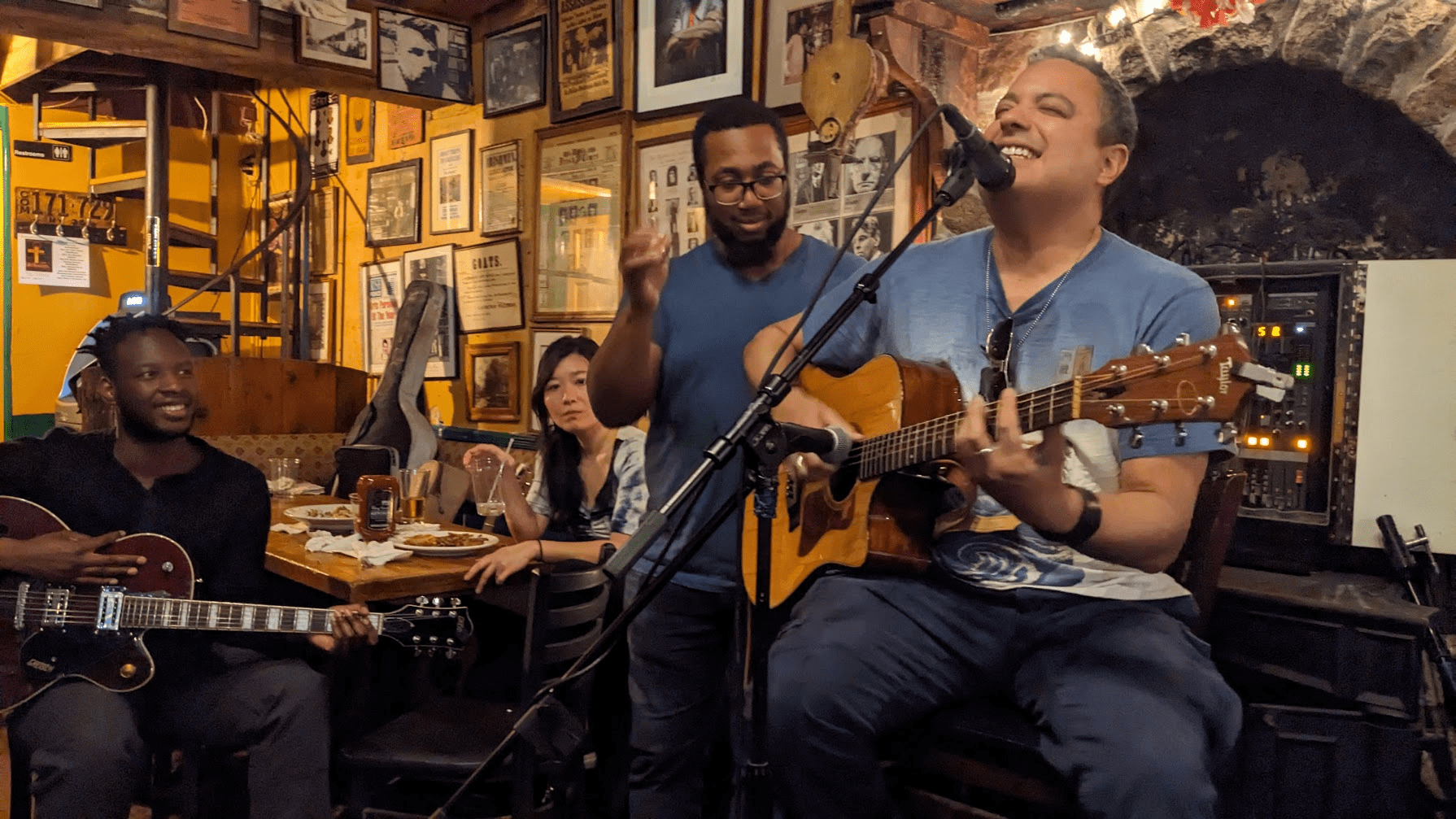
After driving home from work in New Jersey back to the Bronx, I would often feel an impulse to go hang out at An Beal Bocht, our neighborhood Irish Pub. Over the years, An Beal grew to be my favorite bar in the whole world.
I didn’t know why I was drawn to An Beal, but it just felt stifling to go directly from work box to car box to home box. It wasn’t the alcohol I longed for. It was the people, the stories, the decor, the music and dancing, the vibe. An Beal was filled with art, character and characters. Through its frequent live music and open mic nights, theater productions, and just by being a space for all manner of people to gather, An Beal made our neighborhood feel like a community.
Recently, I came upon the term “third space.” This term was coined by sociologist Ray Oldenberg: the first space is the home, the second is work, and a third space is a community space like a coffee shop, church, rock climbing gym, park, or bar, where people can gather. In other cultures, bath houses and saunas serve as third spaces (we have a little bit of this with places like the YMCA).
This idea of third spaces made me realize that I needed them. After learning the term, I’ve been consciously seeking third spaces out. For instance, today my brother and I are going to a rock climbing gym, for the exercise, sure, but also to get a little of the serendipity and magic of community.
There is a loneliness epidemic happening in the USA. Let’s create more third spaces for people to gather!
—
Here are some other names for things that have helped me see the world more clearly:
Values / Alignment – Underneath our language, our thoughts, our actions, and our emotions are our values. Such a simple concept, but seeing life through the lens of values has been quite useful. A related term is alignment — how closely am I living by my values? (Credit to Mark Manson)
Mimetic desire – People naturally want what other people want. This isn’t always bad, but can lead to pursuing things not aligned with my values. For example, in college, there was a period when everyone seemed to be finding a job in investment banking or business consulting. And guess what? I applied for jobs in consulting, even though I had no inherent interest in this field. Thankfully, I wasn’t successful! (Credit to Rene Girard)
Scenius – A portmanteau of scene and genius. We don’t have to go it alone, self-disciplining ourselves into excellence. Excellence can be simply the product of community support. This idea is ancient. In Buddhism, one of the jewels is the sangha, the community of practitioners. It’s a lot easier to meditate in a group rather than alone. (Credit to Brian Eno)
Flow state – A state of state of presence and aliveness that comes from being challenged a little, but not too much. Since learning about flow-states, I’ve tried to seek them out. Activities that produce flow states for me: rock climbing, writing, dancing. (Credit to Mihaly Csikszentmihalyi)
Spiritual expansiveness – To me, this means a state of consciousness that is able to appreciate the primary miraculousness of existence: that I have a body, that I am small in space and time, that I’m interconnected with so many things. Since coming upon the term, I’ve been looking for ways to stoke this sense in me, on the daily. (Credit to Ethan Maurice)
Illuminators and diminishers – Illuminators are people who are curious in conversation, who ask questions, who illuminate the other. Diminishers diminish the other person by oversharing their opinions, not listening, talking excessively about themselves. Now that I know these terms, I can more consciously strive to be an illuminator. A good tool for this is asking questions that start with how/what, and to show up to conversations with vulnerability, without an agenda, and striving for empathy, curiosity, and wonder. Credit to David Brooks and Joe Hudson.
Intercultural relationship — Coming upon this term helped me to see that I was in one, which comes with its own possible challenges as well as fruits. Also, all relationships are to some extent intercultural, because people come from different family cultures. Credit to Ethan Casey, Chat GPT, Rabbi S.
Saying no / JOMO / BOMO — Realizing the importance of these related ideas is something that continues to be hard for me, that I continue to practice. JOMO = Joy of Missing Out. BOMO = Better off missing out.
Existential depression and anxiety — Sadness and anxiety relating to facts that are baked into the human condition no matter what culture or country you live in. Facts like death, cosmic insignificance, and choice that all humans grapple with. I write more about this here. Credit to Irvin Yalom.
Implicit vs explicit culture — At a meditation gathering, I lay down on the ground and the woman next to me said, “Do you have back pain?” “No,” I said, confused about why she was asking me this. There was an awkward pause as I connected the dots: Oh, what she’s really saying is don’t lay down in the meditation hall! There are certain cultures (Japan comes to mind) where things are understood implicitly, through context, without explicit verbalization. There are other cultures (NYC comes to mind) where people are very direct with their words. The reasons are myriad, but this lens helps me to realize that not everyone needs to communicate in the same way. When implicit cultures work well, they are probably more efficient, because things are understood without overt explanation. (Credit: Skyler and Rabbi S)
Progressive Desensitization / the fear box — Fear keeps us in a box. The way out of fear is progressively desensitizing yourself to the thing you fear. This is captured in the quote: “The only way out is through.” Examples in my own life include nudity and nonclownformity. In the show White Lotus, there is a wealthy character named Victoria Ratliff, who has a great monologue when she is explaining to her husband why she doesn’t want her daughter Piper to join a monastery. “We need to teach her to fear poverty so she makes good decisions.” Her husband says, “But what if we lose everything.” “We won’t lose everything,” Victory says. “And if we did, I don’t think I’d want to live. At this age, I don’t have it in me to live an uncomfortable life. I don’t think I ever did” (click here to watch the clip). Victoria lives in a box of fear of poverty, which probably limits her experience of the world. Ironically, if Victoria wanted to get out of her fear box, exposure to the fear (for example, by joining her daughter in the monastery) would be the exact way for her to get out of the fear box. Credit: Corey Muscara, Mark Manson, Peter Lin.
Inner critic / Spirit of Unconditional Love (SOUL) — When I first heard the term “inner critic” I immediately understood with it. “Oh, that harsh inner voice has a name!” I thought. Lately, I’ve been doing a practice where I journal to myself from the Spirit of Unconditional Love (SOUL). This is a way to practice strengthening the muscle of self-compassion. The Grateful Dead sing: “‘Aint got time to call my SOUL a critic, no.” Credit to Sharon Salzberg and Liz Gilbert.
Sophistry — The sophists were a group of people in ancient Greece who taught effective rhetoric, but they didn’t care about the truth. What they cared about was winning. Socrates railed against the Sophists. “The truth matters!” Socrates said. Socrates chose to drink poison hemlock rather take back things he said. He valued the truth more than his own life. These days, there are plenty of politicians twisting facts, fabricating them, and hiding them. Thousands of years after the Sophists and Socrates, here we are. Knowing about Sophistry helps me see what’s going on now more clearly. As Pink Floyd sing: “Haven’t you heard, it’s a battle of words.” Credit: The Good Life Method
High-control group — The term “cult” gets thrown around a lot these days, but I think the term “high control group” is better, because it gets to the heart of what destructive cults are about: control (through fear, shame, and any number of other influence techniques). This term is an internal litmus test I can apply to any group I’m a part of. Credit: The Vow (show)
Old Happy / New Happy — Old happy = 3 beliefs: “I’m not enough”, “I’ll be happy when I achieve X” and “I have to do it alone.” New happy = develop your gifts and use them to help others. Credit: Stephanie Harrison.
Strodes –– The word “strode” is a pejorative term to describe something between a street (designed for walkability) and a road (designed for high-speed travel). Strodes abound in the suburbs all around the US, and they kind of suck. They inhibit walkability, serendipity, community, and speed of travel. Once I saw them, I see them everywhere!
Play personalities — Competitor, Creator/artist, Director, Joker, Kinesthete, Storyteller, Collector. It’s fun to see these behaviors as forms of play.
Chromophobia — In the northeast, bright colors are distinctly countercultural. I realized this after coming back from my clown trip to Mexico when I realized that my whole waredrobe was a collection of blacks, greys and browns. The past few years, I’ve been incorporating more color into my wardrobe, swimming against the cultural current of chromophobia.
Reality tunnel — When in one type of media consumption, I can get into a reality tunnel where I think that perspective is all-true and the only perspective. “It’s good to not attach to any one story too tightly.”
My mental lenses

It took me a long time and most of the world to learn what I know about love and fate and the choices we make, but the heart of it came to me in an instant, while I was chained to a wall and being tortured. I realised, somehow, through the screaming of my mind, that even in that shackled, bloody helplessness, I was still free: free to hate the men who were torturing me, or to forgive them. It doesn’t sound like much, I know. But in the flinch and bite of the chain, when it’s all you’ve got, that freedom is a universe of possibility. And the choice you make between hating and forgiving, can become the story of your life. — Gregory David Roberts, Shantaram
Even digestive sensations have their own replica in the brain, thus enabling strange illnesses like that of a woman who, after a stroke, felt the food she swallowed travel down her throat and descend into a nonexistent cavity in her left arm, a disquieting disruption in visceral virtuality. The limbic brain, too, models the world making our emotional realities a set of neurally generated phantoms loose in the mind. Reality is thus more personal than daily life suggests. Nobody inhabits the same emotional realm. Many people live in a world so singular that what they see when they open their eyes in the morning may be unfathomable to the rest of humanity. When one woman looks at an attractive man, she sees someone who wants to possess her and stifle her creativity. Another sees a lonely soul who needs mothering and is crying out for her to do it. A third sees a playboy who must be seduced away from his desirable and unworthy mistress. Every one of them knows what she sees and never doubts the identity of the man in front of her faithful retinas, her fanciful brain. Because people trust their senses, each believes in her own virtuality with a sectarian’s furvor. It’s the rare person who glimpses the expanse of his own subjectivity, who knows that everything before his mind’s eye is the Hindu’s Maya: an elaborate dream… — A General Theory of Love
If I gave myself the task of counting red cars today, I’d see a lot more red cars than I would otherwise. This silly example points to a deep truth: we always have the power to choose which aspect of reality to focus on.
“Mental lenses” like physical lenses, are tools. Even if we are too sick to leave our bed, even if we are thrown into prison, we still have the power to choose how we see reality.
Here are some mental lenses I’m playing with:
- Learning lens. Approach this problem from a space of curiosity. Realize that I’m not a static being, I can change and grow. Ask: what can I learn from this?
- Overlap lens. Ask: what do I have in common with this person?
- Empathy lens. Ask: what is this person feeling and in what ways does that make sense?
- Grounded optimism lens. In an ambiguous situation, which interpretation brings hope and opportunity? For example, our cat Sticky Rice died and we never found out the cause. I can choose to believe he was poisoned by neighbors, or that it was some kind of accident or health problem. The first interpretation erodes my faith in humanity, so I choose to let it go.
- Long lens. Ask: Will this matter in 10 years?
- Helping lens. Ask: Who did I help today? Who helped me? Who is helping others? Credit: New Happy by Stephanie Harrison.
- Universality of suffering and impermanence lens. See that people are affected by similar flavors of suffering: accidents, disease, old age, death. Nothing is permanent.
- Appreciation lens. When looking in the mirror, say to myself: I accept my body as it is and I appreciate what it does for me. When working, say to myself: I get to have a job where I can help people. When eating, bring to mind all that was needed to bring me this food.
- Responsibility lens. Ask: How did I contribute to the present situation? What can I do to take care of my side of the street?
- Self-compassion lens. Realize that, just like all humans, I’m an imperfect being who makes mistakes, has limited time, wisdom, and energy. Many of us are hard on ourselves for our mistakes. We all make mistakes.
- Miracle lens. Every person is a miracle. A being that can see, hear, think, feel, experience. A unique and precious jewel.
Credit to Alex and Ethan for stimulating my thinking about lenses, and to Alex for the red car example.
Worldview, purpose, community, rituals
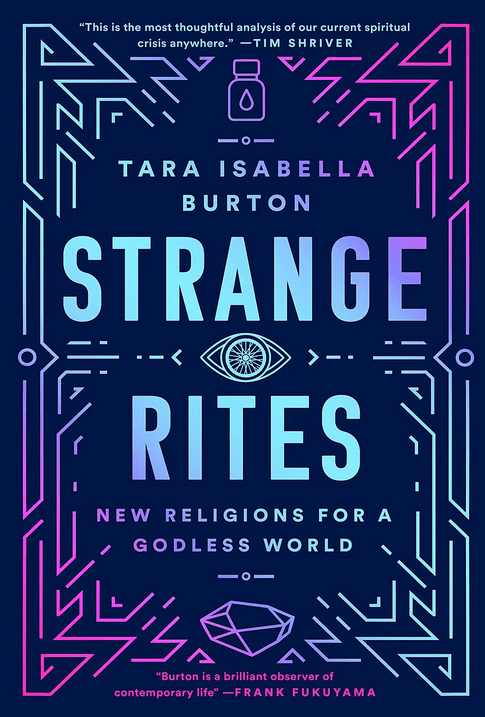
Yesterday, I finished reading the book Strange Rites which makes the case that there are lots of new secular religions cropping up in America.
Among them:
- Fan fiction
- Followers of Jordan Peterson
- Social justice activists
- Techno-utopians
- Men’s rights activists
- Modern witches
- Alternative sexual communities
- Wellness culture
A religion, according to the author, provides its members with:
- a worldview
- a purpose for their life within that worldview
- a community
- rituals
The four categories above could equally apply to other groups not covered in this book, like environmentalists, or political tribes. The author describes how increasingly, Americans are “remixing” religion. I know that I am.
“There is no such thing as an atheist,” David Foster Wallace famously said. Through the lens of this book, I take this quote to mean that humans have psychological needs for:
- a worldview that explains things, gives a sense of meaning to an otherwise chaotic universe
- a purpose which gives one a direction for the future, guidance about what to do with one’s life
- a community to fulfill the human need for belonging
- rituals to help foster states of collective joy (“collective effervescence” in the language of sociologist Durkheim), help structure time and mark life transitions
I grew up partaking in Orthodox Jewish communities, of the Chabad flavor. There was a clear worldview within this community: the world was created by G-d, and the Jewish people had a covenant with G-d. There was a clear purpose for life: to follow the 613 commandments (mitzvot) so that one day, the Messiah would come. There was a strong community and rituals.
There was “collective effervescence.” The first time I got drunk was during the festival of Purim at age ten. I drank an entire bottle of 5% Manishevitz sweet wine, while spin-dancing arm-in-arm with rabbis to raucous Klezmer music. It was so much fun!
I fondly remember warm Shabbat dinners during college. Every friday, we sat elbow-to-elbow in a crowded attic, eating delicious food, conversing, and giving toasts. Occasionally, we’d interrupt the conversation to sing a Shabbat song while pounding our fists on the table. These weekly dinners gave me a sense of community during an otherwise lonely time.
There’s a lot of good in traditional religions. I wonder whether the new, remixed and secular religions above will be up to the challenge of meeting our human needs.
P.S. Thanks to Ethan for lending me this book, and being my co-traveler on the pathless inter-spiritual path!
My metaphors
In the book Metaphors We Live By, the author George Lakoff makes the case that humans best understand abstract ideas through physical metaphors.
Here is a running list of metaphors that are useful to me:
- Life is a river. We find ourselves in the present, unable to change the past, able to chart our course to different futures. “You have a right to your actions, but never your action’s fruits.” — The Bhaghavad Gita
- Time is a rock jar. There are unlimited rocks we can put into the limited jar of our lives.
- Activism is a ball pit. Any activist cause, for example, disability rights or environmental regeneration, has many individual projects — balls — that can be helpful to the overarching cause. We can be part of the solution by helping a ball or two or three come into being. We don’t have the power to individually “fix” the entire issue. Credit: New Happy by Stephanie Harrison.
- Love is opening the blinds. Visualize a dark night, and a house illuminated on the inside with all the lights on. Now visualize the blinds opening, letting that light out of the window into the world. This simple visualization helps me get into the embodied feeling of love. A mantra to say while visualizing this: may you be happy, may you have ease, may you feel alive. Credit: New Happy.
- The mind is a garden. The plants we water, be they weeds or seeds, are the ones that will grow. Credit: Thich Naht Hanh.
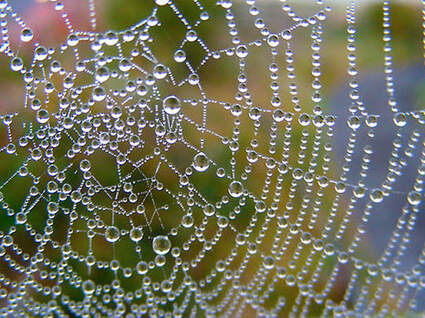
- Indra’s net. This ancient symbol is saying that within each of us is a reflection of the whole universe. Credit: Sharon Saltzberg’s Real life.
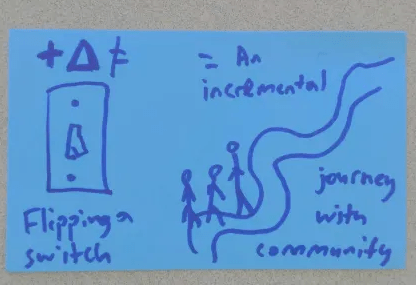
- Positive change is a path, not a lightswitch.
- People are cracked teacups.
- A relationship is a venn diagram. There is the overlap, and the relationship you have with yourself.
- A relationship is a house you co-build. Credit: John Gotteman and Stephanie Harrison.
- A romantic partner is a co-artist on life’s tapestry.
- Values (e.g. friendship, health, learning, love, spirituality) are infinite games, the goal is to keep playing, not to “win” a specific outcome.
- Heaven and hell are places we visit and create in the present moment, in this here life, not in the future.
- The prairie fire burns everything down, but activates the seeds and nourishes the earth for new growth.
Same wine, new bottles
I recently have been learning about the TESCREAL bundle of philosophies, having, myself, partaken in at least 3 of them: transhumanism (through the anti-aging scene of Aubrey DeGrey), rationalism, and effective altruism.
Over dinner last night a friend remarked: “A vision for a future with eternal life? Sounds like Catholicism in medieval Europe…”
Death is a painful thing for an ego to accept. It’s natural to want to deny it. If you’re too rational to believe in heaven or reincarnation, then perhaps a materialist, science-based utopian afterlife is your flavor of wine…
Positive change is an incremental journey, not a lightswitch
The metaphors we live by are significant, consequential.
For a long time, I’ve subconsciously subscribed to the “lightswitch” metaphor of positive change. In this metaphor, I can change my life to a fulfilled, happy state through X.
X can be:
- A book
- A course
- A therapy
- A practice
- A retreat
- A substance
- A philosophy
Nowadays, I’m realizing that there’s a dopamine hit from the early stages of all the X’s above. It’s dopaminergic to believe that THIS THING will solve all my problems, flip the lightswitch of my life.
My pattern would go like this: I would get the dopamine hit from the early stages of X, then lose momentum, and find a new dopaminergic X to imbibe.
The problem wasn’t even necessarily the individual things I got involved in. The problem was my metaphor.
Nowadays, I have a new metaphor: that of an incremental journey. You don’t do a long trail instantly. You have to keep showing up every day, logging in the miles.
And while stretches of solitude have value, overall the journey is better if you hike alongside friends. We don’t have to do the whole hike alone.
Credit to Megan Cowan for calling out my “lightswitch” view years ago, and Em for the “incrementalist” language.
You don’t need to be a poet to be interesting
I think one of the nice things about animals is that they’re unapologetically themselves. When I was growing up, my mom sometimes told me this quote from a Russian poet: “I’m a poet, and because of this, I am interesting.”
Today marked the last day of a book club discussing this book called “New Happy.” This book makes the case that we believe 3 lies that keep us from happiness:
- I’m broken
- I’ll be happy when…
- We need to do it alone
“I’m a poet, and because of this, I am interesting” is the line of thinking that says: to be worthy, you must be accomplished.
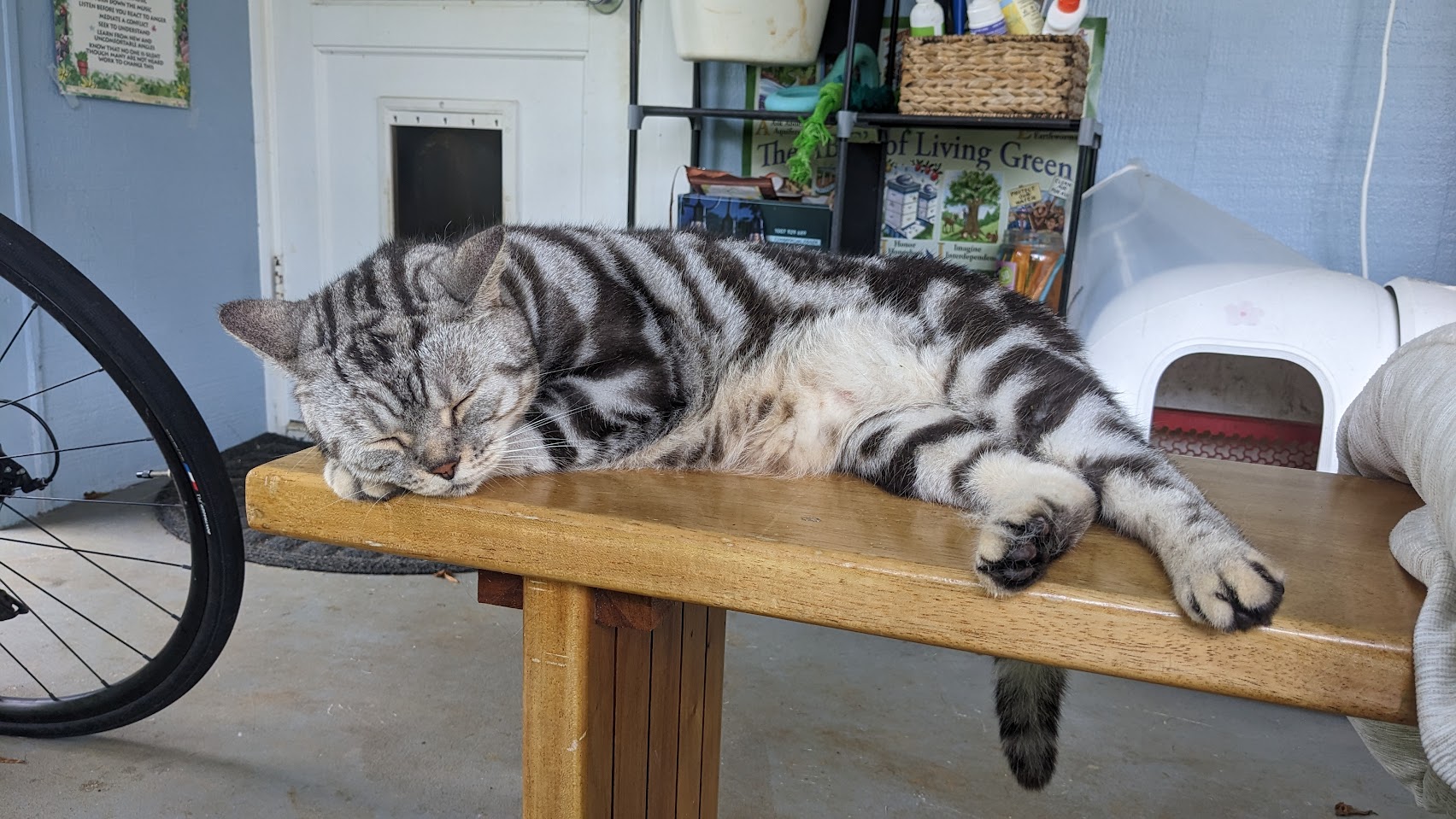
Well, a dog or cat doesn’t need to be a poet. The kitten sitting in front of my keyboard right now purring and wearing a cone is content being a purring furball. She’s not telling herself that she’ll only be interesting after she gets her MFA and first collection of poems published.
I had this moment of realization this morning: what if I stopped believing that I need to become something magical and accomplished in the future to be happy. What if I was enough right here and now, just as I am?
My body relaxed.
I like to write poems, but I don’t need to be “a poet.” I like science, but I don’t need to be “a scientist.” I can be a poet or scientist, but kind of as a byproduct of pursuing what I like and what the world needs. Not as a way to “be interesting.” I’m interesting just as I am.
I can let the soft animal of my body be the soft animal that it is. No need to contort myself into some mythic future X. Happiness is right here and now.
My parables
Parables are stories that contain within them a philosophy of life, a worldview. Here are some that resonate with me:
The Buddhist parable of the mustard seed — Life, for everyone, is impermanent and death is universal. Nobody gets their life “together” permanently. See also the poem Ozymandias and the philosophy of Emerson on impermanence.
The parable of the Chinese farmer — With a longer time horizon, the things that are painful today can lead to fruits tomorrow, and vice versa. An example from my life: when my bosses in internal medicine residency said I wasn’t a good fit for the field, it was painful, but it led to me finding a better career fit eventually. And this painful experience helped me be able to better empathize with people in similar positions (and help by way of sharing my story and undoing some shame).
Walden pond — Solitude helps us discover what we really think. My Waldens have been: a hobbit house I rented off Airbnb, six weeks on the island of Kauai, traveling, writing, long runs and swims.
Sartre’s student — The dilemma of Sartre’s student is the dilemma we all face in life: what to do? which values to choose? External “right answers” to many of life’s dilemmas don’t exist (not in utilitarianism, Kantianism, virtue ethics, or religion, though these can provide ideas). We must choose for ourselves.
Camus’ plague — Life is absurd, the universe giveth and taketh away, we have to choose how we live despite this. Do we despair and think of ourselves as a victim? Or do we live with decency and generosity?
The overview effect — When astronauts go to space, some are struck by wonder and awe at the oneness of planet earth and feel a sense of rage at things like war and environmental destruction. From the vantage point of space, we can see the insanity of identification with small differences (as satirized by Dr. Seuss in The Butter Battle Book). Yes, it’s true that the human psych tends to form in-groups. Yet rather than identify as a certain narrow part of our identity, we can CHOOSE to identify as living beings on a planet. Our tribe, then, is all of life. When I think in this way, I feel an expansive feeling in my chest.
The parable of the empty teacup — keeping beginner’s mind is keeping your teacup empty. When listening, practice not thinking what you’ll say, but taking in what’s being said.
The value of depth
I was talking to a friend yesterday who remarked that if she only had 15 years left to live, she’d choose depth over expansion. She’d choose spending time with the people she loved over meeting new people.
This made me think of Spotify, and how the app actually makes my experience of listening to music worse. Yes, I can listen to any music at any time. But this increased ability to expand and explore actually makes it harder for me to really get into any one artist.
When I was in college, I traveled to a remote village in Ghana for several weeks. There was no internet. All I had in the way of entertainment was what I brought with me: a laptop computer and some books. My laptop had only one album on it: We Were Dead Before the Ship Even Sank by Modest Mouse. I hated this album the first few times I listened to it. But because it was my only choice, I kept listening, on repeat, and eventually, I grew to like, and then to love, this album. I listened to it dozens of times.
In this era of Spotify, there would be no way I’d ever have this experience of struggling through, and then growing to love, an album. The writer Mark Manson said that when one thing becomes abundant, another thing becomes scarce. So many things are becoming abundant these days. It’s easy to meet new people: just join a group. It’s easy to listen to new music on Spotify. It’s easy to find information online.
What’s becoming scarce is depth.
To see the beauty of another person sometimes requires knowing them for years. Our cat died recently, and my wife is grieving. In witnessing her grief, I’m struck by the beauty of her love for our cat Sticky Rice. Yet I wouldn’t have seen this if we’d only known each other for a short period of time.
To see the beauty of a career sometimes requires being in it for decades. I recently reflected on where I am with my career. Zooming out and taking stock, I was able to see the meaning in my past struggles, how those struggles have led me to where I am now. And I was able to better appreciate what I find most satisfying about my current job: the ability to get to know people.
I’m realizing that meaning is proportional to struggle. I’m writing these words with our 90 lb dog Mango warming my feet on the couch. Mango is a 50% good boy now, but there was a time when he was only a 1% good boy. Getting him to this point took a whole lot of training and struggle, and receiving help from a trainer.
Another Mark Manson quote is “Don’t hope for a life without problems.” The problems, the struggles, the periods of feeling lost are what give a sense of meaning when we finally make it out of the woods. Deciding when to quit and when to commit is a subtle art. Yet, in this era when it’s getting easier and easier to pick up a new song, a new book, a new friend, I keep needing to remind myself of the value of depth: that meaning that comes with overcoming struggle, that it’s good to keep at things.
No shortcut to knowing what you like
The only way to know what you like is through experience. After over a decade in medicine, I now know that what I like about it is:
- Getting to know my patients as people (this is my #1 favorite thing)
- Solving puzzles
- Learning
- Helping
- Teaching
I don’t like:
- Publishing papers
- Getting interrupted / woken up
- Being responsible for a very wide range of problems
- Following protocols meticulously
When I was in medical school, I read a few books adjacent to medicine. One was called “My Own Country” by an HIV doctor, who worked in the rural American South. Reading this book, I got the idea in my head that being a general practitioner was “real medicine.”
Yet my experience in internal medicine was not enjoyable. I found being responsible for a wide range of problems, and medical knowledge, to be overwhelming. I didn’t like — and wasn’t good at — being the “manager” of someone’s entire body. After I changed fields from medicine to neurology, I found it far less stressful and more rewarding to be responsible for a single area than the whole enchilada.
While in neurology, I found, after a few years, that I didn’t enjoy inpatient work as much as I thought I would. Though I found the diseases intellectually interesting, the workflow of constantly being interrupted didn’t suit me. So I changed to a more outpatient-focused position where interruptions are minimal.
In addition, in the outpatient world I found that I had more time to get to know my patients as people. I find that when I can glimpse into who people are outside of their diagnosis, my work becomes more meaningful. I did not know, going into medicine, that this would be what I like most about the work. I entered medicine for the medicine. I’m staying because I like people.
Over a decade ago, I read the books, “Surely you’re Joking, Mr. Feynman” and “For the Love of Enzymes” and “Advice for a Young Investigator,” which gave me the idea that it would be awesome to be a scientist. To make discoveries. To follow my curiosity.
My actual experience in science was different from the picture I got in these books. Over many years, I worked in four different labs. I studied the cell biology of aging, tissue engineering, biochemistry, and neuroscience. I was super-interested in each of these topics. Yet, the day-to-day, boots on the ground experience of working in these fields was not something I enjoyed or was good at.
When I worked in research, I found that a tremendous amount of patience was required: organized notebooks, following protocols meticulously. I realized that my nature is to be an intuitive cook — a little of this and little of that — not a fastidious baker.
OK, I thought. Maybe I don’t have to be in a wet lab. Yet, when I took on the project of writing a review paper, on a topic I enjoyed (meditation), the process was still excruciating. It seemed that wherever I tried to enter the world of research, I couldn’t find flow.
The writer Mark Manson asks the following question: what’s your favorite flavor of shit sandwich? By this, he aims to underscore that every path involves failure on the way to gaining competence. For me, the path of studying was somewhat enjoyable. I’m naturally a pretty good student and test taker.
Yet the practice of science or medicine is not really about studying. Being a scientist is about working in the lab and writing papers. Being a doctor is about seeing patients. I realized, only through experience, that I enjoyed the latter but not the former.
Manson asks another fecal-themed question: what makes you forget to eat and poop? By this, he means: where do you find flow? Where do you enjoy the process?
I don’t think it’s possible to answer this question without actual experience. I can read books about something, I can talk to people who do it, I can even shadow people, but until I’m actually doing something myself, for a decent chunk of time, I won’t know if it’s my thing.
I like the process of rock climbing. If you put me in a rock climbing gym, I can hang there for hours and get into a flow state. The workout happens naturally. If you put me in a standard gym, I can force myself to lift weights, but it’ll be a slog. This knowledge about what kind of gym I like came only through trial end error. I don’t mind falling off rock climbing walls. But I don’t like the repetitiveness of a standard gym. So my favorite flavor of gym shit sandwich is rock climbing. Rock climbing makes me forget to eat and poop.
There’s this common advice that goes: do what you like. Yet, I think that the doing is the second part. The first part is knowing what you like. And this knowing can take decades to arrive at, and a whole lot of tweaking and self-reflection.
Knowing that I like “medicine” was just the first approximation. It took a whole lot of tweaking to find a practice setting that has enough things that fulfill me where it’s sustainable. My current job isn’t perfect, but reminding myself the above lists helps me to realize that it’s pretty good.
I saw a patient yesterday whom I feel like I’m really getting to know as a person. I’m working on a difficult diagnosis in his case. I don’t think I’ll be able to help “cure” him — but nonetheless, the process of working towards some kind of answer, and getting to know him in the process, is meaningful.
In my medical school essay, I wrote about my experience working with an eye surgeon in Ghana who helped restore sight to thousands through cataract surgeries. This was the model of medicine I had in my mind: doing great good for people through treatments.
I’m a different kind of doctor, I’m realizing, a slower kind. I like to know people’s stories. I’ve expanded my definition of helping. Yesterday, I saw a patient with headaches. I prescribed her a pill for migraines, but I spent much of the visit talking about the stress in her life and who she is as a person. We did a meditation together and she told me about her job, where she’s from, her family. I found this process of getting to know her the most meaningful part of the visit.
Let’s say that the pill works magic and cures her headaches. I’d be happy about the result, but my main meaning would come from the knowledge of what this improvement means for her in the context of her life.
It’s taken me decades to “know what I like.” Lots of trial-and-error and reflection. “Do what you like” is like an advanced graduate-level program. “Know what you like” is the first step and has taken me a whole lot of time.
Practice holding yourself
I listened to a podcast yesterday where two former addicts were discussing how self-love was so hard.
This got me thinking, this morning, about love. I’ve mused about love extensively in the past. This morning, I had a bit of clarity about what love means to me. Much like spirituality, it’s a tough word to define. Like spirituality, I’ve done a bunch of reading about it, and I’ve sought it out in the world. I’ve looked for love in romantic relationships, in friendships, and in prestige, in “likes.”
While I got “high” from these experiences, none of them ultimately proved to be a durable source of love.
In the past week, though, I did three practices which helped me access self-love:
- Body scan — I went up and down my body, focusing on areas of tension. Wherever there was tension, I gave this area the warm light of my attention, breathed in, and breathed out just a little bit of that tension.
- Letters from love — I wrote several letters to myself, inspired by the prompt “Dear love, what would you have me know today?” Credit to Liz Gilbert.
- Guidework — I did a guided meditation where I went underground and met up with my buddy Thich Nhat Hanh who gave me some unconditional warmth and acceptance. Credit to Megan and Chris.
It strikes me that these different words we use — words like understanding, acceptance, belonging, being seen, and love — all point to an energy, which, as close as I can put it in words, amounts to the energy of being held.
So is self-love hard?
Well, we have parts of ourselves that aren’t very loving. When lost in these parts, we can search for love in the external world. I remember reading once that using heroin was like “being hugged by Jesus.” I’ve never been a heroin addict, but I’ve done essentially the same thing a heroin addict does: looking for love outside myself.
I now know that there are ways I can access loving energy within me. Yes, it’s nice to get love from people in my life too. But if I can’t provide love for myself, then I’m a “hungry ghost,” always searching for a feel good boost externally.
And also, the muscle that loves myself is the same as the one that loves others. Self-love isn’t selfish. Practicing it is actually the best thing I can do to really love others.
Kimya Dawson sings, “You can be sober, and not recover.” Even if one doesn’t use substances, one can be a hungry ghost, filling the need for love with X.
X can be many things.
A few of mine, over the years: shopping, romance, workaholism, new year’s resolutions.
In the podcast, one of the former addicts talks about “getting to the root cause of addiction.” I think the root cause of addiction is always the same: it’s the inability to hold oneself. To escape from an unpleasant inner empty feeling, the addict chases highs. It’s new years resolution time, and I’m reflecting now that for years, my drug of choice has been progress.
There’s nothing wrong with progress. Nothing wrong with exercise goals or dating or decluttering the house. But what is not healthy is using these things to escape a sense of inner emptiness.
Practice holding yourself, Dan. You can still go on the run this morning. But also, practice holding yourself.
Spirituality = oneness
I’ve mused about my definition of spirituality a bunch on this blog. For example, here’s an early musing, from over a decade ago.
Fast forward to today, and I think I’ve come to “the simplicity on the other side of complexity.” Here’s my current definition of spirituality, small enough to put on a post-it:
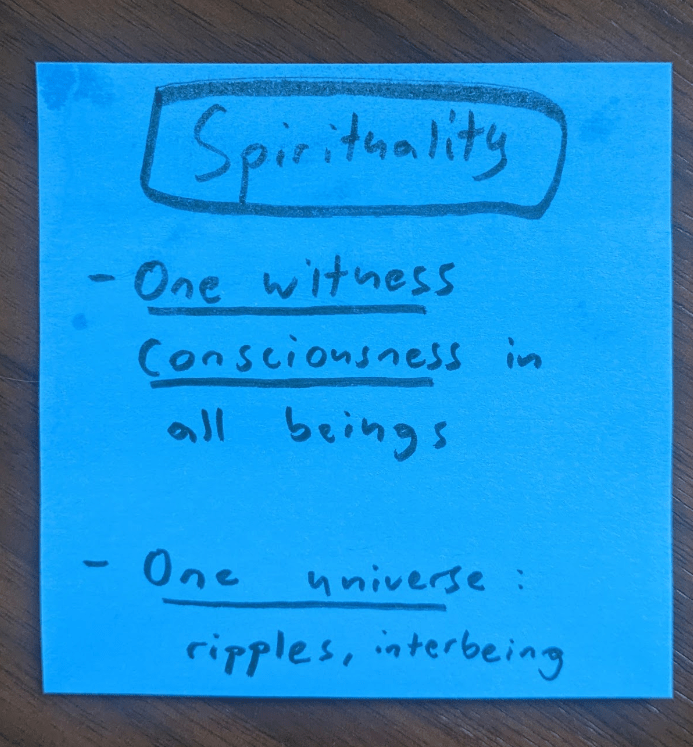
For me, spirituality is a way of seeing that emphasizes oneness. This comes in two flavors:
One witness consciousness in all beings
A common metaphor for consciousness is the blue sky and clouds:

The blue sky is the observer or witness consciousness. Clouds are thoughts/feelings.
The observer consciousness — the blue sky — is the same in all sentient beings.
Two quotes:
You and me, that is the awful lie. It’s I and I. — Conor Oberst, from his song One for me, one for you
I honor the place within you where, if you are in that place in you, and I am in that place in me, there is only one of us. — Ram Dass
The egg is a sweet animated story that makes a similar point to the quotes above.
A penpal of mine gave this pointer: if you look at someone’s pupils, the witness consciousness on both sides of the gaze is one and the same. The two people don’t have the same mind or the same thoughts and feelings. But they do have the same observer consciousness. The same blue sky.
One universe
I have to give credit to Thich Naht Hanh for really bringing this teaching to the forefront of my attention. When we drink tea, there’s a cloud in the tea. Before we we born, we lived inside our parents, and before that, in our grandparents. After we die, the ripples we left in the world will continue. There is no birth, no death, and no independent self.
There is no such thing as a tree independent of the earth, the clouds, the air, the sun. The entire universe is a system that inter-is, changes and morphs through time. Seeing in this way promotes a felt sense of connection.
The art of Alex Grey underscores both of these forms of oneness, for me:

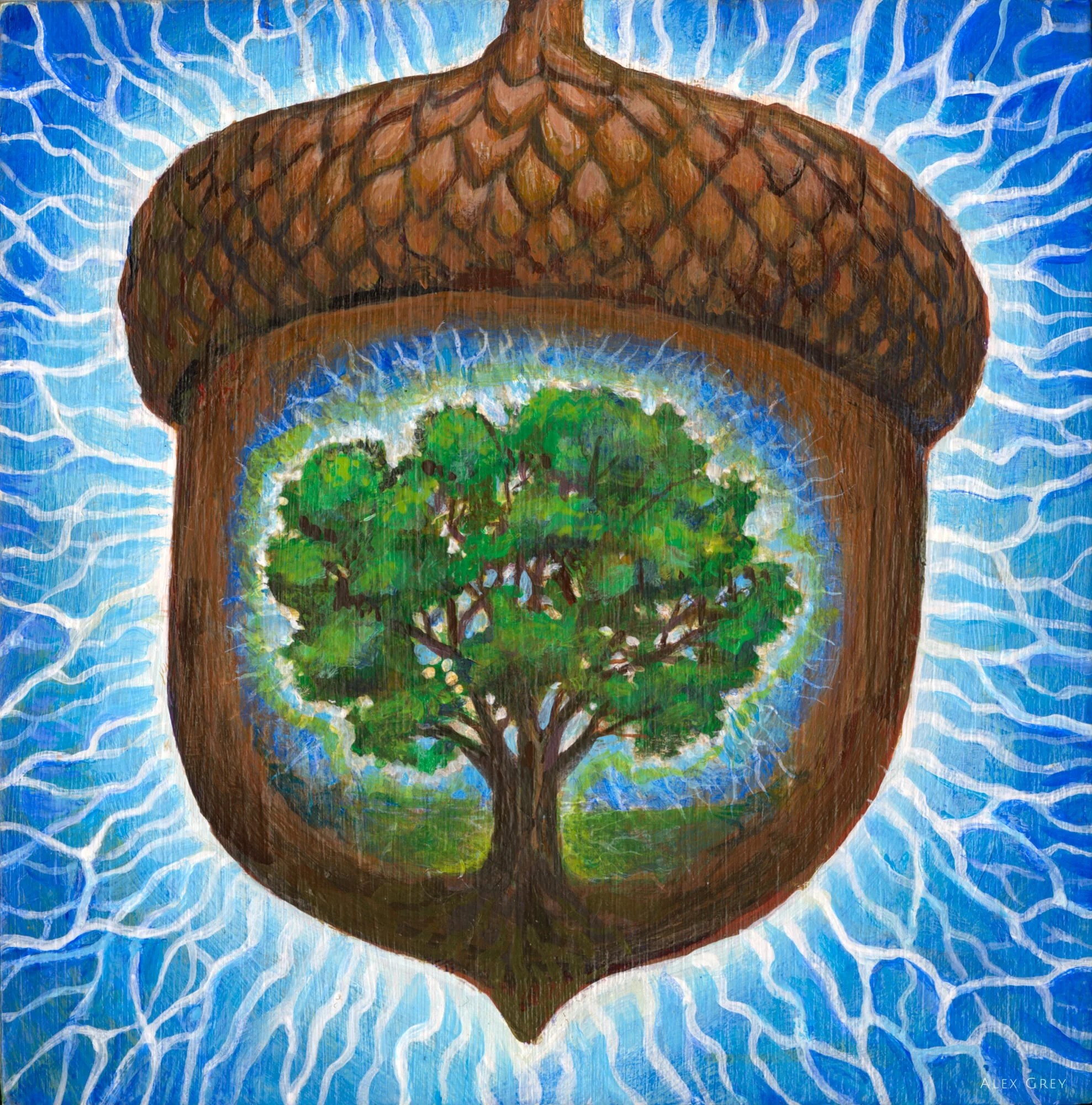

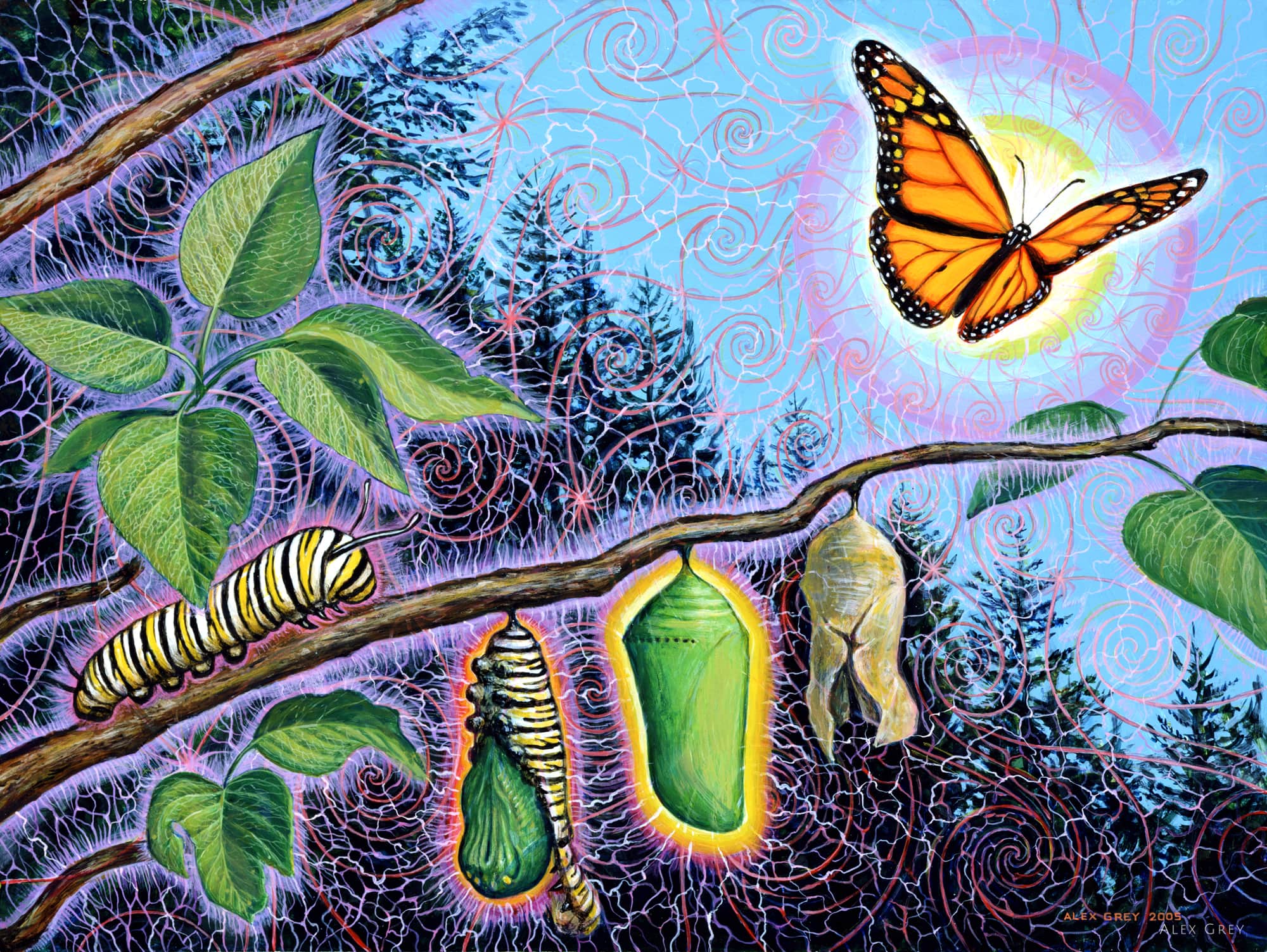


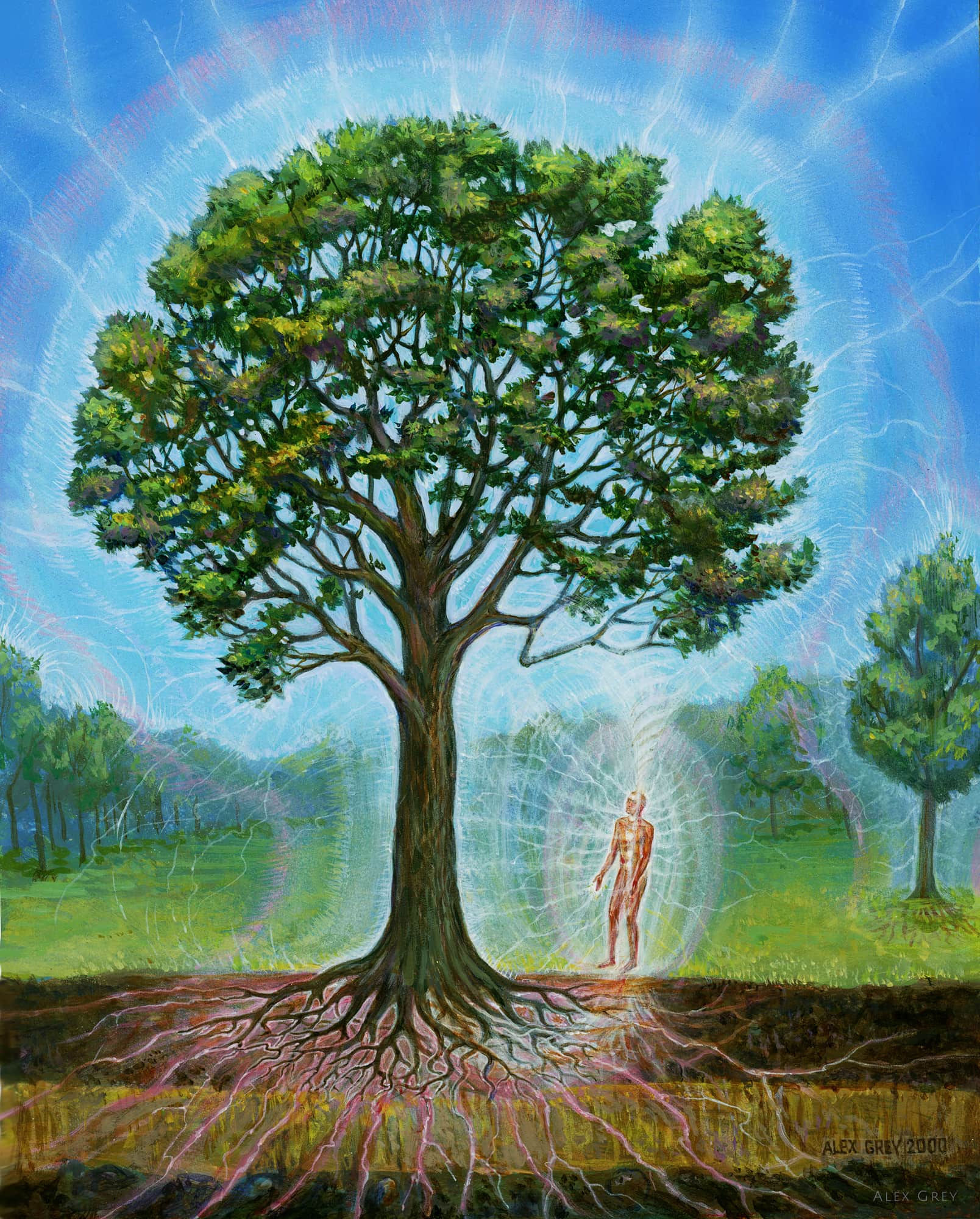
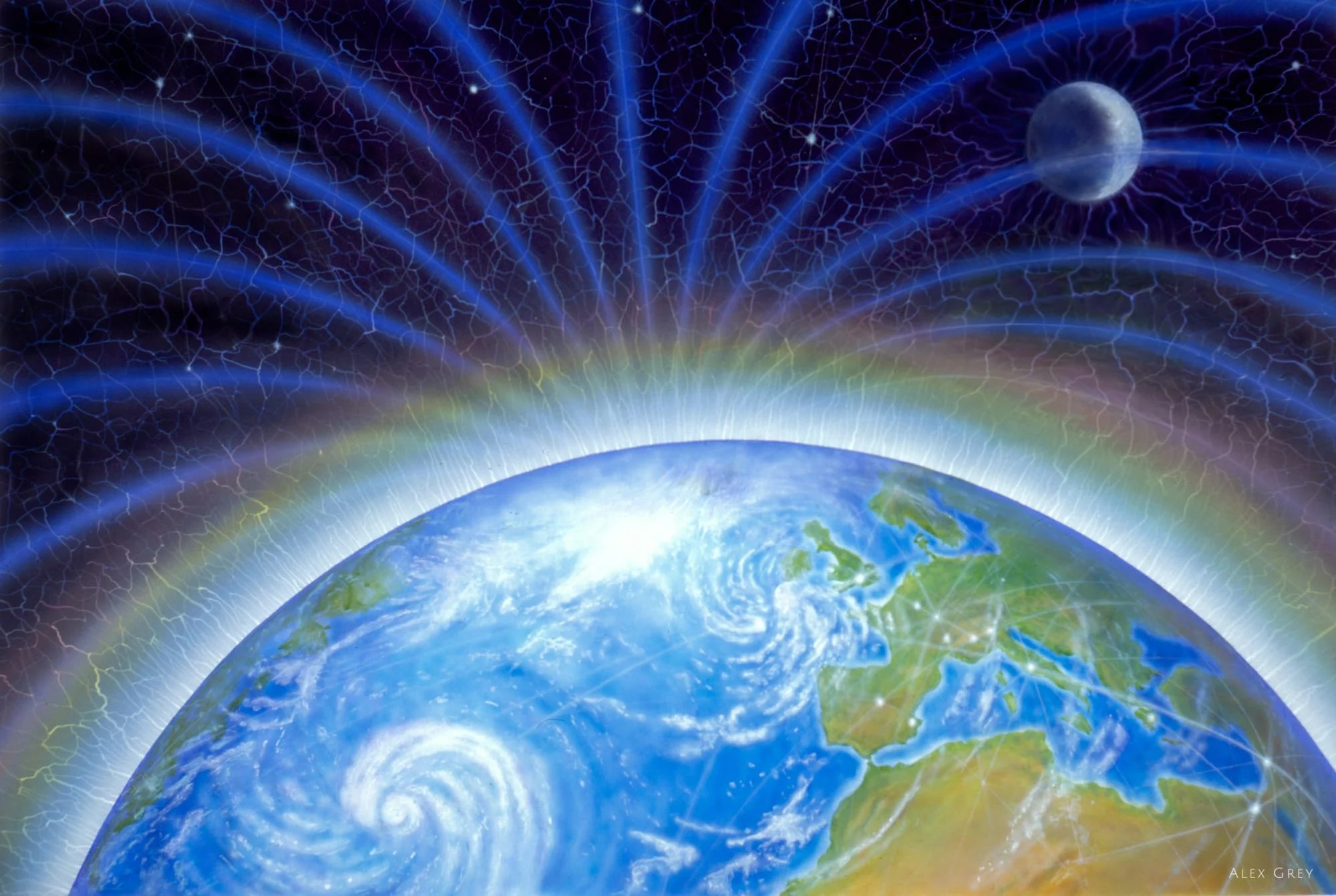

I’m only now realizing that there’s a subtle latticework permeating each artwork above. Could this be a symbol of oneness that connects us all?
For me, spirituality is not about belief in a deity or anything supernatural (like reincarnation). It’s about putting down the illusion of separateness, and waking up to our oneness with each other and the universe.
2025: Annual Post-It Note
Here’s my minimal and intuitive “annual post-it note” — the things I want to focus on in 2025:
Theme for the year: Make my decisions right
Intentions for 2025:
— Practice noticing
— Use my toolbox
— Open up to newness, do something
— Move all the time, not just while “exercising”
— Garden and mentor
My toolbox
Everything is a tool. — Mark Manson
Or: every practice, lens, philosophy is a tool in the toolbox of life.
This perspective has been helpful for me because it keeps me from falling into the thinking that that I need to find the “one thing” will make all my problems go away. This is the sort of thinking that gets people into following culty cult leaders.
I can pick up tools, play with them, and put them down as I need to. I’ve created this running list to remind myself that I have lots of tools to draw from:
- body scans
- letters from love
- tea ceremonies
- juggling
- clowning
- medicine learning
- seeing patients
- cooking delicious food
- walking
- running
- swimming
- climbing
- slacklining
- talking to friends
- community (WUH, men’s group)
- shabbat
- volunteering
- doodling
- living life as art
- dance and freeform body movement
- sunsets
- hugging trees
- noticing colors
- psychotherapy
- journalling
- blogging
- spirituality
It’s a simple and generous rule of life that whatever you practice, you will improve at. — Elizabeth Gilbert
Be with the eggs
In response to my recent post about death, a friend said, “Our ego’s hope for a grandiose legacy isn’t what we’re here to do. It’s to serve our purpose in this continual moving on.”
This reminded me of the word “autotelic” which means “for its own sake.”
My favorite joke:
Two old jewish men are chatting in the shtetl. One says to the other, “Tell me about your business.”
“I buy eggs for a rubble, boil them, and sell them for a rubble.”
“What’s the point? You don’t make any money.”
“I get to be with the eggs.”
Go for the autotelic! Be with the eggs.
The autotelic is our purpose, in the continual moving on.
Philosophy of pleasure
“What’s wrong with pleasure?” my therapist once asked me.
I think she was reacting to something self-shaming that I’d said. While I don’t think there’s anything morally wrong with pleasure, I do think that pleasure can lead us astray because it can be addicting. On a recent trip to Japan, my wife and I walked through a doorway on a Tokyo street and saw this:
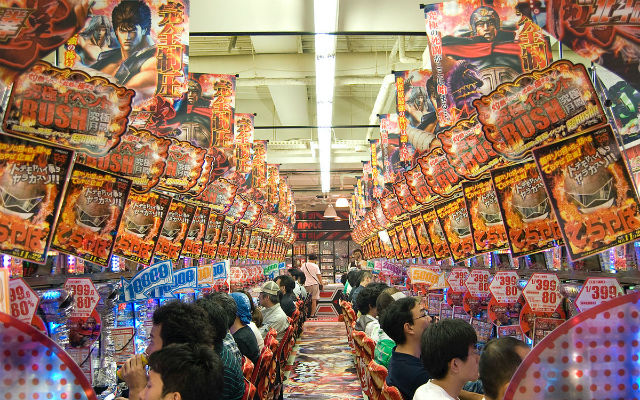
This was a Pachinko parlor, were visitors, mostly men, gambled in a game that’s something of a cross between slot machines and pinball. The pachinko industry in Japan is worth $200 billion — 30 times what Vegas makes in gambling, and double the size of Japan’s export car industry. Crazy!
So, do we become Puritans or Spartans and avoid pleasure entirely?
I don’t think that’s necessary. I think we can upgrade pleasure by adding one of three ingredients (or two or three):
- Memory — we can use pleasure to create a memory, for example going to a fancy dinner to celebrate a birthday
- Community — we can share pleasures with loved ones, for example having a wedding dance party
- Mindfulness — we can consciously savor pleasures, such as mindfully eating a tangerine
So after thinking about it, I would say to my therapist that yes, I do think there is something wrong with pure pleasure, because it can potentially isolate us. It lead us into a state of addiction, of chasing sugar or Pachinko highs. But if we upgrade pleasure with the ingredients above, then it can be a great thing.
Thank you, Arthur C. Brooks, for these insights.
It doesn’t matter who comes to my funeral
I’ve been thinking, of late, about who will show up to my funeral. Maybe it’s because I recently got married, and went through the difficult process of deciding who to invite.
I’ve caught myself thinking, in the back of mind: who are the people who will take the plane to my funeral? As if this were some kind of measure of my life and quality of my relationships.
Yet ultimately, perseverating on such a list – be it for a funeral or wedding – is arbitrary and an example of black-and-white thinking. Just because someone was at my wedding doesn’t mean our relationship is super-meaningful. Just because someone wasn’t at my wedding doesn’t make the relationship worthless. Grey areas abound. Relationships are dynamic things that evolve over many years.
Yesterday, I got a call with sad news that a friend had died. I donated to the fund for her funeral, but I likely won’t likely be booking a flight. I don’t believe that her soul is at peace or not at peace or in purgatory. I believe that she lives in the ripples she left in the world.
I lit a candle for her yesterday, and talked to people about her. She now also lives, a little bit, in these people who have heard about her and have never met her. She lives in the air of my room, which is different now that the ritual candle has been burned for her. She lives in the $25 dollars I donated to a cat rescue fund in her honor. If that organization gets to pair one more cat with owner, thanks in part to that $25, then she’ll live on there, too.
The writer Mark Manson told the story of a transformative moment of his life. When he was a teenager, he spoke to a friend of his at a party. And then that friend, a few minutes later, jumped off a cliff to his death. His friend had miscalculated the depth of the water, and got shattered on rocks. One moment, the friend was having a good time at the party, the next, he was dead. This was the moment that “we’re all gonna die” really registered for Manson, emotionally.
I’m in a similar moment right now. But there’s more to it than that.
I shared my grief with a friend, who told me that his dog of 15 years had died suddenly. The kids in his household, who are young and hadn’t spent much time with the dog, didn’t seem to care.
In a brief span of time, my friend saw the jarring juxtaposition of two things:
- The suddenness of death
- The world moving on
The first thing — “Memento mori” — seems to be becoming mainstream, which I think is healthy. Yet the second point isn’t talked about as much: that world moves on. Sometimes quickly, that very day, as with the kids and the dog. Sometimes it takes a while. But the world does move on.
When I die, a very tiny fraction of this world’s billions will be emotionally affected, and some of those will show up to my funeral. Some will grieve in other ways, perhaps by lighting a candle and swimming in the ocean and looking at the setting sun, as I did yesterday.
Some might write, as I’m doing now.
All will hopefully return to their lives, as they should. As I want them to.
The moments I shared with my friend now seem extra gone, now that the book of her life is shut, and there’s no opportunity for me to pick up the phone and write another page. Yet they are also not gone. They live on in me.
My friend who lost his dog said: “If this is true – that I’m going to die and the world will keep going – then there’s absolutely no reason to live inauthentically, to preserve the version of myself that’s acting out of fear, to burden my future self with regret.”
He told me that his boss wasn’t very empathetic when he called in and said he needed time to grieve. He told his boss, “Look, I’m here to help, but I’m not going to work just because you and I have different ideas about what grief is supposed to look like.”
This small act of standing up to his boss is what it looks like to pursue our values, to live in authenticity.
Whether 400 people come to my funeral or just four, whether I die at 40 or 100, the basic facts are still the same:
My physical body will die. The world will move on.
The ripples I made during the days of my life will remain. They will combine with a myriad of other ripples, and become part of the world of the future.
National values
In our plane coming back from Japan, this video played for all the passengers:
To me, this video emphasized working together towards a common good. The person in the wheelchair was being helped by many. Every person had pride in their work, from the corporate people with their powerpoint decks, to the chef, to the pilot, to the cleaning crew.
At US customs, another video played, which featured visible diversity: an interracial couple, people of many more diverse ethnicities (compared to the above video), and also someone in a wheelchair. This person, however, was not being helped: they sped down a long road in a racing wheelchair, biceps bulging and sweat pouring down their torso, likely training for a competition.
The values emphasized in the US video were: diversity and individual achievement.
In the airport elevator back in the US, I noticed scratches, graffiti. Thinking back to the past week in Japan, I realized that my wife and I had only seen graffiti once, despite spending nearly all our time in cities. The Japanese elevators were immaculate. They even had thoughtful touches such as an “emergency kit” which included a bathroom bucket, food, and even playing cards (in the event that the elevator gets stuck). Below the elevator buttons was a pad to discharge any static electricity on one’s fingers.
These differences between elevators, airport videos and graffiti are fractal-like: in these little fragments of culture we can see the major differences in values between the US and Japan. Every value has a shadow side. The shadow of being very considerate is a stifling of self-expression, a theme that’s come up in my conversations with several Japanese expats. The shadow of individualism and diversity is loneliness and chaos, because people are not on the same page, not looking out for the common good.
Another example: I recently spoke to a German friend about the value of “being rich.” In Germany, being rich is seen as a negative thing: it means you are likely not honest or lazy, achieving a high level of wealth through hoarding resources or inheritance. In Germany, very wealthy people would actually be less likely to be elected because of this national value. This is such a contrast to the US, where billionaires are often lionized on the covers of magazines, in popular songs, and where one was just re-elected president.
Nations have values. Families have values. Individuals have values. These values interact. In his book, How to Know a Person, David Brooks asks the question: “How are you both a cultural inheritor and cultural creator?”
While we are “thrown” into our cultural world, we still have choice. We can embrace our nation’s values, or rebel against them. If we really don’t vibe with our nation’s values, we can even choose to become an expat (this requires a degree of privilege as well as sacrifice).
Traveling to Japan made me come back to the US and see the values here more clearly. Spending time in other people’s homes does the same. I have a friend whose family values frequent big communal dinners with lots of wine. My uncle Buma valued long and serious deep-dive conversations, where he really got to know people. Both of these are different from how my family operates. Neither is “right” nor “wrong.”
The Grateful Dead sing, “sometimes we visit your country and live in your home, Sometimes we ride on your horses, sometimes we walk alone…”
The benefit of travel, be it halfway around the world or to friend’s house for dinner, is that we get to see how other people do things, and when we return, we get a clearer view of ourselves. In the words of Wade Davis, “The world in which you were born is just one model of reality. Other cultures are not failed attempts at being you; they are unique manifestations of the human spirit.”
Little cherishments
The wedding band
Hangs with the keys
In my keyring

I put it there
So I wouldn't lose it
During my swim in the ocean

This little action
Weaving it into the keyring
Weaving it out
Putting it back
On my finger again
Is symbolic
Of the fact:

A big part of life
Is how you show up
A sprig of chillitude
Yesterday I had a new kind of thought
A new kind of feeling

I approached the car and
Realized that my keys
Were back in the locker room

My feet started to run
Nervous system
Going into high gear

I slowed back down

The new thing came over me:

If I lose my keys
If I lose my car
It will be okay

Space will open up
For something new
Kindness for the mean parts
Yesterday, I mailed a gift to my parents by boat.
“It will arrive in 20 days,” said the man at the counter.
Walking out of the post office, I ran into a friend, who was sending multiple boxes by priority mail. I realized then that it would have been cheaper and faster to send my package priority.
“Damn it,” I said to myself. It was too late to go back and change course.
In the car, I listened to an audiobook called Between Two Kingdoms which describes the author’s experience as a 20-something with leukemia. Compared to the author’s life challenges, this package incident was so minor.
Yet here I was: judging myself for imperfect mailing. And judging myself for judging myself.
There are two tri-lettered flavors of psychotherapy that I like: acceptance and commitment therapy (ACT) and internal family systems therapy (IFS). Both emphasize compassion towards thoughts and feelings that come up. Both emphasize living a values-driven life.
I choose to value self-compassion, learning and love.
I’m not going to be perfect. Mistakes are doorways to learning. Yesterday, I learned about the best way to mail things at the post office: get the priority box, pack the box at home (or come prepared with a sharpie marker and some crumpled papers to use as padding), and mail.
Even though I mailed the things imperfectly, I’m glad I got out the door yesterday and mailed them. Sending gifts is not my usual love language. This was a growth-edge for me.
I visualize the perfectionistic part of me as a guy wearing a black suit and tie. He looks a little like Lex Fridman:

Early on in my life, this guy internalized the idea that in order to be loved, he had to be perfect. So naturally, he is judging me about the package.
Suit-and-tie guy can’t be erased. He has to be embraced. He is wounded, and believes that only by getting it “just so” he’ll be loved. He doesn’t know that he already is.
The solution for suit-and-tie guy’s meanness is compassion, kindness. Mean parts of myself are mean because they are driven by fear. They believe they are serving me. Since I can’t erase them, I want to learn to embrace them. To take a wider and warmer perspective.
I can remind myself that the package incident was an opportunity to learn. My parents will still be happy when it arrives in 20 days. Sending it was aligned with my value of showing love.
Yet the suit-and-tie guy still got activated, despite these facts. He said: You are such an idiot. The package won’t arrive before the holidays. Who knows, it might get lost. And you had to use more packaging to send it the way you did.
I can say to him:
I see you. I know you’re trying to help. Come here, let me give you a hug.
Jack Gilbert died of Alzheimer’s
Jack Gilbert
Would not have
Wasted the experience
Of peeling the clementine

Strands delicate and white breaking
As flesh separates from carapace

He would not have wasted
The sensuality
Of exploding droplets
Citrus fresh
Aerosol fireworks

Did it matter
That at the end
He was in a home?

Not gazing greedily at the Aegean
Or the nipples of a lover
Or savoring a meal of fish
In a year of solitude
As swallows flew
Overhead

I don't know where my last hours will be spent

More reason, then, to embrace the scene
Cat nestled on table's corner
Dog on couch
Greasy hands from lunch
Pen on paper
Birdsong, bells
Wind on skin
Wiggling ferns
And yes
The clementine
Today
Believing in slow healing
A year and a half ago, I fell from the top of a 20-foot bouldering wall onto a foam mat. Immediately, I felt a sharp pain in my left Achilles tendon. I brushed myself off, thinking it wasn’t a big deal.
Over the next few weeks, dull pain continued in my tendon, and over the coming months, it did not get significantly better, despite lots of rest. I eventually saw an orthopedist, who suggested more rest, and wearing a boot. I didn’t wear a boot, but did do more rest.
No enchilada. The pain kept on pain-ing.
Eventually, I started to tell myself the story that I’d always have the pain, for life.
Then, I looked up some exercises and saw another doctor, and a physical therapist. The exercises were so boring! I printed them and put them on my fridge. Still, I did not do them.
Then, I enlisted Ron, a personal trainer, to help hold me accountable. During our workouts, Ron always made it a point to have me do my achilles PT exercises. After a month of doing the super-boring exercises semi-consistently with Ron’s encouragement. I began to see results. Today, after a run, I barely feel my Achilles tendon at all.
I think there’s a larger lesson in this Achilles story: my fixed mindset that I would never get better was keeping me from getting better. It’s like that old saying: “Whether you think you can or you think you can’t, you’re right.”
Here’s to thinking you can, and then doing the work, with help from backers.
The clown lens on life

It’s been a year and a half since I delved into the world of clowning. My practice is to clown in everyday life: in the grocery store, in airports, on trains, on city streets.
The main thing that I’ve learned through this practice is that a lot of life is how you show up. A clown chooses to show up with specific intentions, not on autopilot.
Prior to clowning, my wardrobe was drab by default. I had unconsciously chameleoned my color scheme because that’s what everyone else was wearing. Now, I realize that drab colors are a choice, and bright colors are also a choice.
The clown lens on life is: all of life is performance. The clown puts on bright clothing and shows up with an eye towards promoting play, joy, humor, and connection. The clown is not merely an agent of chaos, weird for the sake of weird. The clown is a clown because she chooses to value the above things more than conformity.
There’s a story Elizabeth Gilbert tells about how she was on a New York City bus and the driver told everyone that he would be willing to shake their hand and make their day a little bit easier. The faces of the people on the bus instantly relaxed and people took him up on his offer.
This bus driver showed up with an intention to create connection and compassion in his space. It didn’t matter that the weather was bad. It didn’t matter that he was at work. It didn’t matter that he might have been tired or that people were not in a good mood. He showed up in an intentional way.
This is what a clown does. But you don’t have to be a clown, you don’t have to put on bright clothing and a red nose, to show up intentionally. I’ve discussed elsewhere how at the hospital where I used to work, there was a cashier who would play music and have inspirational quotes prominently displayed: every day spreading good vibes to her customers. From a broader perspective, this too can be seen as clowning.
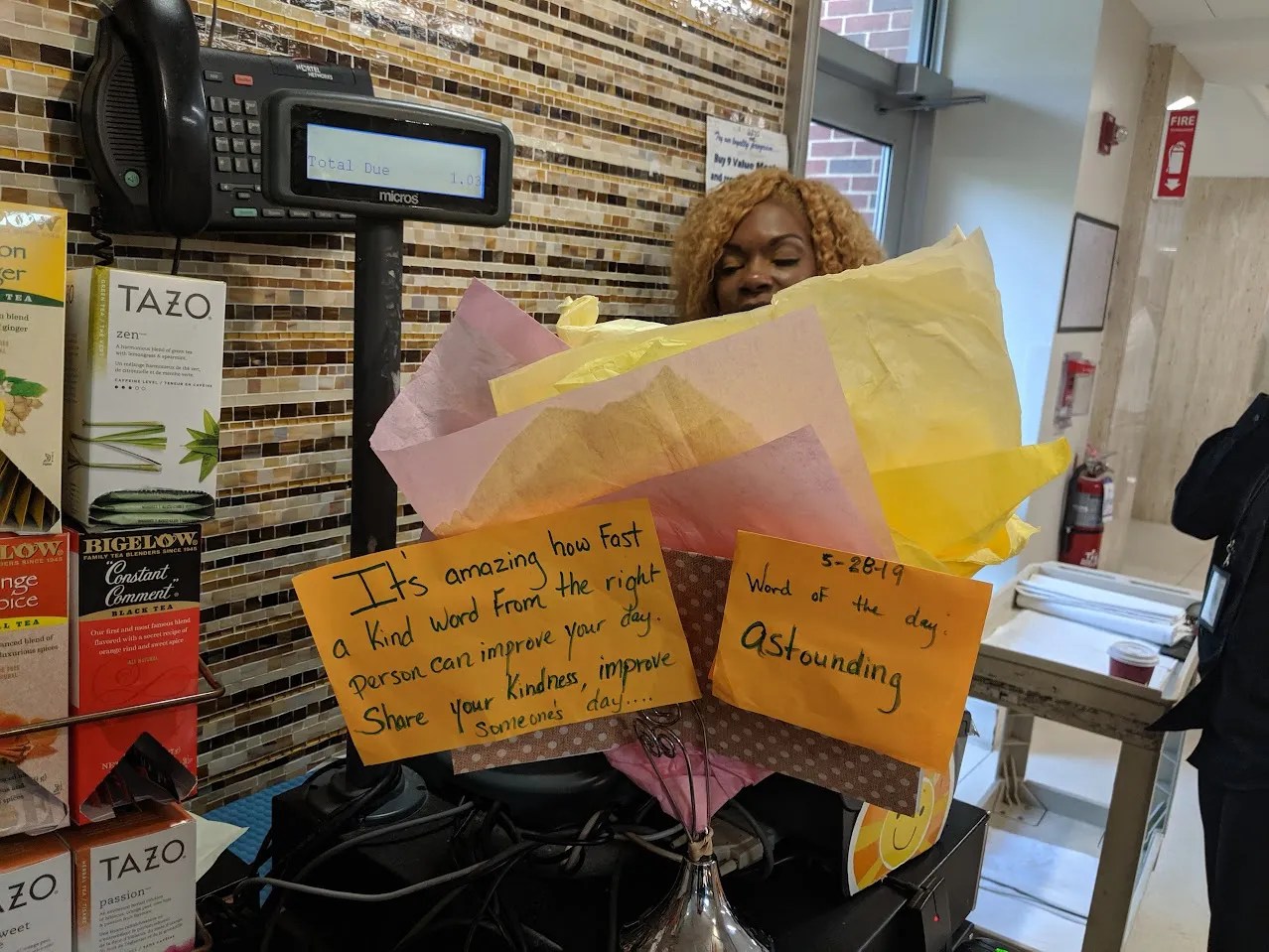
Yet even without non-conformist actions, we can learn from the clown.
Do we see the good in another person and compliment them? Or do we see the flaws and berate them? When we go out to a restaurant, do we see the beautiful mural on the wall? Or do we see the problems with our meal?
I think a BOTH/AND perspective is the truest: we need both the happy and sad clowns in our psyches. We can’t just ignore the fact that we’re tired, or grieving, or just not feeling like connecting. That’s totally okay. Rest and grief are important. Yet it’s also important, I think, to skew positive. Because if we skew positive, we promote positive neural pathways in our minds and we become more positive. It’s an upward spiral.
My most recent clown-outing was taking an Amtrak. I had been with my family for a week and a half, and I was stressed because two family members had fallen ill. I was not feeling much like clowning, but I still put on my outfit. During that train trip, I connected with at least four people very positively, and gave away three “In this together” bumper stickers in my character, The Clown of Interbeing.

The lady above showed me photos of her dog, which she takes to play with neighborhood kids. She shared with me her spiritual practice. If I hadn’t been dressed as a clown, I would have just walked by her. Clowns attract other clowns. There are hidden clowns everywhere!
You might be one too, and just not know it yet.
And also: clowning may not be the tool for you.
I hope that by sharing my clowning journey, I inspire you, a little bit, to find your way of showing up with intention in daily life. Whatever tool will help you, find it, and use it.
A year-and-a-half after my clown trip, I clown less often than before. But when I feel the itch, I put on my clown clothes and nose, to remind myself to show up with joy, and to promote connection.
Clowning has taught me that no matter where I live, whether it’s Hawaii, Buffalo, or NYC, I can choose to be a tree. I can choose to provide shade, nourishment, and beauty for those around me.
That’s what clowning has taught me.
What I loved about our DIY wedding

You must invent your own religion, or else it will mean nothing to you. You must follow the religion of your fathers, or else you will lose it. –Hasidic Proverb
Today, we got legally married. About a month ago, we had our DIY-style backyard wedding ceremony.
I just erased a white-board full of things we could have done better with the event. While it’s good to learn from shortcomings, it’s also good to savor what went well.
In this spirit, here’s a list of things I loved about our wedding:
- The generosity of our hosts for a million and one acts of love and service.
- Dancing the hora and stilt-walking the day after (thanks Hallie).
- The beauty of the decorations: candles, shots, tables, lighting, flowers (thank you friends who set these up, and Sonia-space creator and Api-designer)
- The cultural remix of Thai (white thread bracelets, Khan Mak), Jewish (glass breaking, Kittel, music) and Clown elements.
- My dad’s joy on the dance floor.
- Api’s mom and dad joy
- Letting the organism of the event flow in the way it wanted to flow (thank you to Pat for stepping up and MC-ing, and thanks Nicole/Lisa for the advice to let go).
- The food, makeup, photographer, florist (thanks Mama for help finding many of these folks).
- The bachelor gathering (some highlights: cacao, Nicolette’s voice, softing, rock-climbing hike, Nicole’s game).
- Opening the gifts with both our families. My favorite gift: David’s home-brewed bottle of alcohol that sent me back down memory lane. Thank you notes are in-production!
- The speeches. Thank you everyone who gave one.
- The shots of vodka.
- Elements from both our lives: my violin teacher Max, videos of Api’s friends from Thailand…
- Family time at our house, the day before and after (thanks Mama and Papa for creating such a warm vibe).
- Our first dance.
- Glowsticks!
- Everyone who gave moral support in the months leading up to the wedding (especially: Peter, Avi and Ethan).
- Reading the poem praise the rain, as it rained, while serving tea, with the fireplace crackling.
- Being scared to invite certain folks and then having them actually be really supportive.
- Josh stepping up as audio-visual wizard.
- Overcoming a whole host of challenges: getting COVID, redoing the seating chart, food/dessert issues, cold and rainy weather, losing track of many props, glasses that arrived dirty from the rental company…
- The music (thank you Young Picassos).
- My dad’s chupa, and plum trees.
- Traveling after the wedding: with the in-laws to Canandaigua and Canada for a post-bachelor party.
- Not having shoulds: starting with a blank piece of paper and including the elements from our cultures and lives that resonated with us.
- People showing up, traveling from far away, to attend.
- The support and love I felt from everyone there.
- Scenius: the collective genius of many individuals providing their gifts to make the beautiful tapestry of the event what it was.
- The love vibration in the tent. This was probably the most important thing, for all of the above would be moot if this wasn’t there.
The interbeing of apples
The gray sky
I used to think
Was just the grey sky

The winter cold
Just the winter cold

But as I bite into an apple
This October
I see that in order
For this apple to be

The grey sky
And winter cold
Must be,
Too
The movie is always playing
Right now
Wonder wander is happening
Nicole is going to NYC
And I'm drinking tea
Doing none of the above

Pursuing the social, novel and exciting
To the exclusion of rest
Leads to burnout
An overstuffed sandwich

The movie is always playing
Learn to take breaks
To process
What you've seen
Cefdinir
One day shy of 95
My grandma
Fell ill
I held her, thready pulse
Do you want to go to the hospital?
    No.
So, was this it?
Shaky and eyes closed
Was this it?

Quality of life over quantity
The mantra goes
Easy to accept
In the abstract

The last few weeks
Quality was not that good
A lack of purpose
Had set in

Taken care of
Not taking care
Unwanted attention given
To cleanliness
Down there

My mom
Knew exactly what was wrong
When she saw her
And knew
Exactly what she needed:
Cefdinir

A sufficiently advanced technology
Is indistinguishable from magic
Another mantra goes
Thanks to cefdinir
My grandma turned 95

Gratitude can be
For tragedies
Narrowly averted

It's good
To pause and stop
To say:
Thank you cefdinir
Philosophy of time

On a plane yesterday, I read most of the book 4,000 Weeks: Time Management for Mortals, by Oliver Burkeman. This book that helped me realize that I don’t have a practical philosophy of how to spend my time. Sure, I abstractly knew that how we spend our time is of central importance to living a “good life.” Yet I didn’t have a practical way to apply this insight to the choices I make every day.
The metaphor from the book that I keep coming back to is that of rocks in a jar. The rest of this post will further develop this metaphor.
The rock jar metaphor
The rock jar metaphor goes like this:
- The jar of our life is of a limited size.
- We humans have unlimited imaginations and can think of thousands of possible rocks for our jar: different and varied careers, places to live, people to spend our time with.
- Realizing this, we get to choose which rocks we put in our jar, and which rocks we leave out of our jar.
This metaphor is useful because I have a tendency to deny my jar’s limited size. Saying no to things I’m drawn to is inherently painful. So is admitting my mortality.
Yet keeping up the subconscious belief that my jar is limitless leads to psychological problems, for example:
- Burnout and dilettantism. If I believe I can fit infinite rocks in the jar, and I say yes to anything I’m drawn to, then before long I’ll be spread very thin.
- Living in fantasy. The band The National sings: “Spending all your time / somewhere inside your head / haunted by the important / life you could’ve lead.” The singer David Berman puts it more succinctly: “Nobody should have two lives.” One of the ways I “have two lives” is spending my attention on fantasies while doing nothing to make these fantasies real. I’ve done this in realms of location, career and romance. Living one life while dreaming about another. Fantasy is seductive because it allows for a pleasant diversion from reality, without having to go through the uncertainty, hard work and discomfort of actually making a change. Yet fantasy is itself a choice, a rock in the jar, which is ultimately unfulfilling.
Choosing my rocks
At the end of the day, the rocks in the jar are my life. So, how do I choose which rocks should go in the jar?
Given how diverse the possibilities for a “good life” are, there can’t be a one-size-fits-all answer here. Rather, I give a list of qualities that I think are important to keep in mind, when selecting rocks for the jar.
Rocks should be:
- Imperfect + real. There’s a story in the book of a famous architect who designs the most beautiful mosque. Everyone who sees the plans is awe-struck. The architect memorizes his blueprints and then tears them up because he prefers the perfect fantasy to the messy reality. He knows that if the mosque is actually built, it will never be as perfect as the plans. Perfection is something that only exists in the realm of fantasy. Once you bring something into reality, it becomes imperfect. And that’s OK. That’s why I’ve been saying this mantra to myself: I choose reality over fantasy. Staying in the realm of fantasy preserves the idea of perfection, but ultimately leads to an unsatisfying life. I recently got married, and our ceremony was imperfect. For example, a significant chunk of the guests cancelled because I got COVID right before the wedding. And yet, I’m still glad we did the thing. An imperfect real wedding ceremony was better than a perfect fantasy wedding ceremony.
- Expansive. The Jungian analyst James Hollis poses this question: “Does this choice diminish or enlarge me?” I experience this question in my body. Some choices, directions, feel constricting. Others, expansive. Interestingly, at one time in my life, one choice may feel constricting, but at another time, that same choice may feel expansive. One example I’m feeling that with these days is the prospect of having a kid. When I was back in residency training and super busy, the responsibility of child-rearing felt constricting, like it would pin me down and overwhelm me, keep me from exploring the world. Now, it’s starting to feel more like it would be an awe-filled adventure.
- Seen as cosmically insignificant. From far away, our jars, our lives, are very, very small. From the perspective of space, humanity is a collection of very tiny jars, filled with dust. I can get into thinking that my rocks are so big and important and put undue pressure on myself to “put a dent in the universe.” Yet if I keep in my awareness the vastness of space, and the age of the universe in comparison to the shortness of any individual human life, then I see that the people who I thought put “a dent in the universe” really didn’t. Nothing puts much of a dent in the universe, not even the birth of a new galaxy. And, that’s a beautiful thing, because it frees us from the delusion that we’re so big and important, it brings us back to our “right size.” The cosmic perspective frees me from the thought that my rocks have to be greatly impactful to have value or meaning.

- Limited in number. The jar of my life is limited in size, and can hold only a limited number of rocks. A life may end up lasting 4,000 weeks, or 3,000, or 6,000. Or it may be cut short at 40. The point is that no matter the size of the jar, it won’t be able to hold all of the rocks that I want to put into it. This realization is painful and there’s the tendency to try to get hyper-efficient in an effort to put more rocks in the jar. I once listened to a book called The Four Hour Chef where the author talks about “rapid learning.” This book filled me with a sense of stress and I had to quit in the middle. I think that the stress came from my system intuitively rejecting the idea that one can rapidly learn things well. Eigenzeit is a German word that means “the time inherent to the task or process itself.” This is in contrast to the idea that you can “cram” learning, or speed up tasks faster than the pace at which they ought to go. Being efficient is all well and good, but over-focusing on it can be a trap, a way to deny the fact that we have to choose only a few rocks for our jar, and exclude the vast majority of possibilities.
- Savored for their very existence. One basic fact of existence, that is so basic it’s very easy to overlook, is that it’s fundamentally miraculous. We need not wait to be grateful only for amazing life events. We can be grateful for the basics of life: for having eyes, or fingers, for breathing air, for having the experience of consciousness. There doesn’t have to be matter, life, consciousness, or a human alive in 2024 named Dan, but there is. Burkeman writes that remembering this fact helps him in moments when he’s feeling negative emotions. The other day, my family was driving to go hiking. My brother made a mistake with the GPS, and took us to the wrong spot, which was an hour from where we should have been. I seethed with anger, for a little while. In that moment, I could have acknowledged my anger was real, and also, that: 1) I was getting to breathe, 2) I was getting to experience anger and consciousness. Right now, I’m getting to experience being slightly hungry, and typing on my laptop while listening to roosters, in the wee hours of the morning. It’s all miraculous. Existence is not inevitable. If other things had happened in the past, I would not be existing. At a some point in the future, I won’t be. Any rock in the jar, even the rock of sitting in a car and driving an extra two hours because of GPS miscalculations, can, on some level, appreciated simply for its existence. A mantra (for any moment in life): I get to experience this.
- Autotelic. “Telos” is a greek word that means “end.” An autotelic experience is done for its own sake. One of my favorite jokes goes like this: two old Jewish men are talking in the shtetl. “Tell me about your business,” one man says to the other. “I buy eggs for a dollar, boil them, and sell them for a dollar.” “What’s the point?” asks the first man. The second replies: “I get to be with the eggs.” Yes, there are some things we inevitably do for external ends, yet, as much as possible, I think it’s good when the rocks in our jar fill us with inherent satisfaction and meaning.
- Realistic. Burkeman writes: “Are you judging yourself by standards…that are impossible to meet? …It’s usually equally impossible to spend what feels like ‘enough time’ on your work, with your children, and on socializing, traveling, or engaging in political activism…There is a sort of cruelty…in holding yourself to standards nobody could ever reach (and which many of us would never dream of demanding of other people).” I just got back to Hawaii after spending several weeks in Buffalo, during which time both my mom and grandma were ill. I have experienced guilt for ‘not doing enough’ for my family. Yet, while living in Buffalo for several weeks with very little occupying my time outside being with family, I realized that my capacity to help them was limited, even when I’m in Buffalo and not busy. And if I’m pursuing a life, vocation and marriage in Hawaii, then my time for helping family in Buffalo is even more limited. Not only do I have to exclude rocks from my jar, but even when I do judiciously choose just a few rocks for the jar, I still have to make trade-offs of time and energy between them. On a trip to Thailand, my wife and we visited a Buddhist nun and meditated a few days before leaving the country. Tears streamed down my wife’s face because she would miss her parents. The nun hugged her and said: “You’re doing your best.” There is a trade-off between my wife’s dream of living and working abroad, and her desire to be connected with family. Both are rocks she’s choosing for her jar, but the two are in tension. Ditto for me and my desire to move to Hawaii, and my desire to be there for family. We need to stay realistic about the standards we judge ourselves by.
- Chosen. During a tough relationship patch, when we were on a break, I enlisted the help of a counselor. “You aren’t choosing her,” the relationship counselor said to me after hearing me talk. At concerts here on Hawaii, the musician Paul Izak often says, “Thank you for choosing to be here.” I like this language of choice, because it underscores our agency, the fact that we are always making a choice about what to include, and what to exclude, from our jar. Another example: there are myriad ways we can make the world a better place. Consciously choosing certain causes (e.g. the environment) means I don’t choose other ones (e.g. prison reform). This doesn’t mean that environmental work is more worthy than prison reform work. It’s just that time is limited and we have to choose what goes in and what goes out. Choosing to choose what’s in our jar means that we give up the various unhealthy ways of filling the jar: with too many rocks (due perhaps to FOMO), or with no big rocks at all (due to commitment phobia or perfectionism).
- Not perfectly controlled, consciously responded to. Some of the rocks in our jar, we won’t get to control. For example: the rock of illness, which we will all face in one form or other. In the end of the book, there is an interview with a man going through cancer treatment. He approaches the cancer with an attitude of “militant submission.” He says: “First of all, why would I think I’m immortal here? I’m finite. So I can’t deny that I’m speeding toward my dissolution. Why would I think I should be exempt from illness? And to submit to that is actually a certain freedom. But the militant part is that I’m going to live as fully as I could in the face of that.”
- Settled on and committed to. Given the vast array of possible rocks in the universe, and the fact that getting information about all of them is impossible, it’s inevitable that in making choices and commitments, we are foregoing options that might be better for us. Settling has a bad reputation, but it’s inevitable and necessary. We can’t choose all the options, so at some point we should say: this is a good enough career, partner, location, hobby, etc. and fully commit. The alternative is constantly searching for something better out of a fear of missing out (which leads to dilettantism), or ostensibly committing but keeping an active “second life” alive in fantasy (which leads to not being fully “in” reality). Burkeman tells the story of buses in Helsinki that all start in the city, and then go to interesting places in the countryside. There’s a tendency to want to get off the bus, and try another bus, because the first half-hour of the ride isn’t anything special. This is a mistake. We need to stay on the bus to get somewhere beautiful. Yes, the bus we’re on may not be “the best” bus route out of all possible routes. It is this very act of settling and commitment that allows us to have depth, that allows us to leave Helsinki and move forward.
I spoke to my friend Ethan yesterday about “settling,” and he offered an amazing reframe of the word. “When I settle into meditation, I’m at peace,” he said.
When I think about the whole project of living a good life, its this feeling of peace that I’m ultimately after. That’s the whole point of thinking about rocks and jars and all of the other stuff in this blog post. At the end of my life, I don’t want the feeling of “Damn, I’ve messed up my life. I’ve filled my jar with unfulfilling rocks because I didn’t want to accept some painful facts of reality.”
My theme for 2024 is “inner peace.” But really, inner peace is something I want to cultivate for the rest of my life. By writing this post, I wanted to clarify principles I can use for as many weeks as I have left, to bring more peace in.
As I go forward in time, it’s inevitable that my jar gets filled with rocks. At the end of my life, I want to look back on this jar and feel peaceful, proud of myself for having lived the way that I did.
The Collaborative Universe

I got married!
If you look at the wedding photo above, you’ll see us doing paper-scissors-rock to determine who says our vows first (I lost).
You’ll also see me wearing a white robe, called a kittel, which comes from Jewish culture.
This item symbolizes, for me, a view of life that I’ll call the collaborative universe. This is in contrast to a view that I’ve held for much of my life, which I’ll call the competitive universe.
In the competitive universe view, each of us is an isolated individuals who competes with other isolated individuals for limited resources. This view, for me, has its roots in competition of various flavors:
- academic — grading on a bell curve, giving students a class rank
- sports/games — races with clear winners, games (like hockey or paper-scissors-rock)
- capitalistic — an emphasis on winning in business, beating the competition
- genetic — an emphasis on spreading genes (spelled out in books like The Selfish Gene) rather than collaboration (spelled out in books like Finding the Mother Tree)
The collaborative universe view sees each of us as part of a universe that is highly interconnected and creative.
Rather than wax philosophical, let me use the kittel as a concrete example:
The idea of wearing the kittel was suggested to me by my friend Avi, who wore a kittel in his wedding. Avi and I met in Hawaii. We were introduced through a mutual friend, who I met at Dancing Rabbit Ecovillage. I went to Dancing Rabbit to pursue a longstanding interest in intentional community and sustainability, as part of a sabbatical. The idea to even do a sabbatical had diverse influences — a podcast I listened to, my partner instigating a move to Hawaii which freed up time to do a sabbatical, someone I met at Wonder Wander who said after the event that she wants to join an intentional community, shows I watched as a kid about environmentalism. Lab/shul, the temple I was part of in NYC, was another influence, as it modeled a thoughtful remixing of Judaism — keeping the baby and discarding the bathwater. At a Lab/Shul event, I met someone in an intercultural relationship, who introduced me to a rabbi who was our premarital counselor, who ultimately made me feel better about using the kittel. My mom was hesitant about it, but she came around, and a conversation with our rabbi / premarital counselor helped me feel more confident that I was using the symbol respectfully. My decades-long contemplations about death were a reason why the symbol resonated so much with me: you only wear it during marriage, Yom Kippur, and when you’re buried. My background in Judaism (going to Jewish day school, and Chabad after-school programs) was the reason I was interested in using a Jewish symbol in the first place. So those Orthodox rabbis who would not approve of an interfaith marriage were also collaborators in me wearing the kittel.
What it comes down to is this: it wasn’t me as an isolated individual who made the choice to wear the kittel. It was a tapestry of influences from the universe that conspired in me ultimately choosing to wear it.
Reflecting on the festivities of my wedding week, I am glowing as I think about the contributions that every guest made. The wedding was a labor of love created by many hands. There’s a term I’ve been thinking about a lot: scenius. This is a portmanteau of scene and genius. Scenius is collective genius. Our wedding week was an example of scenius. It was an event created not by one single person, but by the collaborative universe.
My intention in the years ahead, is to see life through the collaborative universe lens.
And to be a good collaborator in the helpful, creative, and beautiful projects that the universe is working on.
Mental prisons, behavioral keys
I’ve been in some mental prisons chronically for the past years, decades.
I’ve discovered simple, not easy, behaviors that can open the doors of my mental prisons.
Here they are:
- Prison: Chronic shame. Key: talking about the shame with others.
- Prison: Chronic regret. Key: doing something DIFFERENT in the present.
- Prison: Chronic judgement. Key: curiosity, actively doing something to learn about the other person
In many ways, these are a work in progress. I hope to write about each of these in detail in the future.
Challenge and meaning
The sine wave of life goes up and down. The downs are not fun.
A friend of mine described how he went to a music festival. It was a lot of fun, free and breezy. What was missing was challenge.
Challenge is one way we create meaning and satisfaction. Another way is to serve something beyond ourselves.
Struggle is when we work hard and get seemingly nowhere. Sometimes, after years of struggle, we make a breakthrough.
There’s a song lyric: “I’m in love with all of it.” That’s a little strong. I’m not in love with the horrible atrocities of life. The death and the illness. Yet, challenge is a potent motivator of growth, like weights at the gym.
I previously had a view of life where I was looking for the magic mansion on the hill, where there’d be no pain. If only I made a lot of money, or joined this religion, or achieved this life milestone, all would be well. I’d be surrounded by community, eating good food, and the weather would always be sunny.
Now I have a different view: challenge is part of life, and, it’s also the thing that causes the most amount of growth, of evolution, of becoming. We are evolving, neuroplastic creatures. Trying to stay the same causes stagnation, ennui. We need challenge, something to push against, for there to be meaning in life.
Theory of perspective
Yesterday morning, my friend Ethan was reflecting on a perspective he used to have for life: “Live a good story.” This perspective helped him to explore, to wander. It led him to some interesting places, such as biking across the country.

This perspective, though, was ultimately limited. Sometimes, I don’t want to be living a good story. Sometimes, I just want to get to work on time.
Clowning has been similar for me. For many days in the past two years, I’ve donned a clown nose and a full clown outfit. Now, though, I see clowning primarily as a tool. If I need more play and serendipity in my life, I’ll put on the clown clothes. But sometimes, I just want to do errands without interacting with people.
Clowning is one perspective on reality. Living a good story is another perspective. They can both be useful. Yet no one perspective fully captures reality.
I read Ethan this poem:
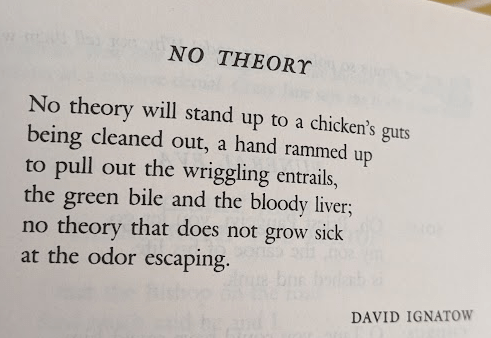
As the poem suggests, no one perspective encapsulates all of reality. No one view will stand up to a chicken’s guts.
So what do we do?
The answer, I think, is to develop a collection of useful perspectives, like tools in a toolbox. Wisdom is the capacity to find the right tool or perspective for the right situation.
As we grow older and wiser, we grow both in our number of perspectives, and in our ability to skillfully apply the right perspective to the right context. We try perspectives on for size. Some don’t work for us. Others may help us so much that we keep them on all day, every day, for years.
Yet, with every perspective, there comes a point when we’ve learned all we have to learn for the time being, and we take off the lens we’ve been wearing, ready to try on a new way of seeing the world.
Me, Us, and You
‘Cause it’s getting kind of quiet in my city head
It takes a teenage riot to get me out of bed right now–Sonic Youth, Teenage Riot
A few years back, I went to Wonder Wander, a gathering of people who I hadn’t met before. At the end of the event, we were sitting around, basking in the collective buzz of each other’s company, savoring the last few moments with one another before we disbanded.
One of the guys had a plane to catch, yet he wasn’t in a hurry. He was just sitting there, chatting, as if he had all the time in the world.
My heartrate quickened. I fidgeted in my chair. Why the hell wasn’t he getting on the road?
I realized something, in that moment: even though I was freaking out, it wasn’t my responsibility to make this guy catch his plane. If he chose to miss the plane in favor of more time with folks, then that was his choice.
It took being in an environment of strangers to see my caretaker part in action, and realize, that maybe, just maybe, I didn’t have to be that good.
As Mary Oliver beautifully writes:
You do not have to be good.
You do not have to walk on your knees
for a hundred miles through the desert repenting.
You only have to let the soft animal of your body
love what it loves.
Last night, I had a great chat with someone who had grown up as the caretaker, the “golden child.” In this role, many of the things she did were either for other people, or to maintain the image of herself as perfect. I resonated a lot with her story.
I never had much of a teenage rebellion/experimentation phase. In fourth grade, I distinctly remember wanting blue hair. But I didn’t do it. Only at age 36, did I gather up the gall to dye my hair a vivid rainbow. Better late than never!
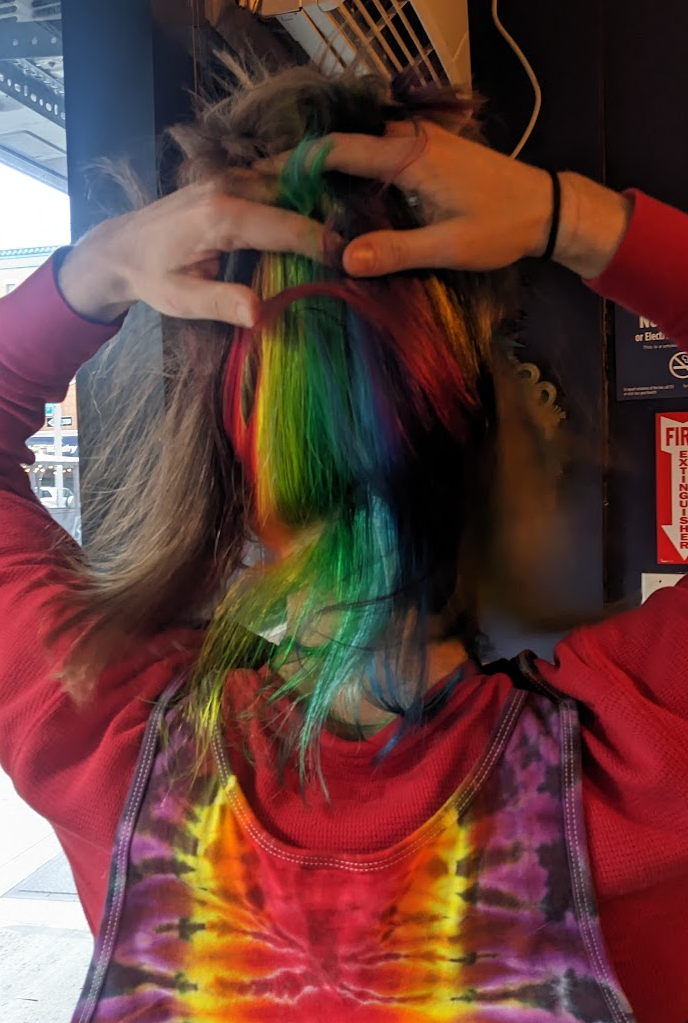
The recovering “golden child” I spoke with also had a delayed experimentation phase. During this time, she was intentionally single and traveled the world. Now she’s in a relationship. This period of doing things for only herself was good for her.
“These days, I’m very clear when I do things whether I’m doing them for me, for us, or for you,” she said.
Occasionally, I encounter a question, a lens on life that suddenly makes things a lot more clear.
“Am I doing this for me, for us, or for you?” is one such lens.
Looking back at the anxiety I felt about the guy catching his flight, I realize that my car was stuck in the YOU gear. It’s not bad to do things for others. It’s great, in fact. But it can be harmful when it’s compulsive, when it’s the only gear you know how to drive in.
A year-and-a-half ago, I took a sabbatical. During this time, I prioritized my interests above all else. Now that the sabbatical is over, I realize that the healthiest thing is to integrate sabbatical energy into my life. One way I do this is a practice called the artist date.
An artist date involves doing something alone just for the joy of it. My most recent one involved going to a cafe, reading a book, and then taking myself vintage shopping.
Periods of self-discovery, experimentation, me-focus, artist dates — these help us differentiate, know what we like.
They can look like teenage rebellion.
They can look like intentionally-single world travel.
They can look like a mid-30s sabbatical involving clowns, eco-villages, and rainbow hair.
As Grandma Tala sings in Moana: “Once you know what you like / Well there you are.”
After going on my journey of self-discovery, I realized that I don’t have to drive every dude to the airport. And if I do decide to drive the dude, then it’s good to know why I’m doing it.
Sometimes, driving the dude to the airport is for him.
Sometimes, it’s for both him and me — for us. A case of “be selfish, help others,” as the Dalai Llama puts it.
Sometimes, it’s just for me. Now, I realize that my motivation for driving him to the airport was coming from some deep conditioning. You don’t intentionally miss planes, I thought. This is a waste of money.
Yet he didn’t care. He was choosing to miss his plane. My impulse to drive him, my impulse to “help,” was really all about me. It was about relieving my anxiety about him wasting money. It wasn’t about helping him, because what he wanted — expressed through his actions — was to miss his plane and have more time to hang out.
A good life, I think, is about balancing me, us, and you. The first step to attaining this balance is a clear awareness of my true motivations. The me/us/you question is a flashlight to shine on my blind spots. I will be keeping it alive on my journey ahead.
Sometimes we live no particular way but our own
Sometimes we visit your country and live in your home
Sometimes we ride on your horses, sometimes we walk alone
Sometimes the songs that we hear are just songs of our own–Grateful Dead, Eyes of the World
Musicians are doorways into emotional worlds

Content advisory: The post below references suicide and depression. I found the interview that inspired this post to be quite depressing. Tread lightly here.
Yesterday, I found myself quite down after listening to an interview with David Berman. I first learned of Berman years ago, when I saw this beautiful eulogy video by Jeffrey Lewis. I proceeded to get deep into Berman’s music, and, though it was beautiful, man, was it heavy.
I shared about my down-feelings in a meditation group. After the group was over a guy came up to me and told me that he has the same sort of experience with certain sad music. Sad music makes him feel real and deep, and also, often, low.
Berman is probably the darkest musician I’ve ever listened to. His lyrics paint the outlines of depression in 4K HD technicolor detail.
Take this one:
Suffering jukebox in a happy town
You’re over in the corner breakin’ down
They always seem to keep you way down low
The people in this town don’t want to know
Berman’s lyrics consistently paint a picture of loss, isolation/lack of belonging, negative social comparison, shame. Even the band name — Silver Jews — points to this: a silver Jew is a Jew by patrilineal descent. Jews have been outsiders in many cultures throughout history. A silver jew is an outsider among outsiders.
This story — that Berman is an outsider among outsiders, a silver Jew — isn’t helpful. Yes, there are the gatekeepers, the people who think that patrilineally-descended Jews aren’t “real.” And there are other communities who welcome them. I’ve been through some of these same feelings with my own relationship to Judaism: I’ve let the shame and gatekeeper storylines into my head. My journey in the past few years had been to realize that if a community doesn’t want me, the world is big enough where I can find a community that will.
In the interview that got me into a dark mood, the interviewer repeatedly makes positive statements to Berman: “You must be excited for your upcoming tour,” “I really love your music.” These can’t penetrate Berman’s dark mental storyline.
In response to the excitement about the tour, Berman replies, “I have a lot of credit card debt.”
To the sentiment of admiration, Berman says, “Of course you would say that.”
Reddit and Youtube comments on Berman’s music range widely. The music makes some people feel low. It makes others feel less alone:
As someone battling with a depression that doesn’t seem to end, it saddens me that David took his life. I feel both ingrained in the melancholia and removed from it when I listen to him. Stay safe everyone.
RIP and thank you dave for giving us the words to describe what we all feel.
You’ve been an enormous inspiration and your work has helped me through several hard times.
After all this thinking about Berman, in the end, all I can confidently say is that he was an artist. He told the truth about his emotional reality with precision and eloquence. And: the reality he inhabited was very, very dark. His music describes every outline of the windowless cellar in which he lived, every centipede and cobweb. He rarely gave his listeners any ladders out.
I think if Berman himself had ladders that worked for him, he would have shared them. It’s just that nothing seemed to work. He knew about CBT. He was very self-aware. For whatever reason, the dark coating on his glasses was stuck on very stubbornly.
Berman says his favorite song on his last album is “Darkness and cold,” which has these lyrics:
Darkness and cold, darkness and cold
Rolled in through the holes in the stories I told
Conditions I’m wishing weren’t taking control
Darkness and cold, darkness and cold
Berman’s music pairs well with this TED talk by Andrew Solomon, who also suffers from treatment-resistant depression. The music gives me a visceral feeling of what its like to have depression: a feeling that no matter what you do, the darkness and cold rolls in through the psychological defenses. I’m lucky to never have had depression set in for very long in my life. My “psychological immune system” seems to be fairly robust. Berman’s music gives me empathy for people who chronically swim in very rough mental waters.
On the clown trip I took a year and a half ago, one of the questions Patch Adams’ wife asked us was: “How can I make my mind my friend?”
Tragically, David Berman did not find a satisfactory answer to this question in his life. No matter how much external love or therapy he got, it didn’t help. David Berman’s last album comes from this place of a mind that was not a friend.
His music resonates with a lot of people, because they’ve been there, too.
In another interview, Jeffrey Lewis talks about how he loves music that integrates both optimism and sadness. I love bands like the Grateful Dead and The Flaming Lips for these reasons (the top-right corner in my graph above).
Take these lyrics:
All those birds go chasin’ some better sunny days
You can’t hear them singing ’cause they’ve all gone awayBut this one bird didn’t leave you
It stayed through the wintertime
You can’t hear it sing but you can hear it as it fliesSo don’t you believe them
They’ll destroy you with their lies
They only see the obvious
They see the sun go down but they don’t see it rise–Flaming Lips, My Cosmic Autumn Rebellion
This song helped me through a dark time, when I didn’t see much hope for the future in my life, when I was in a prison of shame. This song became like a mantra to me. I played it on repeat and would sing along to it. This song helped me see there was always a small bird of hope, even in the bleakest situation.
Or take this song:
Mother I’ve taken LSD
I thought it would set me free
But now I think it’s changed me
It’s changed me
It’s changed me
It’s changed meNow I see the sadness in the world
I’m sorry I didn’t see it before–Flaming Lips, Mother I’ve Taken LSD
This song helped me see the beauty in the sadness of life. A similar sentiment is found in this song:
Stop the car, lay on the grass
The planets spin and we watch space passWalk a direction, see where we get
I never knew nothing, so there’s nothing to forget
Get real drunk and ride our bikes
There’s so much beauty, it could make you cry–Modest Mouse, So much beauty in dirt
Another way to see the beauty in sadness is by seeing the beauty of empathy itself, the beauty of deeply listening:
Old man down
Way down, down, down by the docks of the city
Blind and dirty
Asked me for a dime, a dime for a cup of coffee
I got no dime but I got some time to hear his story
My name is August West, and I love my Pearly Baker best more than my wine
More than my wine
More than my maker, though he’s no friend of mineEveryone said
I’d come to no good, I knew I would Pearly, believe them
Half of my life
I spent doin’ time for some other fucker’s crime
The other half found me stumbling ’round drunk on Burgundy wineBut I’ll get back on my feet again someday
The good Lord willin’
If He says I may
I know that the life I’m livin’s no good
I’ll get a new start, live the life I should–Grateful Dead, Wharf Rat
Empathy is worth more than “a dime for a cup of coffee.”
Objectively, the old man is in a worse situation than Berman. Yet he believes he can make a change, and this makes all the difference.
As my great-uncle Chaim used to say: “If you lose money, you’ve lost nothing. If you’ve lost hope, you’ve lost everything.”

In sum, I believe that music and musicians are doorways to emotional worlds. Music can help us feel more deeply. It enriches life. That’s the sentiment behind the Nietzsche quote in the picture above.
And also, if we’re not careful, music, and art in general, can imprison us in someone else’s dark emotional world.
Diversify your music and art consumption. Be aware of how it makes you feel. Don’t be afraid of the darkness, but be aware that, as Nietzche said: “If you gaze for long into an abyss, the abyss gazes also into you.”
Yes, these are notes to self.
Circles of care: an antidote to toxic productivity
I have this tendency to judge myself harshly for “not doing enough.”
So far today — and it’s only noon — I’ve made coffee, breakfast, washed dishes, deep cleaned the counters and bathroom, drafted a document, walked the dog. And still, there’s that voice in my head that says: YOU’RE NOT DOING ENOUGH!
Well, Mr. Voice, thank you for your contribution, but I don’t need to believe you. I have this journal that asks the question: what are 3 things you want to get done today that will make you feel accomplished?
I like this question because it helps me set reasonable expectations for what I can get done in a single day. I can write down the things I’ve accomplished. When I hit 3, then it’s time to kick it.
Also, I recently discovered a practice called “Circles of Care” that goes through multiple areas of life: body, home, work, help, relationships.
Mr. Voice doesn’t give me “credit” for cleaning, for taking a nap, for nourishing my body with healthy food, or for nourishing my relationships with quality time. This practice is an antidote to the voice.
Yesterday, I didn’t sleep well, so I didn’t give myself any pressure to get things done from my to-do list. But I did bring the dog and cat to the vet, co-listen to a history podcast with my partner, help cook a delicious dinner, have tea over zoom with good friends, dealt with a stressful work situation, and did my work responsibilities. Mr. Voice would say I got nothing done. Now I see that this is very narrow perspective. Yes, I got nothing done from my to-do list. But I got a lot of things done from other “circles of care.”
Self-talk to soothe fear and shame
All the world is a very narrow bridge / the important thing is not to make oneself afraid.
Some small examples of recent loss in my life:
- The dog chewed through his nice periwinkle-colored leash.
- I lost my custom-made clown nose that looks like planet earth.
- I got a call from my boss about a problem at work.
- I sent an email to a group and forgot to BCC the addresses, thereby “leaking” people’s emails
In each case, there’s some grief — in the first two cases, purely for the material items I enjoyed. In the last two cases, for my internal identity as a “perfect” person beyond reproach or mistakes.
In the third case, I felt fear, catastrophizing. “What if I get fired? What if I never work again?” I came across this antidote to catastrophizing: think of best, middle, and worst case scenarios. Best case: nothing changes. Middle: there’s some training modules I have to do. Worst: I cause a major issue at work that hurts lots of people. I get fired and never work again in my field.
In every case, there’s a possible upside:
- Thanks to our dog chewing through his periwinkle dog leash, we got an even better one.
- While I don’t yet have a replacement clown nose, perhaps losing the earth nose will lead to placing an order for multiple earth noses, so that the Clown of Interbeing will have friends!
- I could learn something from training modules. I could develop a new identity if I don’t work in my field anymore.
- I could learn to pause before I send group emails in the future, and return to them later for proofreading
The important thing is to not make myself afraid. To not “fear-ify” myself. Yes, I’ve lost my identity as a “perfect” person, but this identity was bound to be lost. Real humans working in the real world make mistakes.
The important thing is to not make myself afraid.
I went to a meditation group last night where the theme was “taking up space.” I realized that a big root of my fear and shame in response to both taking up space, and to mistakes is a desire to be liked by everybody.
If fear and shame come up, I can say to the scared part of myself: “You are suffering. You are afraid. You think that people might hate you, exclude you. I see this. But people love you and the people who matter won’t cut their ties with you over small things. May you be happy and peaceful. May you water the wholesome seeds in your mind.”
My friend Alex gave me these mantras for dealing with feelings of fear and shame:
- “We all make this or similar mistake, it’s ok.”
- “The outcome is not as important as I’m making it out to be, it’s ok.”
- “I will be able to overcome the outcome, it’s ok.”
I’ll be trying out these ways of talking to myself in the coming months and years, when I’m sure I’ll make plenty of bloops, blops, and blunders.
Expand your borders
What happens when you see
That the water in the tea
You are drinking
Was once a cloud
What happens when you see
The soil that
Your urine flows into
Will feed a tree?
What happens
When you see yourself
From far away?

Are you a body with clear borders?
Or a community of cells working together
With the same DNA
But different programs switched on and off
Or are you molecules, atoms, or empty space mostly?
Or are you the system
Of cloud, tea shrub, body, soil and tree?

When you see
All the things
That go into
And out of you
Then you can
Expand your borders
And relax
What “being an adult” means to me
When I was a kid, I dreaded “becoming an adult.” I saw the adults around me as conformist and boring, and I vowed to myself that I’d never become one of them. In college, I had a sense of dread that the process of “adultification” was happening to many of my peers. I didn’t want to be adultified.
In high school, I loved engaging in silly antics with my peers. During my freshman year of college, I was suddenly surrounded by people who were serious. They read newspapers with coffee over their dorm breakfasts. Adultification is happening too fast! I thought.
Yet, now that I’m 38, I see that my 18-year-old view of being “an adult” was quite limited. At 18, I thought that being an adult meant:
- being boring, stale, conformist, unimaginative, uncreative
- having a house in the suburbs
- caring about material things like fancy cars, making lots of money, and prestige/power
- doing “adult things” like reading the newspaper every morning, tucking in your shirt, working in an office
Over the past 20 years, I’ve updated my view of what “being an adult” means. I now think that being an adult has nothing to do with conformity or boringness. I know plenty of creative, non-conformist adults. Rather than having to do with external behaviors, like reading the newspaper or drinking coffee, I currently see “being an adult” as a trifecta of internal qualities:
- responsibility
- accountability and integrity
- vision and action
Let me explain each of these…
Responsibility
Everything can be taken from a man but one thing: the last of the human freedoms—to choose one’s attitude in any given set of circumstances, to choose one’s own way.
— Viktor Frankl, Man’s Search for Meaning
My definition of responsibility is the ability to learn from the choices I’ve made in the past, in order to make better choices in the future.
I currently have a sunburn. This was because yesterday, I talked with my friend on the phone for an hour without a shirt, in the mid-day sun.
I can look back upon yesterday and see the choices I made: I chose to text my friend and tell her I was available to talk. When she called, I chose to pick up the phone. I chose to walk outside and have the conversation with her while shirtless. I chose to talk for a long time. I chose not to keep sunscreen around.
The opposite of taking responsibility is the victim mindset. While in this mindset, I’m blind to the choices I made that contributed to my sunburn. In the victim mindset, I’d see that my friend called me during the mid-day sun and that I did my best to stay in the shade during the phone conversation but got burned nonetheless. Paying attention to only these things puts my attention outside the choices that I made that contributed to my problem of sunburn.
The victim mindset can feel good for my ego because I can continue thinking that I’m 100% good. I can avoid seeing that I made choices that contributed to my problem. I can blame the sun for burning me, or my friend for luring me outside for a long phone call, and continue to think that it’s all the sun’s / my friend’s fault.
Yet the victim mindset also saps me of the power to learn, to make changes, and to get different outcomes in the future. If I blamed the sun and my friend, then I wouldn’t see that change was as simple as saying to my friend: “Can I call you back?” Then going outside finding a reliably shady place from which to converse.
The past year, I’ve done a set of journal prompts a number of times to help me take more responsibility in my life. These are:
- Describe your problem
- What are the choices you made (thoughts, behaviors) that have contributed to this problem?
- Do you want to make different choices in the future?
- Which new problems will arise from these new choices? Are these better / more meaningful problems?
- What have I learned from this problem?
Source: The subtle art of not giving a f*ck journal.
Accountability and Integrity
For me, accountability and integrity are all about agreements. Accountability means keeping agreements with others. Integrity means keeping agreements with myself.
For example, the past several weeks, I’ve been working on being on-time to work. I have an agreement with my men’s group that if I’m late to work by more than 5 minutes, I’ll text the group. I am in a relative position of power at work, and have been able to “get away” with being somewhat late on a consistent basis. But being late is not a good practice. As an employee, there is an unspoken agreement of punctuality, and I don’t want to be out of accountability with this just because I can “get away with it.” So I’m proactively working on changing.
Integrity is a lot harder to keep, because there may not be external repercussions for breaking with integrity. In fact, the world may reward your for doing so. For example, I might have an internal value of being healthy, and if I get sunburn, I’m out of integrity. But as an adult, there will be no outside person who is mad at me if I get a sunburn.
Or let’s say that I think it’s more ethical to be a vegan or vegetarian. The world, by and large, won’t care whether I eat meat or not. In many cases, the only person who will care about the choice of my diet is myself.
I think that the poem The Guy in the Glass is about integrity. Other people may (or may not) let us know when we’re out of accountability. Our soul will let us know when we’re out of integrity.
Vision and action
Another crucial part of being an adult is having a vision, and taking action towards that vision. When I was in college, undecided on my direction in life, I wrote this poem:
Ode to the Unambitious
       The arrow of your life is not locked, yet
       Thoughts within your mind still freely swim
       The key to make you speed has not been turned, yet
       You look up at the tall plants as a seed
       You have not been pressure-packed and shipped, yet
       There is no single place you want to be
       Wishes that stream out from you have not been capped, yet
       There is no need for practicality
       You stand above the helpless souls
       Who kick their way to some small goal
       My friend, you watch the arrow sway
       And delight at the directions
While the undifferentiated state is beautiful, it’s also not healthy to stay there your whole life. Being an adult means picking a vision, and taking action to make that vision a reality.
There’s a show called “Crazy Ex-Girlfriend” which features a character called Heather who is a perpetual student. She intentionally doesn’t finish her undergraduate degrees because if she did, she’d have to become a defined thing.
In the poem above, I called this being “pressure packed and shipped.” There’s a certain pain to this cutting-off of possibilities. By becoming one thing, you don’t become a million other potential things.
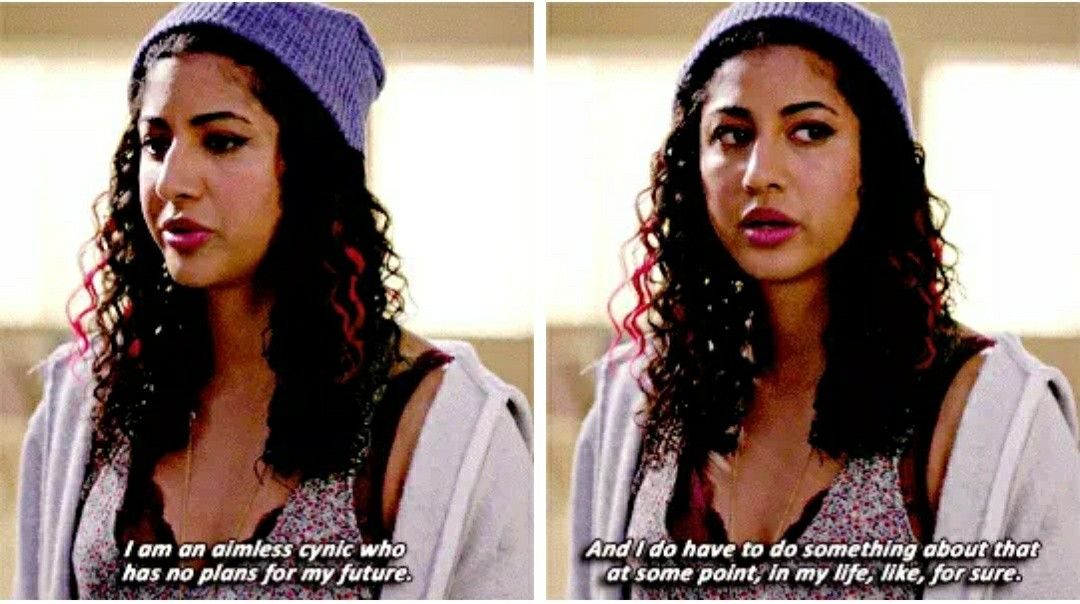
In a phone conversation yesterday, my brother expressed to me the desire to me to have an orchard. I was excited to hear about his vision. Yet vision is just the first step. The next step is taking action. This could mean volunteering on an orchard, or planting a tree, or looking at land, or something else.
I volunteer on a farm with someone who is planning to establish an avocado orchard on the Big Island of Hawaii. She’s been living the farm lifestyle for years and now she’s at the point of looking at land. She’s got both vision and action.
Vision without action is stagnation. By analogy, think of being lost in the woods. To find your way home, you need to have a vision of where home is. But the vision alone is not enough. To get home, you need to actually walk.
Vision is a useful thing, because it gives us the direction in which to take our next step. It’s often good for our vision to be somewhat flexible because the place we end up is often quite different from our initial mental picture.
As with all posts on this blog, I’ve composed it mainly as a reminder to myself and to clarify my thinking. “Being an adult” is not something that just happens with age. Rather, it’s a conscious choice to pursue certain values. And “being an adult” is not a binary state, but rather a matter of degree. I can be more or less adult, in various moments of my life. I’m striving, these days, to be more of an adult.
I never thought I’d say that.
P.S. I was reflecting, with a friend, on what “being a kid” means to me, in the good sense. I think that for me it means keeping wonder and play alive. We can be adults and still wonder and play, though this by no means easy to do for me. Bob Dylan sang, “The man in me will hide sometimes to keep from being seen, but that’s just because he doesn’t want to turn into some machine.” A better lyric would be: “The child in me…”
This question, of how to be an adult while keeping wonder and play alive, is one that I’m keeping at the forefront of my mind. It’s the reason I started The Wonder Project, and why I clown.
Pacifiers and local maximums

During the COVID pandemic, I got addicted to Zoom meetings. I like both learning and social connection, and zoom meetings met both of these needs. I enjoyed the new people energy of these meetings. My novelty neurons were stimulated. Most weeknights, I’d be on a zoom meeting. Some nights, I had two.
But, when the meeting was over and those squares-containing-faces disappeared, I’d be left sitting alone in my room.
After about a year like this, I canceled my membership to an online community where I’d probably spent hundreds of hours. This felt like a break-up. It wasn’t fun. Yet, after I did this, I had much more space in my life to seek in-person community.
Zooms meetings kept me pacified, but not truly fulfilled. In order to get to a higher peak, I had to “face the blank page” of the unknown. For a time, this made me less happy (the downward sloped arrow in the doodle above). I felt fear.
Yet this white space was also an opportunity, a gift. I could use this space to build in-person community.
Only now, after some time away from zoom life, do I see that my zoom addiction was a local maximum. When I was in it, I didn’t have that insight. That’s what made it hard to change.
This post is a reminder for myself: the blank page is an opportunity. On the other side of uncertainty waits a more fulfilling thing.
The Philosophy of YES
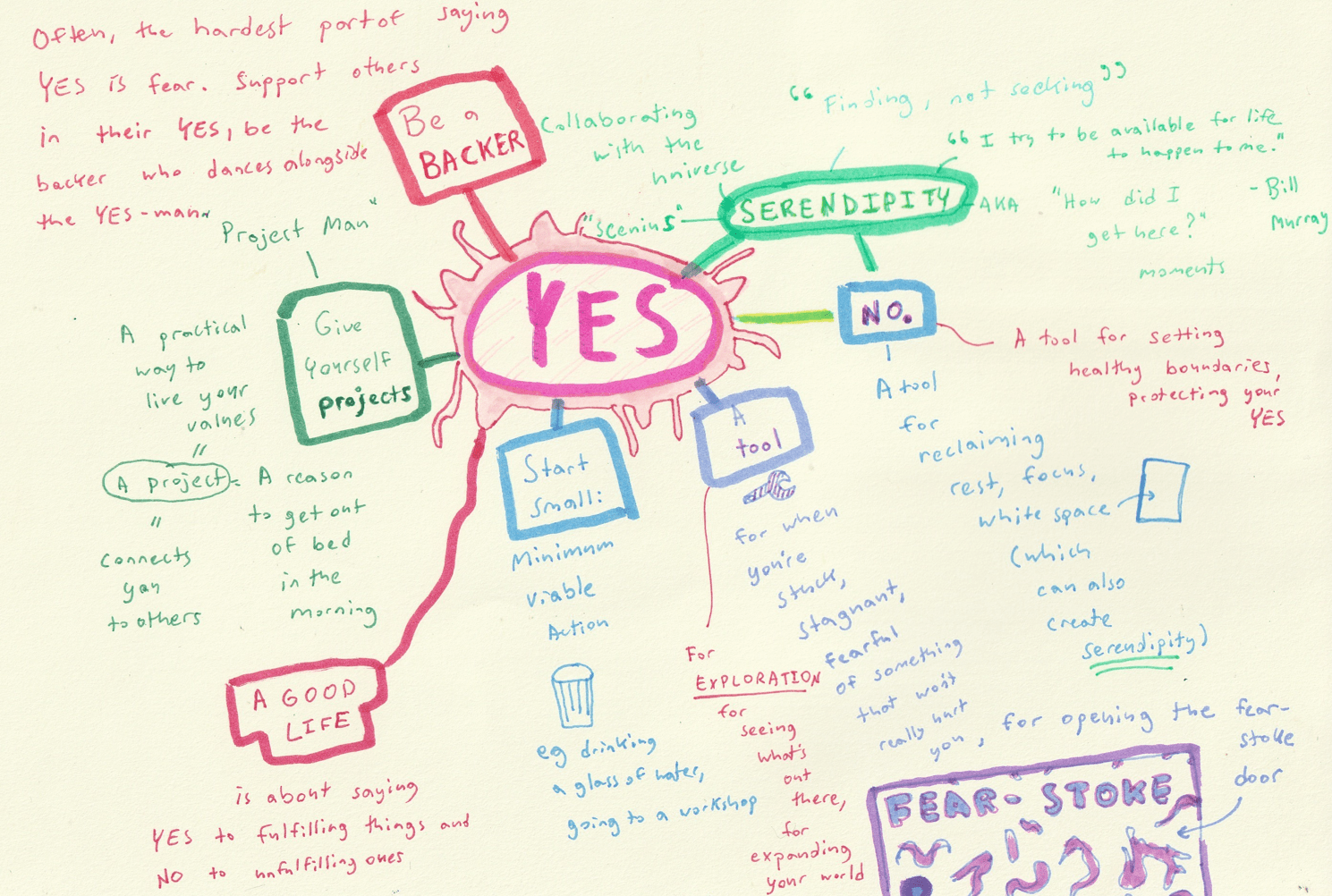
A year ago, I dressed up as The Clown of Interbeing and went to the Festival of Yes, a magical 2-day gathering in the woods of the Pacific Northwest.
Not going to the Festival this year was a difficult decision for me. So, I was super-excited to get in my inbox this conversation of my friends Ethan and Alex riffing on the subject of Yes Philosophy. I took notes!
The mind-map above is a lot to look at. To keep it simple, I’ll boil the “Yes Philosophy” down into three core values:
- Agency
- Action
- Generosity
Let me give a concrete example of how I used the YES philosophy today.
Today was a rough day. Work was super busy and cognitively demanding. By the end of the day, I felt drained and angry. I found myself snapping at everything that moved.
In the interview, Alex talks about his practice of choosing every morning to drink a glass of water. This ritual isn’t about the water, but about agency. By choosing to do this every morning, Alex is effectively telling himself: “I have lots of choices in my life.” We all have lots of choices. We can choose to say Yes or No to lots of things, every single day. Embodying the Yes philosophy doesn’t have to look like booking a trip to Antarctica. It can look like saying Yes to a glass of water or making your bed or going to a workshop.
So I decided to exercise agency this evening: I decided to go for a run. I decided to move. To get out of my funk. I would take action. I strapped on my shoes and walked out the front door!
But, after 10 minutes, I realized that I didn’t have it in me to run. I said No to running, and Yes to walking. This was me utilizing agency again, my freedom of choice.
The Yes philosophy is not about rigidly saying Yes. It’s about saying Yes to values that I want and adjusting course as needed. My key value in getting out of the house was to recharge my batteries. And walking felt more restful than running.
After walking for a while, I lay down on the grass and looked at the sky, read an old blog post of mine on my phone. Then I walked towards a plaza.
In the plaza I discovered a specialty shop that sold knives, weapons, and sexy lingerie.
Then I saw it. My destination. The holy grail:
Baskin Robbins.
I got myself an ice cream cone:
“In life, you never know what you’re gonna get,” says Alex in the interview. The Yes philosophy can lead to success or failure. Today, it lead to ice cream. Which was exactly what I needed.
This is where the story of my whimsical YES walk ends. But there is one missing value I didn’t touch on: generosity.
We all are on our journeys of growth in this life. Being a backer means supporting others in taking risks, in pushing through fear to do things that make them come alive. Being a backer could mean giving someone encouraging words, money, a high five, or anything else.
I went to a fancy event dressed as a clown the other day, and was quite fearful. What would people think of the weirdo dressed as a clown at the gala dinner with a business-attire dress code?
At the very start of the evening, a guy asked to take a picture with me in the photo booth. He wore my spare clown nose and put on my hat. He was a true backer, a generous soul.
The Yes philosophy is about WE as much as it’s about ME. By being a backer, this guy helped me walk through the fear-stoke door. For the rest of that night, I had a blast. I danced freely. I connected with tons of people on an authentic level through clowning. But it all started with that guy who gave me that first signal of support.
Agency, action, and generosity. Three simple values that form the Philosophy of YES.
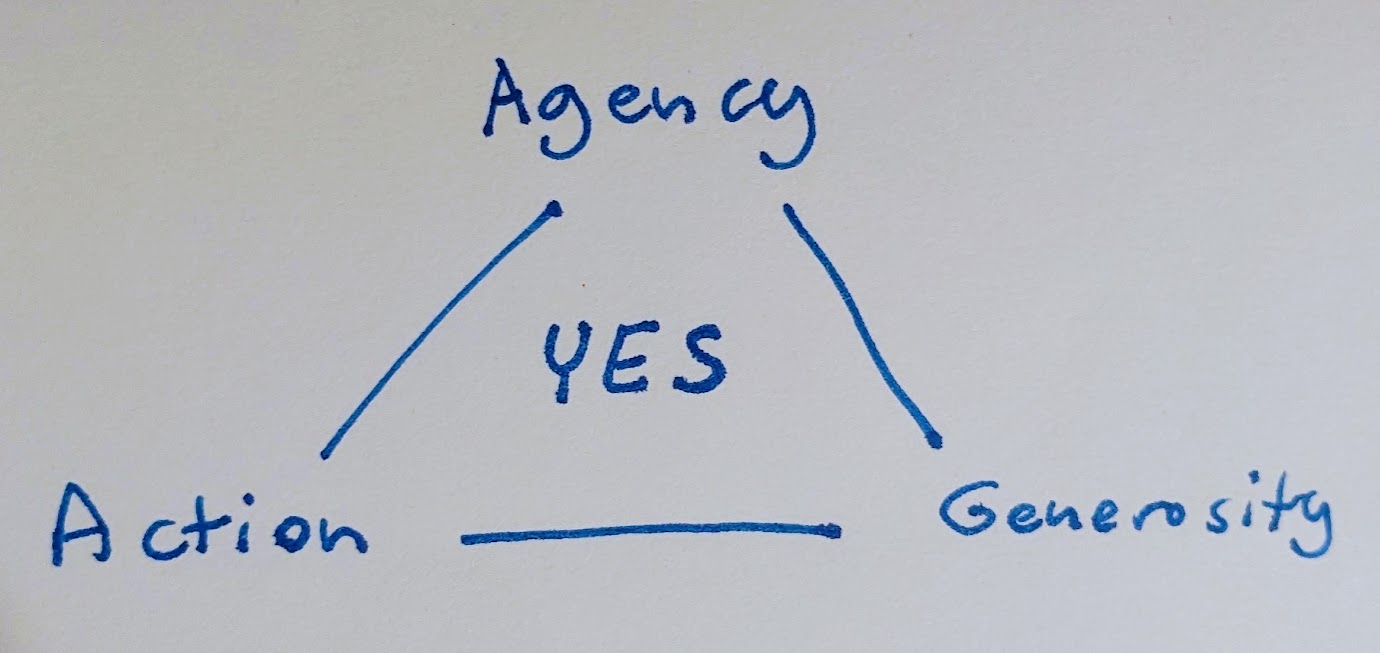
Walking skills
[a poem for myself on my 38th lap around the sun]

A blind scarlet macaw
Helped me celebrate
My 38th revolution
Around the sun

The macaw and I danced
To a live band
Outside a rock climbing gym
As I came down from a buzz
That I'd gotten during my birthday dinner
With my future wife
At a very fancy restaurant

There, elixirs were concocted
With fire and smoke
In the dim candlelight
Scents of rosemary and garlic
Steak, butter
Cherry, and gin
Swirled in my consciousness

It was all
Even more fun
Because of two things

First,
I had come to
This dress-code
Reservation-only
Spot
Dressed as a clown
Red nose and all

Second,
The restaurant
Was a bit of a secret:
Only accessible
Through an unmarked door
At the back
Of a nondescript
Sports bar

***

I've spent many birthdays
Longing
For belonging

On my ninth birthday, I hid under my parents bed crying
Feeling small and sorry for myself
For not having enough: friends, appreciation
For not being enough

I celebrated my 20th birthday
Alone, getting drunk in a tree
On a remote island
Thinking about
How I would die
And not really being
Into this idea

Growing up,
Bullies told me
I was bad

I believed them
And I spent
Days and years
Prettying myself
For them

Even after
They'd left me alone
I kept on working to please
The bullies I constructed
In my own mind

For years I knocked on doors
That wouldn't open
Petitioned clubs
That wouldn't take me
As opposed
To wandering this vast world
And finding
The many clubs that would

I didn't believe
That such clubs
Existed

***

The world
Is full of universes
To discover
And to create

Every person
Is a universe too:
Our waitress
In the secret restaurant
The man at the gas station
My future wife
Alike

My work
Is learning to see the world
And its people
Like that sports bar:
Seemingly mundane
But with a room
Of magic
Waiting to be discovered

And not as the bar
Where everyone is having fun but me

***

A text
Invites me
To a gathering of men
Another
To a club around creativity
Another
To a trip to Ecuador
Another
To a music festival
I say no to all of these
To preserve my bandwidth
Though my instinct
Is to say yes
Because I was without such opportunities
For so very long

Learning to look for beauty
To create it
To trust
That my people
Will find me
And also, to say no
These are skills
I'm building
This next year

I'll need these skills
To walk the trail
From the place of self-pity:
Under the bed or
Up in a tree or
On my computer
Petitioning the cool kids
For invitations
That are
Not forthcoming

I need these skills
To build a life
Of connection
And creativity
And wonder

I need these walking skills
AI statement
Nothing on this website is written by AI. I write to clarify my thinking and to sing in my own voice. If I used AI, there’d be no point to be writing, for me.
 danscreativeoulet