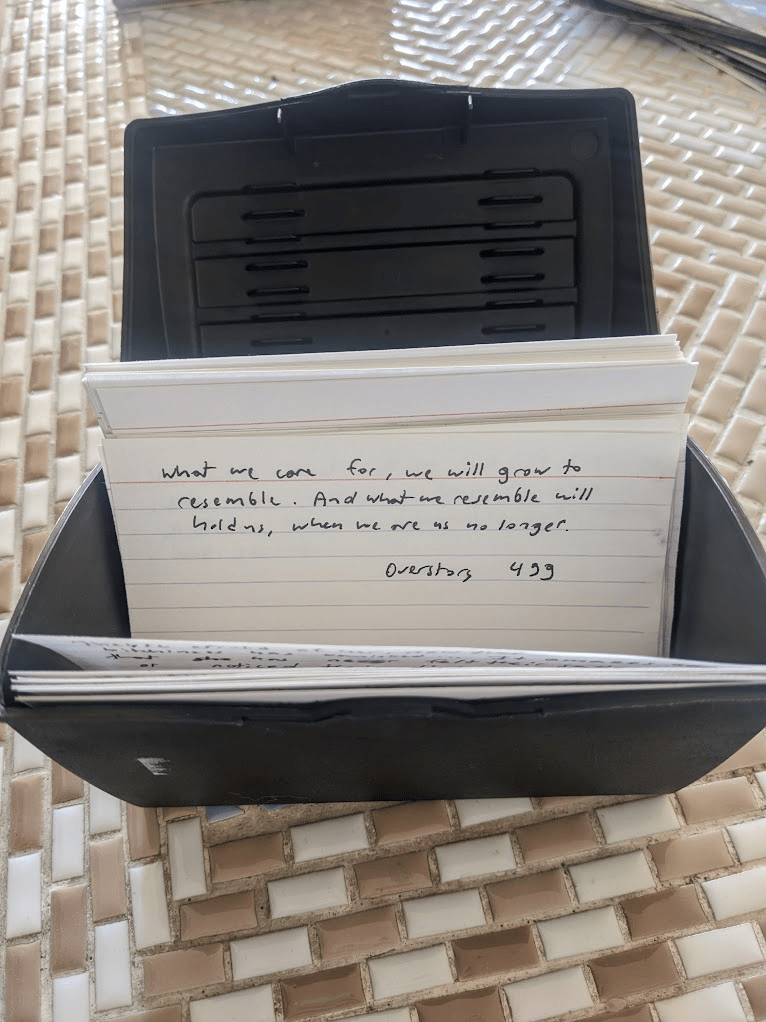
Index cards of my insights from books, movies, anything
I’m such a slow reader. Take Emerson’s essay on self reliance. That essay, which is about 20 pages long, took me about two years to read. Because each paragraph I’m like: “Whoa! I got to take that and see if I can apply that in life. See what the reverb of life is back to me if I’m looking through that lens. Which takes me a couple of months before I can read the next paragraph.”
I have this idea kicking around in my head that “I don’t read enough.”
This idea comes up when I hear about “big readers,” like this one who read 187 books in a year.
I think back to myself in 3rd grade. I read 40 books that year. School was painful, and I retreated into the world of books. I’ve never read as many books in any year since. Not even close.
It’s true that I really would like to read more.
But there’s another, more important truth: I don’t integrate enough.
I want my reading to make my life richer. If I consume, consume, consume, but don’t integrate, then I’m a hungry ghost, using the short-term dopamine hit of “learning something” to feel good for a moment.
“Intellectual stimulation” is an apt phrase. There is a short-lived pleasure that comes from noshing on a new idea. But true nourishment comes from digestion.
I want my reading to change me, to seep into my soul, to become part of who I am. That’s an alchemical process, and it happens slowly.
Take the quote on the index card above. I can read it a thousand times and still not be done with it.
Let me return to it, again:
What we care for, we grow to resemble. And what we resemble will hold us, when we are us no longer.
I see this as a quote about values, and how values are really the only thing that lasts.
When I first read The Overstory, I highlighted this quote. Then I wrote it in a letter to a friend. Then I wrote it on an index card for myself. Now I’m writing about it here.
By returning to the quote, again and again, I’m increasing the chance it will color my world.
I love what McConoughey did with Self Reliance. Sipping on an essay for two years…that’s something. It’s a counter-cultural act in a culture that loves to celebrate hitting metrics.
The integration isn’t easily summarized in a pithy metric. Getting a more positive “reverb of life” is a feeling, an alchemy, a transformation.
Put another way, words are fingers, integration is the moon.
I had a therapist who said that she distrusts anything that promises “quick results.” At the time, I was contemplating taking a 6-week, $6,000 self-development course.
I didn’t end up taking the course. I’m now working with meditation teachers who talk about “slow spirituality” as an analogy to the slow food movement. I do a weekly meditation, listen to a weekly dharma talk. There isn’t a promise of quick results.
An image comes to me: carving wood. Whittling. Sanding. Working slowly, and eventually creating something beautiful.
Here’s to slowing down the ingestion of ideas, which are so plentiful these days. And here’s to spending more time playing with them in our lives.
It’s a well-worn cliché that two basic energies motivate all behaviors: love and fear.
Ram Dass had a different lens on the dichotomy. He thought the two basic energies were love and power.
I would like to add my take on the matter. I think the two basic energy sources are fear and stoke.
“I should clean my apartment” is a fear that if I don’t clean, my apartment will be overrun by cockroaches.
“I should order these lab tests” is a fear that if I don’t, something bad will happen to my patient.
On the other hand:
“I want to clean” is based on stoke, excitement about having a clean place.
“I want to order the lab tests” is based on stoke for getting my patient better.
I think of fear like fossil fuel energy. It’ll get you from point A to point B, but in the long-run, the planet, and the human, will burn out.
I think of stoke like green energy: it’s sustainable. A person running on stoke is able to keep going, and won’t burn out, because the enthusiasm is self-generated.
My mom recently told me about her friend’s daughter who refused to do something because “she doesn’t want to be doing things out of guilt.” This is wisdom. In the short-run, succumbing to guilt-based action allows one to avoid feeling guilty. But in the long-run, the person is left doing things powered by guilt (a form of fear), and not by stoke.
Abraham Maslow called fear the deficiency realm. The buddha called it habit energy. Whatever you call it, it’s a mode of consciousness that likely evolved for our survival. The alarm bells are ringing, the boat has a leak, and you are frantically trying to plug it before it sinks.
Maslow called stoke the “being realm.” The buddha called it freedom or true nature. In this mode of consciousness, we are generous and operate from our love, our interest, our stoke.
I pray that we can all change our life energy source, as much as possible, to stoke.
I’ll begin by talking about the philosophy of birdfeeders. My partner recently bought one, and now, every morning starts with a procession of cardinals, blue jays, sparrows, morning doves…
The birdfeeder puts my attention on the birds — the nature that exists around us — even though we live in the “concrete jungle” of New York City.
I’m going to coin a phrase: attention machine. Instead of defining it, let me give some examples:
A practice, like going to my local mycology group meetup and learning to see the mushrooms that have been hiding in plain sight, in the local park.
A phrase, like “concrete jungle.” If I look at New York City through this lens, then I’ll tune in more to the concrete, the stench of the summer garbage, the traffic…
An attention machine can also be a person, a place, a prayer, a poem, a profession, a pet. Anything, really…
Dynein and Kinesin
It strikes me that life is a miracle.
A patient of mine has progressive neurological symptoms that have left her disabled at a young age. After much testing, we diagnosed her with a defect in dynein, one of the proteins that’s responsible for moving cargo in the nerve cell. Here’s an animation of dynein walking, transporting cargo down the long length of an axon (sometimes more than 3 feet!):
For more info on dynein and kinesin, check out this cute video
We humans might tell different religiousmyths, wear different religious hats, have different skin colors, have different proportions in our faces and bodies, but we all rely on dynein (and it’s cousin kinesin) to move stuff around our cells. If we didn’t have these proteins, then our nerves wouldn’t work. Ditto for all other animals.
The spirituality of molecular biology!
All animals are alive thanks to the miracle of dynein and kinesin.
I want to start a very specific and strange gratitude practice:
For the next 30 days, before I get out of bed and use my legs, I will trace my fingertip from my lower back to the tips of my toes and say, “Thank you, kinesin.” Then I’ll trace back up my legs and say, “Thank you, dynein.”
I’ll report back on how this goes, in the comments!
Some of my Attention Machines
I met a guy the other day who was wearing a bunch of rubber bands on his wrists.
“What do they mean?” I asked.
“That’s always changing,” he said.
For him, these bracelets are attention machines, and he’s constantly cycling through new meanings for them, depending on what he needs in his life. And this guy is in his 70s!
Here are some of my current attention machines:
Complaining bracelet. I’m wearing a bracelet that represents not complaining. Every time I complain, I change the bracelet to my other wrist. The bracelet also is made of beautiful stones, and reminds me of the beauty of nature.
The artist date. The past few months I’ve been going through a book called “The Artist’s Way” with a friend. One of the exercises that the book gives is to have a weekly “Artist date.” The purpose is to restock the creative pond with fish, so to speak. Lately I’ve been thinking of my morning drives to work as artist dates. My attention is being tuned to look for opportunities for artist dates in daily life: maybe a walk in the woods by myself is an artist state? Maybe my evening run is one too? Maybe chopping vegetables is not a chore, but a mini-artist date? Changing how I think about the things really does make a load of difference.
Birthday poems. My mom has been writing my brother and I birthday poems ever since we were little, and lately I’ve gotten into this too. This is a great attention machine. Doing a creative project for somebody every birthday takes a lot of effort, but you get out when you put in.
Here’s an attention machine that I haven’t integrated, but would like to:
Saying “good morning.” I frequently get called out for not saying “good morning” at work. I show up to work and just get right into business. I’m in my own world. “Good morning” or “good afternoon” gets us to pause. It gets us to realize that we are on the planet and there is a particular position of the sun in the sky. “Good morning” is an attention machine I could use a bit more of in my life.
Attention Engineering
The coolest thing about attention machines is that we have the power to engineer them.
In the words of the punk band Crass:
If the programme’s not the one you want, get up, turn off the set It’s only you that can decide what life you’re gonna get
I would update this lyric to be: if the attention machine is not the one you want, engineer a new one.
Here’s an example of this attention engineering, from my own life:
I recently noticed, chatting with a friend, that we had great word-play chemistry. We set up a commitment to do a periodic phone call where we just play with words. I think there isn’t enough play in my life. It feels nice and fun and free to have this phone call exist as an attention machine for the purpose of play.
Here’s a homework assignment: do an inventory of the attention machines in your life, as I did above. Some of them might not be serving you. Some of them might be serving you very well. Don’t underestimate their power.
The objects in our lives can seem unimportant: a coffee maker, a wrist watch, a bird feeder…who cares?
Well, the things we include in our lives have ripple effects, even the small ones.
A coffee maker in the kitchen makes it more likely I’ll drink coffee.
I could replace the coffee maker with a teapot. Or a bong. Or an aquarium.
It’s not the most practical to have a kitchen aquarium, but it would definitely change where my attention goes…
I recently replaced a wonky shoe rack with a functioning one. Now I no longer shout expletives every morning because my shoes have fallen into the crevasse behind the rack. Replacing the shoe rack was a small act of attention engineering.
Holy moly, life is our canvas on which to paint. Attention, oh attention, shine, oh you shine. If matter is made of atoms, then consciousness is made of attention, and attention is sculpted by attention machines.
I pray that we can all use our attention well, in this life.
Shine
Oh, you shine

Onto trees and rivers
Birds and bears

Mind, oh mind
Don't you believe
All
The dancing men
Up there on the stage
For some are charlatans
But some speak truth

Question mark
Oh, question mark
You are the one
Who moves the spotlight
To and fro
Wince to wither
Earth to moon

I was brought up
Thinking that
"How do we get to the moon?"
Was a perfectly good question

Until I heard a man from Harlem say:

"What's up there on the Moon? Nothing
Going there is groovy
For certain people
But not the black man in America"

"How can we make life on earth better?"
Seems like a better question,
Now

Attention, oh attention
Shine
Oh, you shine

Will you light up
Our delusions
Or our truths?

Attention, oh attention
I move you
And you
Move me

I pray to you,
I love you,
So much


/WilliamBloxham_8592_FinalProject/content/InnerLifeCellGif.gif)
 danscreativeoulet