
If an activity helps you satisfy three or more of your most important values, you’ll keep doing it.
Danielle Williams
Yesterday, at the rock-climbing gym, I scanned my card and locked eyes with the front-desk guy. He looked at my red rubber nose and bright patchwork vest and said, “I gotta ask you…”
He paused, because we both knew where he was going. He said it anyways:
“…Why the nose?”
“I’m going…Rock Clowning!” I said.
We both smiled, and then I walked past him, into the gym. Yet this was a cop-out answer, like answering “Fine” to “How are you doing?”
At other times, I’ve answered the “Why the nose?” question with other cop-outs like “I have an allergic reaction” or “I lost a bet.” Even when my mom asked me, “What attracts you to being a clown?” I haven’t given a full answer.
I’ve been pondering clowning ever since March, when a spark of interest led me to sign up for a trip to Mexico City on a “humanitarian clowning” trip with Patch Adams. Afterwards, I brought clowning back home with me.
Since then, I’ve clowned almost every day. I have my red rubber nose hanging on the doorknob of my front door, to remind me to wear it when I go out. I often keep it hanging around my neck, like a necklace, ready to put it on when the moment strikes.
In parallel, while I’ve been clowning out in the world, I’ve been working on a mind-map of sorts, attempting to capture what clowning means to me.
My reason for clowning comes down to three values: play, connection, and courage. Each of these has nuances, additional layers of richness. And each value shares the quality of agency. By donning the red nose, I am choosing to bring play, connection, and courage, into an otherwise mundane moment.
Really, every moment of being alive is special, magical, un-repeatable. All time is precious time. Everything is sacred. “Mundane” and “boring” are illusions of my mind. Clowning is a way to cut through these illusions, and bring me, and hopefully others, back to life.
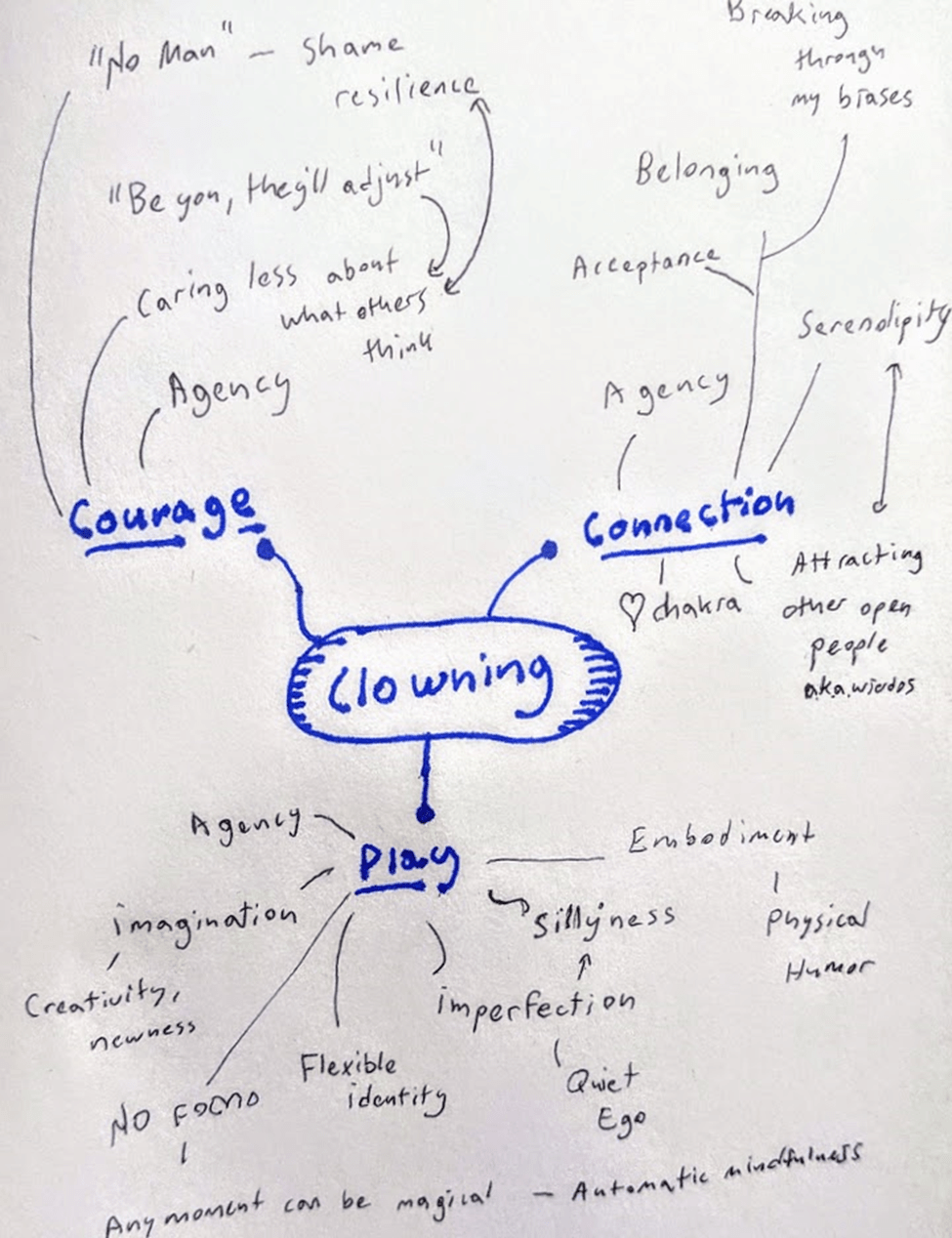
Play
At the start of the clown trip with Patch Adams, people weren’t sure “what to do” when they were clowning. Patch said, “For an hour, be something totally strange. Become a little finger specialist, and examine everyone’s little finger.”
One of my first clowning acts was to practice balancing objects. I’d use common objects — sticks, water bottles, balls — and see how many ways I could balance them — on fingers, noses, heads. This simple act of play took me surprisingly far.
When I was a kid, I was interested in magic, but doing magic carried with it a lot of pressure to be “a good magician.” As a clown, I became more playful with my magic. If the trick turned out well, great. But if the audience caught my slight of hand, that was OK too. I’m an imperfect clown.
Lately, I’ve been wearing my red nose and practicing juggling in public. It doesn’t matter that I frequently drop balls. I’m a beginner clown. And guess what? I can juggle three balls now! Something I never thought I’d be able to do.
The red nose acts as a cue for many people that something unusual is about to happen. A “newness” brain circuit opens up. People are more open to play.
Here are some examples:
- One guy in the park asked me my name and I said “Dan the dancing clown.” He wanted me to dance. I told him I needed music. So he played songs on his phone and my friend and I danced in the park to his beats for 10 minutes, as people were walking by on their usual strolls.
- I started mime-scrolling an imaginary phone on the subway (a light mockery of the habitual subway-taker, myself being no exception). Then someone took an imaginary phone call from me. We began to chat with each other, on our imaginary phones. I then threw an imaginary ball at a different person on the subway car, and they caught it. Pretty soon four people on the subway were playing catch with the imaginary ball.
- Someone came up to me in a grocery store and told me it was her 64th birthday. I jumped up and down 64 times in honor of her. She streamed the whole thing for her sister, who was on a live video call.
- On a plane, I traded shoes with a kid across the isle. I traded people’s hats. The family next to me wrote me a note that said “You are awesome, keep going.” Then, I faux-meditated, balancing many books on my head. A kid and I connected seatbelts across the isle, forming a bridge for people to walk under. At the end of the hour-long clowning experience, I got compliments and a $5 tip.
These sorts of experiences help me see that under its serious surface, the world wants to be playful and silly.
Sure, there are those who don’t engage. Some even get on-guard. The clown-horror genre probably has a lot to do with it. Other folks are just not in the mood. Perhaps they are going through grief, or are stressed, or have social conditioning around not engaging with strangers. All these things are understandable, and I don’t push people when they give me nonverbal “not into it” signals.
Still, clowning is worth it for me. I wouldn’t have had nearly a many magical experiences in the last four months had I not inhabited the character of the clown.
Clowning has helped me see that magic is not “out there” in places of rarefied experience. Magic is for us to create in any moment.

Connection
When the clown trip was over, I put on my red nose as I walked into my new hostel. I introduced myself to two guys sitting outside.
After chatting for a minute, one of them said, “OK, what’s with the clown nose?”
I told them about the trip I’d just been on. I quoted Patch Adams:
There are 7 billion people out there in the world, and most of them are lonely. Clowning is a trick to bring love close.
Patch had lived communally for many years. He had taken a tour bus across Europe with a group of twelve or so. “Depression is a symptom of loneliness,” Patch would often repeat during the trip.
With these ideas rattling around in my mind, I thought, what the heck, let’s put myself out there. I turned to the newly-arrived travelers and said:
“I was wondering, do you guys want to go out for a shot of mezcal?”
“Sure,” they said.
The bar we arrived at was hot, too hot for mezcal. We ordered three cold beers. Mysteriously, six beers showed up.
We looked around and saw a man and woman sitting at the bar. They smiled at us.
We bought them some beers in return. Then they followed suit with more beers. Before long, we were one group. Drinks kept getting ordered, and the world started to spin…
As I recovered from that day, I continued to wear my red nose in the hostel, meeting more people. Then an idea came to me: what if we all travelled together, like Patch in his van?
I offered up the suggestion, and the group was into it. So I did something I’d never done before: I rented a van for seven. We took off to explore Mexico, road-trip style. A whole world opened up. We met strange and wonderful people, saw beautiful places, and for a few days, lived in community. The portal of the red nose brought me there.
I emerged from the trip with a greater trust in myself to be able to manifest the things I want in my life. I’d been to many hostels, but I’d never organized such a trip before. I think that clowning had a lot to do with it. Clowning helped me to say YES to life.
“Thanks for bringing the ridiculous clown energy. I think it helps people loosen up,” said Ben, one of my new friends, who joined the trip.
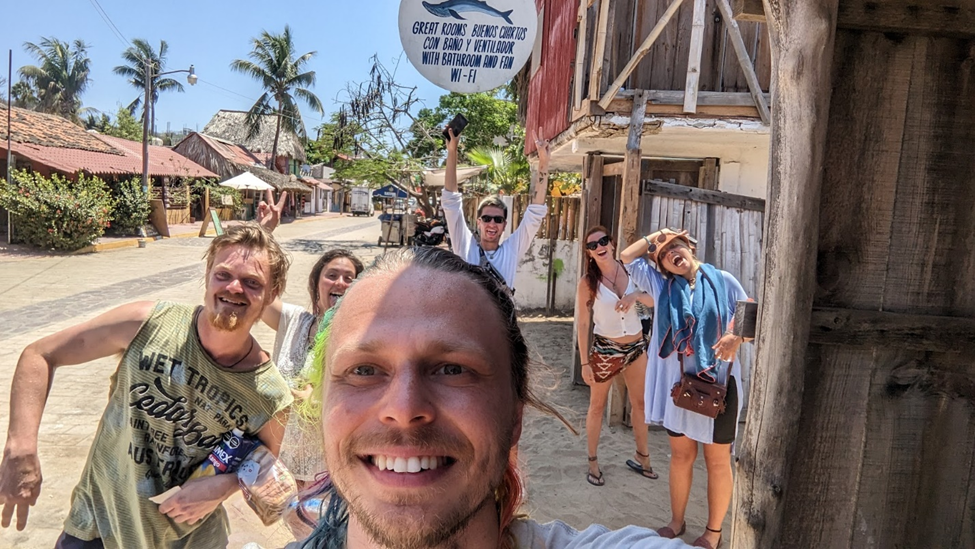
On one hike during these adventures, our group passed a guy with a bright red beard. The guy pulled out a red clown nose from his pocket, and we took a selfie together.

Back home in New York, I was excited to show clowning to my friends. I was a bit nervous. All dressed up in clown, walking with my friends, and nothing much was happening. I said hello to a guy on the street. Then this guy went into his house and came out with a bottle of tequila. He poured us all shots, at 2pm. A beautiful moment of connection was born!
One of the best settings I’ve found for clowning is wearing a red nose during my runs. Wearing a red nose running is the opposite of running with headphones because headphones disconnect you from your immediate environment, whereas the clown nose connects you. The nose is a catalyst for friendliness, for channeling love.
Today, on my run, I pounded fists with a bus driver. At the end of my run, I saw the bus driver again. She was just hanging out, waiting for passengers. I walked into her empty bus and we chatted about life. I thanked her for the positive vibes. Yes, I could have been friendly without the nose, but the nose put me in a mindset of connection. Without the nose, I’m in “running mode.” I’m not usually in the headspace to stop and chat.
On the clown trip, we thought of all of life as a performance. Every choice we make — from our clothing, to our tone of voice, to our body language — is just that, a choice. When I came back to NYC after the clown trip, I realized I had unconsciously filled my closet with drab colors. I started to find new fun outfits to wear.
It is important for me to feel that the world is a friendly place. There is a stereotype that New Yorkers are unfriendly. I believed this stereotype until I started clowning and having many, many amazing encounters in New York City. Clowning helped me break through my biases. By performing the character of a friendly clown, I bring the friendly out in others.
Every person is an individual. There is no monolith called “New Yorkers.” Some people in NYC (or anywhere!) will be friendly, some will be unfriendly. The chances of friendliness are greatly improved if I’m friendly first.
Courage
The very first time I went running with my clown nose, I was scared. I felt like a freak. What would people think of me?
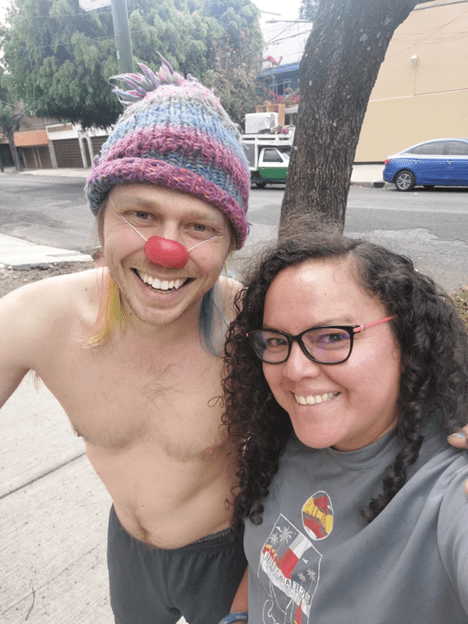
Five minutes into my run, a lady called out to me and said, “I love what you’re doing. We need this! Life can be really stressful!” She snapped a selfie, gave me her number, and sent me the photo. I have this photo as a memento of the first time I transcended my fear, and took the clown nose into “the real world”:
When I crossed the border back into the U.S., I felt fear again. It was fine to clown in a foreign land, but what will people back home think?
Yet once again, back in NYC, I got mostly positive or neutral responses.
As I brought my clown character into contact with more and more the people in my life, I felt fear, again and again. Going to a formal event with my former boss, I donned my clown outfit. He asked me about it, and I gave him the backstory.
“You went on a trip to clown trip to Mexico with Patch Adams; that’s the most Dan thing ever!” he said. He had known I was a clown before I did!
Clowning has taken me out of my comfort zone time and time again. It’s often a bit scary to clown for the first time with people who haven’t yet seen this facet of me. And it hasn’t always gone well. I’ve gotten cold stares, and sometimes worse (though these experiences have been quite rare). Yet on the other side of each uncomfortable experience, I’m still here. So far, I’ve sustained zero physical clowning-related injuries.
And thanks to clowning, I’m able to inhabit a bigger space of Dan-ness.
Clowning is my truth. Yes, it’s not appropriate in all contexts. But if I don’t do it out of fear, then I’m hiding, not living.
I think a lot of people who shout “I love the nose!” as I run past them are reacting to a sense of possibility within themselves. A part of them is resonating with the clown — the energy that wants more play, courage, and connection. This is the same energy in me that resonated with Patch Adams’ book when I serendipitously picked it up for $1.99 at the thrift store. The same energy that found Patch Adams’ website and wrote him a physical letter. And the same energy in me that booked the clown trip to Mexico (with the encouragement of friends).
So, in conclusion…
I clown both for myself and for others.
I want to be a more playful, connected, and courageous person. These qualities are like muscles — they develop with exercise, and they atrophy with disuse. Clowning helps me practice play, connection, and courage every day.
I also clown to bring these values to others. I want the world to be a more playful, connected, and courageous place.
I hope to meet you there, my friend. I’ll be out there clowning, casting my vote for this kind of world.
 danscreativeoulet
Beautiful work. Work, because it’s not easy. It takes courage – as you know. Beautiful, because that is all play is, and that is all you are doing. Feeling free and freeing feelings, letting life rush into you and the world at large you interact with.
Beautiful work, my friend! 🙏