The gummy pouch from the story below, which is now a collector’s item!
From Kindergarten to second grade, I attended a Jewish day school called Kadimah. One day I wandered the halls after school was over, eating Teenage Mutant Ninja Turtles gummies from a yellow plastic pouch.
Across the hall, I saw the the principal. He was a tall, bald man wearing a white yarmulke.
“Hello, Dan,” he said.
He had always been kind to me, but this time, I registered disapproval on his face.
“What are you eating?” he asked.
“Gummies.”
“Can I see them?”
I handed over the package, which he scanned.
“You can’t bring this here. It isn’t Kosher,” he said, and put the package in his pocket. My face flushed with embarrassment. I wanted to hide.
I don’t remember if he told me this, or if I learned it later, but the reason for the un-Kosher-ness was gelatin. Gelatin, the thing that gives gummies their gummy, is often made out of boiled pig bones.
Years later, I no longer went to Kadimah, but I did attend an orthodox Jewish after-school program. One day, I was talking about how I wanted to see the movie The Nightmare Before Christmas with one of my classmates. The Rabbi, a man with a long beard and black hat, overheard me.
“Don’t talk about that movie here,” he said. Again, I felt embarrassed. Like I’d done something wrong.
I’ve been thinking about identity a lot over the last few years. What is it? How does it form?
The simplest definition of identity I’ve come to is this: identity is how we define ourselves. A green square is green and a square. It is not orange. It is not a circle.
Yet even in the simple example above, there is choice. A red triangle may choose to define itself simply as a shape, not by color or form. In a way, the red triangle is making a choice similar to the Dalai Llama, who says:
For me the best introduction is the human face. When I see two eyes, one mouth, one nose, I know I’m dealing with another human being like me. I’m like those young children who don’t care about their companions’ background so long as they smile and are willing to play.
The red triangle is choosing a larger common identity over a smaller one.
Someone I met recently told me about her research in identity formation. She said that one tool used in this line of research is to have people write aspects of their identity on a gingerbread man graphic like this:
Stronger identities go closer to the center of the gingerbread man. Weaker identities go more at the periphery.
A related question I’ve recently been thinking about: are there healthy and unhealthy versions of identity?
What I’ve come to is that healthy identities are:
Freely chosen
Uniting
Expansive
In contrast, unhealthy identities are:
Imposed
Divisive
Constricting
This year, I have gotten involved in men’s work. In one way, the identity of being “a man” is biological. But in another way, I am freely choosing to identify as a man, and I’m choosing what this identity means to me. “Being a man” can mean being someone who does stereotypically masculine things. Or it can mean embodying certain archetypes. Or it can mean something else entirely.
My identity of being a man is uniting. In men’s group, feel connected with other men, regardless of age, background, religion, race, etc. And also, there is a culture of respect towards women.
Finally, this identity is expansive. I feel a sense of more possibilities and connection in my life because I adopted it. Anywhere I go, I can drop into men’s circles. I am aware of a global network of men doing work on themselves in community, to live in greater integrity for the benefit of the world.
The identity of “man” can also have an unhealthy flavor. It can feel imposed rather than chosen, for example, if a transgender or non-binary person is born into a family with very rigid standards of masculinity. It can be divisive, for instance if men band together and bash on women. It can be constricting, if I adopt an idea of being a man that limits what I can do (e.g. if I’m a man I can’t wear a dress, dance ballet, etc.)
Another example: I found the identity of being a Jew limiting when I was trying to fit into orthodox Judaism. I found it restricting to follow traditional Kosher food standards (I resonate more with the idea of eco-kosher). I found it restricting to be forbidden from watching or discussing certain movies like The Nightmare before Christmas.
Yet, when I discovered Lab/Shul, I found that the identity of “Jew” became uniting and expansive. I enjoyed the inter-faith events that created bridges to other traditions. And I found greater possibilities to connect with Judaism, my own spiritual backyard.
To conclude this post, I’ll return to The Nightmare Before Christmas (which has become one of my favorite movies). One way to view this film is through the lens of identity.
[spoilers ahead]
At the start of the movie, the main character Jack Skellington finds himself imprisoned by his identity. Yes, he’s the King of Halloween Town. He’s powerful and well-loved. But he finds this role constricting. Being King limits his possibilities. He didn’t choose to be the King, this role was imposed onto him by his society.
As the movie progresses, Jack travels to Christmas town, and sheds his identity as King. He takes on the identity of Santa Clause. This choice fails horribly.
But when he returns to Halloween town, he feels invigorated, more alive. He freely chooses to come back.
At the start of the movie, and at the end, he has outwardly the same identity: the King of Halloween town. Inwardly, the situation is vastly different: at the start of the movie, Jack’s identity was unhealthy: it was imposed on him and constricting. At the end of the movie, it was freely chosen and he feels a greater sense of possibility.
Jack sings:
And I just can’t wait until next Halloween ‘Cause I’ve got some new ideas That will really make them scream
These days, I’m finding myself discovering new identities for myself through experimentation. Some of these identities are dead-ends (like being a devotee of Sadhguru).
Other identities are pleasant discoveries:
“Wow, I never thought I’d like house music, but the way I feel with the beat thumping while driving down these beautiful roads makes me feel alive.”
or
“Wow, I never thought I’d be a dogowner, yet here I am, going on a run with a 90-pound dog.”
I believe we all need some degree of identity to lead good lives. Matthew McCounaughey says that a good place to start figuring out who you are is to answer the question: “What am I not?”
I think another good place to start is to answer the questions:
What identities do I freely choose?
Which identities align with my values?
Which unite me with others?
Which expand my possibilities and sense of aliveness?
Identities are tricky. They can lead to war and genocide just as much as they can help us improve ourselves and the world. Our challenge then, as both individuals and as communities, is to use the above ingredients to cook healthy identities for dinner tonight.
For the past 2 months, my fiance Api and I have been working with Sean, a dog trainer. The results have been incredible.
Humility was my first lesson on this journey. Hiring Sean took me admitting that I didn’t know what the hell I was doing, that I was out of my depth. Two months ago, our dog Mango was a 90-pound punk who pretty much ran the show around here. He’d buck and escape from his leash if he didn’t want to go somewhere. He’d ignore us most of the time. In addition to the behavior problems, he had a full-body skin rash that was causing bleeding ulcers. Not to mention chronic diarrhea.
Nowadays, Mango follows most commands (while at home), makes eye contact, and bucks only rarely. The skin rash and diarrhea are gone. Mango isn’t perfect, but he’s come a long way.
The thing that kept me from getting help sooner was the belief that I could do this on my own. Humility was what allowed me to open myself up for help. If I’d have insisted that “everything was fine,” we would likely still be struggling.
Sean taught us many principles for training Mango to be a good boy. It has dawned on me that many of these principles will likely work well to help me be a good boy, too.
Here’s a summary of what I learned in the past two months, that I think applies equally to both dogs and humans:
The importance of whole food. The very first session, Sean told us to feed Mango a raw meat diet to help treat Mango’s skin problems. Prior to this, Mango had been eating a diet of mostly processed kibble. The results were nothing short of miraculous. In 2 days, Mango’s full-body rash was 90% better and his diarrhea resolved.
Dog version: Wolves eat whole animals, including bones and organs. This is the bedrock of a healthy diet for dogs.
Human version: Humans should eat whole foods. In the words of Michael Pollan: Eat food. Not too much. Mostly plants. Or slightly longer: eat local food with ingredients your great-grandmother would recognize. Avoid processed foods. Shop at farmer’s markets.
Shaping. Shaping a behavior is the principle of finding the small components of the desired behavior that can be rewarded. Building up a behavior out of components.
Dog version: Rewarding mango for staying for 1 second, then 2 seconds, then 3 seconds.
Human version: The minimal viable action. Giving myself a pat on the back for putting on gym clothes and stepping into the gym. Or for writing the first line of that email I’ve been avoiding.
Every behavior is a vote for the future. Early in our journey, Sean brought up an analogy for the dog mind as a chalkboard that, through repetitions, gets grooves etched into it. I think that the human mind is like this too. So, a behavior can be thought of not just as something in the present, but also something that deepens the groove in the chalkboard. Every time a behavior is chosen, it’s more likely to repeat.
Dog version: The first week of training, we focused on just getting Mango to pay attention to his name 50 times. The point of doing this was to deepen the groove of him paying attention. This also goes for destructive behaviors. For example, if Mango runs away successfully, he learns that running away is a fun game, and this makes him more likely to run away in the future. Or if he learns he can buck to escape from his harness, he is learning that bucking is an effective way to get what he wants. Getting a martingale collar was instrumental in stopping the bucking. Getting a chain leash was helpful getting him to stop playing tug of war (biting a chain is no fun for Mango). And ignoring Mango when he would go crazy and show teeth was instrumental in stopping these behaviors.
Human version: If I reward myself with alcohol after a run or a hard day of work, then I am not only making these choices in the present, I’m making it more likely that I’ll repeat these choices in the future. Conversely, if I reward myself with a sparkly non-alcoholic beverage, then this, too becomes more likely in the future. If I allow myself to get into the headspace of righteous indignation while talking to my mom, then I can get addicted to this feeling and be more likely to get into this same headspace in future conversations.
Patience and expectations. One very helpful thing Sean said to us was: “Training is a lot. If you need to go for a walk in the forest to zen out, do this by yourself. Taking your dog to the forest requires a lot focus. It takes 1.5-2 years to train a dog.” This set my expectations that this would be a long journey, and there would be no “instant results.”
Dog version: Not getting frustrated that after 2 months of training, Mango still doesn’t listen reliably when walking in the forest. The forest is a level 10-difficulty environment because of all the smells and distractions. Set the expectation lower: in the forest, success = having him pay attention to his name.
Human version: Not getting frustrated that after a year of rock climbing, I can only do V3 climbs. A year ago, I was only doing V2 climbs. Slow progress is still progress!
Structure before freedom. This was a major mindset shift for me over the past 2 months. I recently traveled to Thailand, and was amazed at how well-behaved the village dogs were. “We should let our dogs roam around in packs, not keep them caged up in yards,” I thought, upon returning. Well, these are totally different contexts. The street dogs of the rural village are socialized in the pack, whereas the dogs here in the west generally rely on humans for socialization. Neither context is “right” or “wrong,” they are just different. In both cases, discipline must be taught. In the case of street dogs, it’s taught by the pack. In the US, it’s taught by dog owners.
Dog version: No free feeding, food is given in exchange for good behavior. No off-leash forest or beach walks, until the behavior is excellent on-leash.
Human version: Kids can have freedom (e.g. play) after they demonstrate that they can control themselves. I can give myself freedom and relaxation, after I get things done on my to-do list.
The fulfillment equation. A dog needs exercise, mental stimulation, and affection every day. Ditto for humans. These needs can be met with small deposits: a short walk, a touch or kind word, reading a book (for a human) or following commands (for a dog).
Dog version: Before asking Mango to relax on the beach, it’s important that his needs for the above are met. When I see a dog barking at me, I used to think: that’s a bad dog. Now I think: that’s an under fulfilled dog.
Human version: If I’m feeling agitated or unbalanced, see if any of the above are missing. If someone is mean to me, ask myself: is this an under-fulfilled human?
What behavior do I want instead? The two main levers for shaping dog behavior are rewards and interruptions. Yet interrupting an unwanted behavior is just the first step. After interrupting, I must ask: what behavior do I want instead?
Dog version: If Mango is chasing our cat or barking outside, I can interrupt this by keeping him on a leash, and bringing him onto his “station” and rewarding him with food. If Mango is chewing something he shouldn’t be, I can replace this item with something I want him to be chewing.
Human version: If I don’t want to be tossing in bed with insomnia (training myself that the bed is not for sleeping), I can interrupt this behavior by getting out of bed and reading a book or writing this blog post!
In all, dog training has been a lot of fun for me. I really enjoy teaching and seeing the progress of our furry pupil! A big shout out to Sean and Jenia at A Pet Perspective for making our journey with Mango possible. And to Api for being down to journey with me.
“Follow your electric golden thread” –Ethan Maurice
“Stay in the sequence” –Chris McKenna
“Follow your bliss” –Joseph Campbell
These different words are Different fingers Pointing towards The same moon
I'll add a corollary
A note to self:
When (Not if) You lose the thread Remember, Remember Remember To find it again:
Oliver goes to New York City Cheryl to the woods Katrina to the desert
On some days I stay at home Reading books and Chopping vegetables
Dorothy and Greg and Wally They go to the neighborhoods You are scared to go They serve the poor and downtrodden Like Jesus would have done
Aaron gets married Mike, divorced Matthew sells his stuff His furniture and pickup truck His electric golden thread Is leading him towards The open road
For Mark The open road Has ceased to sing That thread Has frayed and faded His electric golden thread Now wants roots He buys a house
This morning, my thread Took me out on a long jog Wet, after the shower I write these words In the interstitial space Of early morning Before breakfast Before work A time When I can feel my thread Most reliably A time before The hum of life Amplifies into a din And distracts me From the subtle art Of following the thread
I drew this doodle 11 years ago, in decision paralysis about which medical specialty to pursue
The issue that drove me to psychotherapy in my early 30s was this: whenever I had to make big decisions in my life, I’d go into decision paralysis. After three years of therapy, I still had this problem. Therapy was merely another dead-end in a long journey of trying to “solve” my decision paralysis.
Today, I see the root cause of my decision paralysis, and a way out. But before I get to that, let me describe a decade of dead ends.
Guru-hopping
During my mid-20s to mid-30s, I was like a frog on lily pads, jumping from guru to guru, from philosophy to philosophy. Driving this was a desire to have life be the way it was when I was a kid: when all I had to do to succeed was to do the things that the adults wanted me to do.
My first guru was Charlie Munger. I was unemployed, living with my parents during the 2008 financial crash. I felt a deep sense of shame. I had just graduated a fancy college alongside people who seemed to have it all together. Yet here I was, not knowing which direction to go with my career and unable to find a job. Something must be wrong with me, I thought.
I was thrilled to find Munger and his aphorisms on life, career, money. I consumed every quotation of his that I could find.
Over the next few years, I settled into a career path (not without some decision-paralysis along the way). The next big question on my mind was very broad: how should I live?
And the “guru” I found was not a single person, but a whole way of life: Orthodox Judaism.
Orthodox Judaism gave very clear answers to the “how to live?” question: you follow these very strict rituals, that’s how. It did not, however, give much space for questioning. In the long, run, I couldn’t just “turn off” my questioning mind. After a year or so, I gave up on becoming orthodox.
Over the next decade, my guru-hopping took a more “self-help” flavor. I wasn’t cool in school, so I followed gurus that promised me the key to coolness and charisma. When I wanted “answers” to how to have a good life, I took courses by psychologists.
I did a workshop to create an Annual Review plan for myself. At the time, I felt that this exercise was “the answer,” the key that would, once and for all, make my life OK.
This pattern — excitement about the guru, technique, or philosophy du jour, then a fading of this excitement, and then a discovery of some other thing that would solve all my problems — ultimately proved unsatisfying.
So, I slowed down. I asked myself: what’s driving this guru-hopping?
Fear: the root cause of my decision paralysis
That was the year, my twenty-eighth, when I was discovering that not all of the promises would be kept, that some things are in fact irrevocable and that it had counted after all, every evasion and every procrastination, every mistake, every word, all of it.
— Joan Didion
Look at your birth certificate. It doesn’t say life is easy. There is no easy life. There is no guarantee. There is no certainty. There is probability.
— Edith Eva Eger
In high school, I worked hard to maintain the appearance of success, at least on paper. My resilience was low. I believed that my life could be insured against failure, sadness, shame.
After more than a decade of guru-hopping, I realized that I was using gurus to avoid taking responsibility for making decisions.
I didn’t like the fear that came up when I had to choose between two uncertain paths. I wanted a guarantee that the path I was choosing was the “correct” one and everything would be OK.
For such a guarantee, I spent thousands of dollars over the years on books, courses, and appointments. I didn’t consciously know that what I was seeking in all this guru-hopping was certainty.
My pattern was this: I would discover a guru or philosophy or technique. After a while, when this thing failed to deliver a sense of certainty, I enthusiastically hopped to another one, subconsciously convinced that it would have all the answers. And so on, ad-infinitum.
A telling example: over the years, I got into two diametrically-opposed approaches to decision-making:
The less wrong movement, which holds the view that we should make decisions as rationally as possible
Now I realize that both intuition and rationality are decision-making tools and neither one is “better.” Sometimes, it’s more skillful to use one, the other, or a combination of both. I’m realizing that every guru, technique, and approach likely holds some partial truth, is a tool in the toolbox of living well.
I accept now, that there is no end-all, be-all technique available to free me from the fact that the decisions I make are my own, and they may very well cause pain and suffering. As Joan Didion says, “some things are in fact irrevocable.”
Attaching to gurus allowed me to delay growing up. I replaced my parents with gurus, philosophies, techniques. As long as I attached myself to them, I could believe that there was a way to avoid the risk that comes with choosing.
This was delusional. In reality, there is no way to guarantee the path I’m taking in life will be pain-free. A routine choice — like choosing to drive — can end in catastrophe. Living is making choices, and making choices always involves risk. There is no philosophy or guru that can change this existential fact.
Four reminders to myself
“She’s decided to live her life, from the inside out. The sound of failure calls her name. She’s decided to hear it out.”
A choice came up the other day, and there I was, stuck in decision paralysis again: analyzing pros and cons. After a day or two of this, I made the decision. I realized that no amount of analysis would keep me from the fact that my choice could lead to problems. Things might not go well. But I was excited about my choice and that was enough.
I realize now that decision paralysis is a place my brain tends to go. But this doesn’t mean it has to stay there.
I wrote these four “notes to self” to hopefully help me break out of decision paralysis faster.
Dear Dan, when you are stuck in decision paralysis, contemplate these things:
There is no way to remove the possibility of failure. Every choice is uncertain, and there is no guarantee that any choice, even a seemingly safe one, will be free of problems and pain.
The “perfect” choice doesn’t exist. Every choice has trade-offs.
Decisions exclude alternatives, by their very nature. The road not taken is “the ghost ship that didn’t carry us.” I’ll never get to truly experience it. We can only be in one place, do one thing, at one time. Living wholeheartedly in reality requires accepting this fact.
See life as an infinite game. On the other side of this decision, there is more life, and more decisions to be made. Making this decision unlocks the flow of life.
Let me elaborate:
There is no way to remove the risk of failure from decision-making. The advice of others can help at times. But ultimately, I have to choose to go down one poorly-lit path or another. The path may bring me great joy, great sorrow, or anything in between.
In the past, I subconsciously believed that by analyzing a decision a million times, I could make “the right one.” But there is no “right” decision. There is only a decision, and then there’s life on the other side of the decision. And then there’s another decision. And then there’s more life.
Life is an infinite game. Even after we die, other life forms get to make more decisions, enabled by the decisions that we’ve made in our lives.
There is no perfect decision. There is only an imperfect choice that you can accept and grow to love. Be this choosing a ceiling fan or a partner.
The good news is that decisions which in the short-term look like “mistakes,” in 20 years may end up having taught us our most valuable lessons.
The other day, on a run, I encountered the store above in my neighborhood. I peered inside.
Rows upon rows of supplements, powders, were stacked on shelves. On the wall was a poster of very muscular people posing in small shorts and bikinis. Fascinating, I thought. The world is vast, and has all kinds of communities.
I jogged home.
My last post was about the metaphor of life as a house with many rooms. Since writing that post, I re-read an article which talks about four stages of life: mimicry, exploration, commitment, and legacy.
This article, I think, is spot-on, though I prefer to think of these stages as blending into each other rather than having clear borders. At any point in life, we each have some mimicry, some exploration, some commitment and some legacy-building going on, though the balance drastically shifts as we go from child to old person.
In my early 20s, I committed to going down the path of medical training. This big commitment took up pretty much all of my time, and my desire to explore went unfulfilled. When I finished the training path, I had more free time to explore. In the last five years, I’ve explored a lot.
Now, I see exploration’s limits: the people I meet while traveling seldom turn into real friends, serial monogamy doesn’t allow me to build a family.
I have a friend who said once, “I’ll try anything three times.” A few years ago, I’d have agreed with her, but now I realize that some things, I won’t even try once. For example, I won’t go into muscle, inc.
Why not? Am I becoming a curmudgeonly old person not open to new things? Like Sam who won’t try the Green Eggs and Ham…
No, I think it’s more that I know myself, and life, better now. I trained for and ran a marathon a few years back. This took discipline. I got satisfaction from adding on the miles and going the distance. Yet, once I completed the marathon, the satisfaction dissipated. Satisfaction is something you can’t keep.
In the past year, I’ve learned to juggle three balls. A similar pattern: practice -> struggle -> success. And then what? The satisfaction dissipates, unless I start learning a new trick.
Body building, I imagine, would follow a similar template. I have other learning projects in my life, that I’m more interested in (like learning to surf). My time and energy are limited. So, I jog past the store.
I was talking to a friend the other day about polyamory. Why don’t I try it?
Maybe I’m wrong, but I think I can imagine what it would be like: monogamy, but more complex. With more people to understand, feelings to manage. I’m OK not entering this room. Building one solid romantic partnership is hard enough for me.
There are some rooms of life that a require major commitment to enter the door. To explore these rooms, I have to give up exploring a bunch of other rooms. The room of starting a family is one such room.
In the book The Light of the World, the author Elizabeth Alexander describes that her husband Ficre was a good pick because he had “drank his water” before he got married. In our culture, we talk about “sowing wild oats.” These are two different ways of saying: Ficre had explored enough, and was ready to commit.
In my late 20s, I dated someone who wanted to marry and have kids. I told myself that this was what I wanted. I didn’t want the pain of breakups anymore. And subconsciously, I also probably wanted to keep up with the societal script of marriage and family, out of a sense of shame. Yet, in my subconscious, there was a strong desire to explore.
When girlfriend said: “I want to get married,” I was filled with anxiety. Ultimately, the relationship ended. And for many years, I’ve had major regret about this. I told myself stories like, “I let THE PERFECT PERSON get away.”
Yes, we were compatible in many ways. Yet in a big way, we were incompatible. I was at the stage of exploration, and she was at the stage of commitment. I didn’t have a discreet time when I’d be “done” with my exploration stage. And so, from my vantage point at almost 38, the breakup now seems wise. It would have made us both miserable if we’d have stayed together, because the relationship wouldn’t have let either of us fully do what we — in our core — wanted to do.
Seeing my life through the lens of these stages frees me from regret and shame. My ex and I were simply at different stages, and the right thing was to end the relationship, as hard as it was. It wasn’t that either of us were “bad people.”
Now, though, I feel myself leaving the stage of exploration, and entering the stage of commitment. I look at young families around me and earnestly want to be like them. Not out of a sense of shame, but out of an inherent desire. And I look at many possible adventures and “see through them.” Yes, that could be a fun experience, but what about after it’s done? Will anything be left? I ask myself.
Exploration and commitment are partners in a life-long dance. For my 20s, commitment was leading the dance (while I was in med school and residency). But exploration grew frustrated. And so, when I finished training and was able to work part-time, exploration took the lead for about 5 years.
Now, commitment wants its turn to lead the dance once again.
This dance will continue, I think, for the rest of my life.
Because that’s life. A thing that’s always changing, grooving, and unfolding.
Thanks to Avi, Peter and Nicole for conversations that led to this post.
NYC has walkability, serendipity
Hawaii has turquoise oceans, whispering waves
NYC has a consciousness of speed
Hawaii has a limit to what's here

We can't have the good of this
With the good of that
Ultimately, we have to choose:
To accept the pain of missing out
To accept the bad
And to love the good
Of where we're at
Jimmy and Bug #2 (Bug #1 was made beautiful and sold)
Q. …I want to stop floating. I have the strong desire to change and become the woman I know is deep inside me. I feel like I’ve recently woken up to the urgent need to do something that helps me figure out the direction my life will take, one with a sense of purpose. But how do I do that, Sugar? Where do I begin?
A. …You say that you’re done floating, but I encourage you to think of it another way and trust yourself to keep floating, except differently. Instead of letting the days pull you down the same old streams that make you feel vague and full of regret—the meaningless jobs, the endless social media scrolling, the too-many hours with friends and “Friends”—let yourself float down channels that are more likely to bring you to the places you want to go. Float down the channel of your curiosity, of your creativity, of your fears, of your ambitions, of your power, of your desires, your dreams.
Take out a notebook and at the top of a blank page write the word curiosity. On the next page write creativity. On the next fears and so on, page by page, through ambitions, power, desires, dreams and other words you might wish to add and then go back and fill each of those pages with lists of your own. Write down all the things that you’re curious about, all the things you want to create, that you fear, that feel like your power and keep writing until you’ve filled up all your blank pages with everything inside of you.
Doing this is the beginning of doing things rather than lamenting that you haven’t done them. It’s where you begin to imagine how you will learn the languages you want to speak, read the books you want to read, volunteer to change the world, and pursue your passions. The regret you describe in your letter is all about inertia; about what you haven’t done, rather than what you have. Holding onto your regret will only keep you where you are, floating among the meaningless things that will eventually drown you…
A good place to start is on the page of your notebook where the word fears is written at the top. What if you allowed that page to be the map of your passage? What if you floated your way down the channel of every one of your fears as if you were enacting a ritual?
Walking down the street today, I greeted my neighbor Jimmy who is there most days, tinkering with his classic VW bug. What if I got into fixing old cars, I wondered. What kind of people would I meet? What kind of things would I learn?
When I was a kid, I spent many summers, alone in my room, trying to get invited to the cool parties by sending messages on AIM. 99.9% of the time, my attempts were unsuccessful. I sat in my room for many summers, not leaving, knocking on the doors behind which I imagined the cool kids were having great times, all the while feeling lonely and excluded.
Now, I see I don’t have to keep banging on doors that don’t open. There are SO many amazing other rooms in the house of life: the room of classic car fixing, the room of farming, of dog owning, of child raising, of kite surfing, of campaigning for religious freedom…the list is nearly infinite.
What made me change my view? In a word: wandering. What Cheryl Strayed calls floating differently. I took a sabbatical a year ago, and floated towards two of my interests: clowning and eco-villages. In the subsequent year, I changed my location to Hawaii based largely on curiosity, and have been exposed to things I would not have been exposed to in my prior, more concrete-bound habitat.
A year later, my soul is more alive. I see life more expansively. I’m excited to see what new rooms lie ahead…
Over the past 15 years or so, I’ve dipped into mindfulness practice. One unhelpful idea that I’ve absorbed from my adventures is this one:
“Mindfulness / presence is good. Any other state of mind is bad.”
Reality, it turns out, is a bit more nuanced than this.
I’m reading a book right now called Mindwandering which is teaching me more precise language for states of mind. Let me narrate my experience this morning, using this new language:
I woke up. Lying in bed, my mind wandered to the past, to the future, and I got a writing idea through these various associations (mind-wandering).
I wrote in my journal, in a creative flow state (immersion).
I decided to do some mindful walking practice and focused on the sensations of my feet on the ground (mindfulness).
As I did this, my mind drifted to a task I wanted to do, to additions to my writing piece, to an idea to create this blog post. I did my best to bring my mind back to the present: the sensation of my feet on the ground, the beautiful clouds in the sky (oscillating between mindfulness and mind-wandering).
On my walk, I saw that someone had put birdseed into the road (which causes birds to get hit by cars) and became angry (immersion).
I said to myself, “Breathing in, I feel my anger. Breathing out, I hold you, my anger.” (mindfulness)
When I came back home, I wrote this post (immersion).
All three states of mind: mindfulness, mind-wandering, and immersion are helpful at various times, and unhelpful at other times. For instance, when creativity is needed, mind-wandering allows us to access the full store of our memories and to make novel associations. However, mind-wandering can also cause us to miss the present moment. Also, ruminative worrying and negative self-talk (the inner critic) can lower our mood and make us suffer. Mindfulness is a tool we can use to detach from this unhelpful mind-wandering. Journaling and therapy are other tools.
When execution is needed, full immersion is helpful. When I’m rock climbing or writing, I want to be immersed, “in flow,” rather than watching my experience mindfully from above. However, when I’m angry or sad, or in the grip of an addiction, mindfulness can allow me to step back from my experience and interrupt destructive behaviors.
Mindfulness helps foster appreciation and gratitude. When I become mindful of the tea farmers as I drink my tea, or mindful of my feet as I walk, I’m grateful for them. Mindfulness can also help with negative emotions. For example, when I became mindful of my anger about the bird-seed this morning, it became a little less intense. I was able to get some perspective on it.
I can brainstorm ways to address my anger: I can accept that I can’t control the seed-scatterer, I can remind myself that he probably has good intentions, and/or I can attempt to talk to him.
So, each state of mind is kind of like tool, to be used at the right place and the right time.
Thanks to Api for suggesting the title, and also another kind of mind: MIND YOUR OWN BUSINESS!
The above picture is from a birthday card I made for a friend. In the text of the card, I was reflecting on the burnout we’d both felt over the past few years.
The weights on the mobile of life are all individually “good things,” but when they are out of balance, we get the feeling of “burnout.”
The other day, I was all dressed up and ready to go volunteer at a farm when I heard a small quiet voice within me say: “No.”
I unlaced my shoes and stayed home and read old notebooks, instead of going “out there” and volunteering. The voice was telling me: “Reflect, focus on yourself, you need this right now.”
I listened, and this felt really good.
This small, quiet voice gets the name “intuition” or “wisdom.” Wisdom is the master balancer of the weights on the life-mobile. Learning to heed the voice of wisdom is the work of a lifetime.
Thanks to Peter and Steve for conversations that led to this post.
Usually I zoom in to doodles, but I wanted to feature my cracked teacup tattoo 🙂
I’ve noticed, of late, a rather brutal habit of my mind. I’ll look at someone in the world — let’s call them person X — and paint them as a paragon of perfection.
My brain will then compare this perfect person X with my imperfect self, and flood me with shame: “You are broken. You are alone in your brokenness. You are inferior to person X.”
This habit likely started with bullying that I experienced when I was growing up. The bullies said: you don’t belong, you are inferior. Over time, I internalized these words. And so began the savage habit of bullying myself. I started to feel like I would forever be locked outside the party of life, where all the perfect shiny people were dancing.
The first noble truth of Buddhism is that suffering is a part of life for all people. I’ve known this for years, intellectually.
In the past few months, I’ve gotten to know this in a deeper way. This has been thanks to two investments of my time: 1) going to a men’s group, and 2) getting into the writings and podcasts of Cheryl Strayed. Also, over the past year or so, I’ve had some conversations which have helped me to see that my challenges are by no means unique.
Men’s Group
Men’s group begins with a ritual of smudging each other with smoke. After the opening ritual, we open up to each other.
I notice that when I first meet someone new in the group, my mind will often paint a picture of them as perfect. “Look at that guy,” my mind says. “They are a cool dude, good looking, fit, able to surf, with an attractive partner, better than me.”
Then then sharing begins…
I won’t discuss details of what people share, but suffice it to say that life isn’t all roses for these men who, on the surface, seem perfect to me.
Dear Sugar
The “Dear Sugar” advice columns, written by Cheryl Strayed, have also helped me undo my sense that people “out there” are perfect. Strayed connects the issues people are having to stories from her own life. What emerges is a sense of common humanity: You are struggling with this. It’s something I struggle (or struggled) with too, Strayed says, in so many of her responses.
Mark Manson describes Strayed’s work like this:
There are two ways to help people in this world: 1) give them specific, tangible advice on what they should do to fix their problems, and 2) normalize their suffering to simply remind them that they are not as alone or as hopeless as they think they are. Strayed’s work here is light on the first and heavy on the second. But she’s an expert at the second… Often what we need the most is not more “tools” and “tips” to get through our hardest hours. What we need is someone who simply understands our pain, and is able to clearly and beautifully articulate that it will one day be OK again.
Conversations
In a similar vein, conversations with friends have helped me feel less alone. I recently spoke with someone who grew up with a similar family dynamic to mine. “Wow!” I thought. Other people go through similar things as me.
A friend of mine recently moved cities, and was having some trouble moving on from his former life. I’ve been going through the similar feelings, having moved a year ago from NYC to Hawaii. We supported each other in our commitments to appreciate the place where we are now. And he also shared feelings of loneliness growing up, which I resonated with. From afar, when I first met this friend, I thought of him as one of those “shiny perfect people.”
Another friend I’ve known for over a decade opened up to me about his struggles last year. Holy moly, I thought. I had always thought of him has “having it all together.” Who else in my life is like this? Who have I painted as a shiny perfect teacup in my mind, when in reality they are cracked, just like me, just like all people.
For years, I had put my therapist on a pedestal, thinking of her as someone who’d achieved “inner peace.” When I visited her home, I realized that she’s a human with struggles, too.
Also, my own life, from a distance (or on social media) may seem devoid of suffering, to a distant onlooker. In reality, I’m human like everyone else.
In sum, these experiences have helped undo my sense of aloneness. They’ve worked to counter the brutal voice in my brain.
I’m sure that the voice will continue to pipe up (it’s a habit, after all). But now, I’m more aware. I can recognize when it comes on-line. And I don’t have to believe it.
If the voice tells me I’m broken, I can remind myself that I can learn and grow and behave differently in the future. I can repair the crack in my teacup, like the Japanese art form of kintsugi.
If the voice tells me that I’m alone and inferior, I can think back to conversations with friends, or to men’s group, or to Dear Sugar, and feel, deep in my bones, that though I might be suffering, I’m part of the human condition, I’m not alone, there are lots of other folks with similar struggles. If this weren’t true, Dear Sugar wouldn’t have much of an audience and there wouldn’t be men’s groups.
Ultimately, suffering is the compost from which the flower of compassion can grow. I think that’s what makes Cheryl Strayed such a good advice columnist. She’s suffered a lot herself, so she can relate to the suffering of others. Similarly, because I’ve suffered in various ways, I can see the cracks in the teacups of others, and react with compassion rather than judgement.
A religion is a house
Some rooms have good stuff
Healthy values
Helpful practices

You're alone at home today
Where do you put
The needle of your attention?

Do you go online and look at porn?
Do you imbibe a pleasure-producing substance?
Or do you do some fasting, song, silence or service?
Do you try a flavor of meditation:
Breathing, walking, eating, drinking tea
Loving kindness or Tonglen
Do you repeat a mantra
Or contemplate death, perhaps?

Do you devote yourself to a being
Who represents
The qualities
You want to grow
Within yourself?

Or do you join with others
With a sangha, for meditation
With a community, for celebration
Perhaps you try: Carnivale, Purim, Ramadan,
Songkran, Christmas, Sabbath, Holi
And see what sticks?

Some rooms are best
Not to enter
Rooms with people who say:
"This house is the right one
The people out there
In other houses
Are 'them'
Failed attempts
At being us"

Learn about the house
You were born into
And if you're curious
Explore other houses too

On your travels
Be mindful
Of the rooms you choose
To go inside
Cherish the baby
And leave behind the bathwater
The woman on the TV show Bear
Says that getting up early in the morning
And peeling mushrooms
Is time well-spent
It's grounding
It shows people
That someone put extra work
Into their meal

Peeling squash
Chopping onions
In the wee hours this morning
In preparation for company
Is time well spent, too

North African Chickpea Stew
Takes hours to make
Every time I make it
It's a special occasion

I think of my mom and grandma
Spending hours in the kitchen
Late nights and early mornings
Making knishi, varenike, tort

Birthdays only come once in a while
Your kid doesn't visit that often
Your grandkid will only be small for a time
So what do you do?
You cook

Meaning is proportional
To effort
And to sacrifice

"Time is gonna take so much away,
But there's a way that you can offer time a trade..."
I awake Residue of yesterday's shame Lingers in the folds of my brain
Everything seemed wrong yesterday The way I drove The T-shirt I wore The words I said The thoughts in my mind My lack of knowledge My lack of skills My inability to listen
Everything I put into the world Seemed ugly and awkward and harmful I seemed wrong, as a unit I might as well just go And hide in a closet Away from it all
This morning, smiles seem phony Plastic, put on Glitter on shit
This morning, I sit Before me Eggs, toasted bread, arugula, pepper, pesto Open face sandwich The bread crunches The runny eggs spill onto the plate A colorful design Forms on the plate: Luminous yellow-orange yolk Bright green leaves, orange pepper Food collage In the sun
I pour tea Delicious The taste links me to the earth
I see you, across from me Your smile no longer Seems fake You come alive
Sometimes, focusing on the potato Cooks it
Sometimes, we need a wider view Zoom out from the breadcrumb And see the whole plate
Sometimes insight does the trick Asking: what can I learn here? How is this part of the curriculum?
The colors in the teacup Glow in the sun The potter was a master My brother and I Bought two cups from him Each one a dazzle of subtle color: Faded blue, yellow, and aquamarine
Teacup, I never really appreciated your color Until this morning It was as if your color Was waiting All this time To rescue me
This morning I really see you Your colors The cracks in your glaze And the green Oh, green You smile at me
Something warms Inside my soul Something gets lighter
The brain
Is a great forgetter
That’s why
We need mantras
We need songs
We need holidays
Every month
Week and year
We need rituals
We need songs, again
We need to
Play them
Again and again

We need poems
Prayers
And we need to
Learn them by heart
And say them
To others
And to ourselves
When we wake up
And drive home
And go to bed

We need this
To remind us
To keep us out
Of the gutters
Of our minds
We need help
All this help
To remember
A mensch — someone who shows up for you unconditionally +
A therapist — someone who sees you deeply, without judgement +
A companion — someone with whom you have fun, do common interests (a.k.a. a buddy, a colleague, a collaborator) +
Someone with whom you have shared history. This history, developed over years of living life and making memories, adds meaning to the friendship, allows you to “pick up where you left off” if you haven’t seen each other for a while.
To have a friend, be a friend. — Ralph Waldo Emerson
True success = joy, growth, values
Brings you joy (this is needed for something to be sustainable)
Helps you grow, pushes your comfort zone
Is aligned with your values: Contributes to / inspires others in some way, is aligned with the person you want to be long-term. It’s something you’re proud of doing.
Has blinders regarding outcome. These blinders help overcome the inner critic who says things like: “You are a failure because you don’t have what person X has, and it’s too late to even try,” or “What you’re doing is worthless because it isn’t unique, and it’s not changing the world.” Focus on hitting the three things above every day, and keep your blinders up. Don’t compare yourself to your neighbors (real or imagined).
An example: I’m going to go for a run this morning with the dog. This pushes me out of my comfort zone, contributes to others (the dog!), and is aligned with who I want to be long-term (healthy, physically active).
I could get down on myself if I compare myself to more accomplished athletes. My inner critic could say: “You’re not an ultra-marathoner or a surfer.”
Yet this perspective is not helpful. So, I keep my blinders up. I focus on executing today, lacing up my sneakers, and getting out there.
Any success takes one in a row. Do one thing well, then another. Once, then once more. Over and over until the end, then it’s one in a row again.” – Matthew McConaughey
Waking up this morning, I smile. Twenty-four brand new hours are before me. I vow to live fully in each moment and look on all beings with eyes of compassion. — Thich Nhat Hanh
I itch a mosquito bite It seems, in the moment That the itch will last forever Yet the bite is a wave, too A mountain on my skin forms, persists Then recedes
A real mountain is also like this Over much longer Spans of time
Botox smooths wrinkles A magic trick that obscures decay Until the next injection Three months later
Childhood, The time of smooth skin Is a wave Mine's gone now, I must admit
Humans put their names On buildings, organizations, children From a redwood's eyes It's easy to see That all these projects Are waves too
The oldest redwood was alive When the Egyptians Were building pyramids Though we still visit Giza Little of that old society's culture Remains alive
Species are waves Even the long-lived redwood When viewed through the million-year eyes Of the grand canyon
And the grand canyon is itself a wave When viewed with the billion-year eyes Of earth
And through even longer Cosmic lenses The whole of planet earth Is itself a wave Once again
Zooming back in: Consciousness also Is made of waves
Thoughts, feelings, emotions Born, persist, and pass
In every moment We are reborn
Consciousness is not a solid thing But a series of moments A procession of waves
I can identify With this particular wave Of "me" Or I can see That all beings Present, past and future Are waves Unique in their own unrepeatable way And also made up Of the same Water
A moment ends And if it didn't We'd be locked inside With no way out
A moment ends And that's what lets Us make Something new
Beauty and meaning Only illuminate Moments that end If you cling You block the flow
A trip, our youth, or middle age We only get to do it once We have to admit, at the end It was difficult, painful, beautiful It helped us see Reality better Yes, we made mistakes Our art wasn't perfect It was enough
Don't keep painting and repainting the painting Let go, let go, let go Then the work can spread To others' minds and hearts If you don't end it You don't let it affect others
The banana leaf today Has unfurled Yesterday, it was a green tube Nature is born, blossoms, withers Like us
My first third of life is over That painting is done I'm painting the middle third now I hope that's true
We don't get infinite moments We don't have a never-ending canvas supply That's what makes each painting Beautiful and dear Even if it's misshapen and ugly
Our shared ruin Makes our moments holy Scarcity keeps the days From blending together Endings wake us up
The above photo shows the only two bumper stickers I have. These stickers capture two identities I keep:
A person who will die (symbolized by the Grateful Dead sticker)
A creature on a marble floating in space (symbolized by the In This Together sticker)
These are the things I’m most certain about in life.
I was unable to fall back asleep the other night, so I downloaded the audiobook At Work in the Ruins, and pressed play.
The author described a lecture he gave to university students. The students were expecting his predictions about the future, and so, he displays a PowerPoint slide with just these words: YOU WILL DIE.
This is the only prediction he can make with certainty. Maybe the environment will collapse and we’ll end up in dystopia, with humans going extinct. Maybe, after humans go extinct, in many billions of years, new intelligent life emerges vastly wiser than humans. Maybe we redirect our extractive culture and pivot towards a more beautiful world:
Regardless of which of these scenarios happens, it’s best to bet on mortality: just like all humans before me, I will die.
In my life, I’ve worn many hats: writer, neurologist, tea lover, AcroYogi, Jew, Buddhist, environmentalist, clown. While these hats all fit, to one extent, or another, I feel most free and open when I start my days hatless. When I wake up in the morning with a sense that I’m free to discover who I will be.
On the flipside, aspirational identity can be a useful tool for living well. For example, identifying that I want to be an empathetic, competent doctor helps me to focus my f*cks (to use the words of Mark Manson). At work, I could give a f*ck about many different things (e.g. pleasing all people, making sure my paperwork is 100% up to date all the time). Yet, pleasing all people and being really good at paperwork doesn’t make me an empathetic, competent doctor. So I can let go of these things and focus on being present with my patients or reading to improve my knowledge-base — two things that do help me embody the qualities I value.
Some other thoughts on identity:
Identity is best thought of as a verb: you have to keep acting it out, in daily life. I’m writing now. Later on, I’ll be eating. At some point, due to aging or disease, I’ll likely be unable to write, or eat. That’s OK and natural. Our identities are impermanent.
Group identities can close us off to learning new information. When we identify as part ofgroup X or Y, we become less open. Yes, there are times when we should take a stand with a group (e.g. supporting the Allies rather than Axis powers in WWII). Yet for most of life, it strikes me that rigidly holding onto group identities is unnecessary and can do more harm than good.
The only tattoo I have is this little one:
The emptiness of the tea bowl represents maintaining openness to life.
For me, identity is a Goldilocks kind of thing. Too much identity and I’m rigidly boxing myself in. Too little identity, and I don’t know what I want out of life. Identity is about balancing openness with intentionality.
Here’s my best crack at describing my identity, today: I’m a mortal (identity #1), earth-creature (identity #2) who works to embody his values (identity #3), in different areas of his life.
Sweeping away the old perspectives, bringing in the new
I asked a monk why the lotus flower is a symbol of Buddhism, and he said that each petal of the flower represents part of the Eightfold path. The first petal is right view.
In a podcast about happiness, a researcher said that there were three “buckets” of happiness: genetics, life circumstances, and mindset/attitude. It strikes me that mindset/attitude roughly maps onto “right view” and this is the most controllable part of the happiness equation.
And so, inspired by my friend Ethan’s 2023 annual reflection article, here’s a list of ways my outlook on life has changed in this past year or so.
1. Right-sizing. I spent time at Dancing Rabbit Ecovillage and saw one vision for living sustainably. In that vision, were actually many different approaches. Though I chose not to join Dancing Rabbit as a resident, I really want the community to succeed. Am I a hypocrite? Should I feel guilty? No. Dancing Rabbit’s future will not be determined by one person joining or not. Dancing Rabbit is a much bigger thing than me. And, in the grand scheme of life on this planet, Dancing Rabbit is also tiny. Traveling in Thailand now, all the street food is wrapped in plastic. Is it up to me to be an eco-warrior and get them to stop doing this? No. Thailand, and the global addiction to plastic, is bigger than me too. I care about the environment, yes. And also, I am small, a pixel in the grand picture. Gratitude for: Dancing Rabbit Ecovillage and the diverse people I met there, Father Greg Boyle for the term “right-sizing,” Avi for some great conversations.
2. Seeing social connection as abundant. Growing up, I was constantly seeking approval from groups that wanted little to do with me. I saw the social universe as house with a fun party inside, and locked doors. For many years, I felt myself socially rejected, locked out. Now, after connecting with lots of people (sometimes wearing a clown nose, sometimes not), I see that social connection is abundant. Not everywhere and at every time (I still feel the pain of social rejection, and can get depressed if rejected repeatedly). Yet now I see social connection as abundant. If I’m rejected here, I can always move over there and eventually, I’ll have the faith that I’ll find a warm person who wants to connect. Gratitude for: the Patch Adams clown trip, Dario (a member of the trip) for inspiring me to keep clowning after the trip was over, and Ethan Maurice for encouraging me to go on the clown trip.
3. Seeing my bandwidth as limited. Arriving in Hawaii, I went dizzy with all the outdoor activities possible: acroyoga, rock climbing, trail running, surfing, beach volleyball… The list was endless. Now, I keep 2 lists: Active projects and dreams. The active projects lists has to be short. This year I said no to a meditation retreat so I could spend time with my brother. I said no to traveling to see distant friends to connect better with my local life. In the moment, these decisions were painful. Excruciating, even. In a similar vein, I used to think I had to be good at all aspects of neurology. Now I realize: I can “strategically underachieve” at inpatient neurology, in favor of doing outpatient work, which fits me better. Gratitude for: Feel Good Productivity, Existential Psychotherapy, 4,000 weeks podcast interview.
4. Seeing love as something you choose to enact, in the present, through words and actions. Love has always been a bit of a mystery for me. I recently listened to a book where the author said that love comes down to words and actions. I like the simplicity of this view. Yes, there is a loving feeling you can experience (which, like all feelings, is impermanent). But more stable than a feeling, love is a choice you can bring to any moment.
5. Seeing emotions as impermanent, impersonal. I recently spent a day in a Thai forest monastery. While sweeping the floors (pictured above), a monk named Ajahn Bun Cha said to me: “Emotions are not yours because they come from many factors that aren’t in your control.” Holy crap, I realized. That’s true. So often, I blame myself for having certain feelings. Yet the feelings that arise are based on many factors: parenting, how much I slept, advertising, etc. All of these factors are in the past, and outside my control. And all emotions are impermanent. Realizing this is huge, because there’s a huge difference between feeling shame unconsciously (which feels like it will last forever) and realizing that, “I’m having a feeling: shame. It happened because of certain factors and events. Because it’s a feeling, it will pass (usually when a new life experience presents itself that generates another emotion).” Gratitude to: Ajahn Bun Cha.
6. Seeing solitude as necessary for connecting with my soul. Spending time on Kauai alone helped me realize: I like my own company! Before that 6 week solitude exposure therapy, I was obsessed with always being with others. A related thing: discovering activities I enjoy, like reading, rock climbing and juggling, that are rewarding even if no one is watching.
7. Seeing empathy as a skill that can be developed. If I’m not careful, I can catch my brain stereotyping people. “This older guy white guy and that younger Thai lady are together for these reasons,” my mind says to me. But I don’t actually know their story. Ways to develop my empathy: travel, reading narrative books, asking people questions about their story/childhood. Gratitude for: David Brooks’ How to Know a Person, and Actually Curious card decks, which helped me get to know my own family better.
8. Seeing fear as something that must be overcome to have experiences I value. Case in point this year: getting a dog, moving to Hawaii. Gratitude for: the festival of YES, airplanes, the fear book.
9. Seeing my job today as living and loving a little bit better than yesterday. If I’m not careful, I can catch my brain comparing my life to some idealized picture or the lives of my peers, and feeling inadequate. Why don’t I have five children by now? Why don’t I have five million dollars? I learned a new way of goal-setting this year: making goals input-based. Did I show up for myself today? Did I climb a little bit higher than yesterday? Did I do something that I value? If the answer is yes, then that’s enough.
It’s a cliche that’s true: you are the average of the five people you spend the most time with. We are always unconsciously modeling ourselves based on the people around us.
A silly made-up example: if you were raised in a culture that thinks that goats are evil, then you likely will hate goats. If you then move to a culture that worships goats, you will have a period of adjustment, but may over time develop a soft-spot for goats, too.
Moving to a different culture could mean travel. It could also mean changing your friend group, religious community, or job. If your friends are not very adventurous, finding more adventurous friends will likely make you more adventurous. If your religious community is not very accepting, finding an accepting community will likely make you more accepting too.
I’m writing these words now from Thailand, a country that loves fish sauce.
This was my brain before coming to Thailand:
My “fish sauce” neuron was mapped to the part of my brain that creates bad feelings. This was because my first impression of fish sauce was that it smelled like rotten fish.
Now, after repeated exposure to fish sauce as one note in delicious food that everyone around me enjoys, my brain is changing. Though the process is still a work in progress, my brain is starting to look like this:
The fish sauce neuron is getting mapped to good feelings.
People’s brains have innumerable associations like this, and many of these are culturally programmed.
For example, I went to a religious Jewish school that taught me the eating pork and bowing to idols is sinful. In Thailand, eating pork and bowing to gold Buddha statues is the norm. The past 1.5 weeks, I’ve been surrounded by Buddha-bowing pork eaters and notice that they aren’t having any major life problems because of these practices. As with fish sauce, so with bowing to Buddhas and eating pork. Rewiring is happening.
A day spent learning from Buddhist monks, receiving food offerings from villagers, and eating dishes with pork and fish sauce
When I told my girlfriend Api the above examples, she remarked that for her, leaving Thailand made her realize that being dark-skinned is not bad (Thailand has a culture of colorism where being white is seen as attractive and being darker-skinned isn’t).
This evening, Api and I met a guy named Michael who is biking around the world. Michael said that the experience is making him more open to life.
Api, Michael and Me
What does being open to life mean?
I think one thing that it means having fewer rigid cultural associations. Not believing, for example, that pork or bowing to Buddhas or dark skin is bad just because your culture told you so.
This doesn’t mean not having any values. It just means having fewer culturally-programmed values and more authentic internal ones.
I recently read a piece of writing by Matthew Strother, a guy who went to my college who passed away recently from early-onset colon cancer. I was struck by these words:
As I was sitting in the specialist’s office sharing a box of tissues with my partner, Berta, something quite beautiful happened: it suddenly seemed crystal-clear to me that all my usual anxieties and worries about my life – my concerns over what I was going to be and do – were more or less bullshit; that what really mattered was to love and be loved.
Matthew Strother
Which of our values are core, and which are, in the words of Matthew Strother, “more or less bullshit?”
Travel to new cultures is one tool for finding out. Travel helps to strip away the bullshit and cultivate openness to life. I’m grateful for the opportunity to be here, in Thailand, right now.
Raising a puppy has been a learning experience. Here are three surprising things I’ve learned, so far.
Culture determines what we see as weird
In Cosco the other day, I saw the following product for sale:
Birds nests for bird’s nest soup. Weird, I thought.
Next, I passed an isle selling snack foods. Oreos, Pop Tarts, the like. My “weird” detector did not go off. My girlfriend, however, had the opposite reaction. She thought the Pop-Tarts were weird and the bird’s nests were normal. She comes from a culture where bird’s nest soup is eaten, but Pop Tarts aren’t.
Wait a second, I thought. Pop Tarts are weird. They are this completely artificial food-like thing made in a factory with tons of obscure ingredients.
Raising a puppy is teaching culture. For example, a puppy doesn’t know that chewing shoes is bad, and chewing a toy is good. You have to teach this.
Being a “cultural teacher” has made me to see that culture is not objective truth. Just like I am teaching the puppy that toys are for chewing, American culture has taught me that Pop Tarts are for eating, and bird’s nests aren’t.
At one point, slavery was normalized in society. How could people not see that it was wrong?
There seems to be a quirk in our brains that once we are taught that something is normal, like eating Pop Tarts, it becomes hard to see it as weird. And vice versa.
Another example: We had to be taught, by advertising campaigns, to throw away plastic packaging, because this went against the culture of thrift that had developed during WWII and the Great Depression.
What else has my culture taught me, that’s actually kind of weird, which I see as completely normal?
This question isn’t easy to answer because culture for a person is like water to a fish. It’s so ubiquitous, we don’t see it. By stepping out of our culture, or by becoming a cultural teacher to another being, we can become aware of its tremendous power.
A good life is simple, not easy
Dogs need a few simple things: exercise, exploration/learning (preferably in nature), food, affection, rest, toileting, and play.
This list is useful, because if the puppy isn’t happy, I can go to the above list and try to find which thing or things are missing.
When I wrote this list, I had a little epiphany. I realized that humans need the same exact things!
Distinct from dogs, humans also need a sense of purpose (a feeling that they are serving something valuable which is bigger than themselves) and a connection with creativity (this can mean creating something yourself or appreciating music, art or beauty).
Distinct from humans, dogs need to engage their nose and mouth, through smelling and chewing.
Here’s a Venn diagram summary:
So, just like I can “problem solve” our puppy’s needs by going to this list when he’s not happy and asking myself “what’s missing?”, I can do the same for myself. If I’m feeling exhausted, burned out, irritable, empty inside, I can look at the above list and think about which needs are not being met for me.
How to love more universally
In childhood it is easy to make friends. You only have to laugh with someone once and immediately you are friends. Children do not ask about each other’s race or profession. The main thing is that the other person is a human being like us and we relate to him or her.
The Dalai Llama
Walking the puppy down the hiking trail, he greets everyone. As my friend, a fellow dog owner said, “They give everyone a chance.”
The puppy doesn’t discriminate based on race or social status.
Spending time in the presence of a being with this simple loving attitude towards everybody is good for my soul. It brings me back to the state of mind of childhood, which the Dalai Llama describes in the quote above.
From my perspective as a neurologist, I can see that the brain is really the organ that makes us human. Our race is external appearance, not who we are most deeply. Our culture is learned from our environment. All other organs support the brain, but if you lose a chunk of any other organ except the brain, who you are as a person doesn’t change. If you lose a chunk of brain, you may become quite different.
Religions speak of souls. Neurologists speak of brains and nervous systems. I think they are one of and the same. Brains and souls are the deepest things that we are. Do we identify a person with his or her wrapper: culture, external appearance? Or do we identify a person as soul, spirit, consciousness, brain? The deepest things that we are.
Dogs and children and spiritual teachers, they all have a naturally ability to hone in on soul. And to love all souls indiscriminately. I’m lucky to be living with a spiritual teacher, in the form of a puppy.
I was reading the above book at a party yesterday, and explained its premise to a lady I just met there. The book discusses the shoulds we learn from society. The lady said: “For every should, we can ask: Is it healthy?“
She went on: “We know about unhealthy dependence, now. Codependence. What about healthy interdependence?”
As with should, so with dependence. I should do the dishes, is a healthy should. I depend on my family for support during difficult times, is healthy dependence.
Black-and-white thinking is dopaminergic for me. I can get high on its seductive buzz. “Shoulds are bad, musts are good,” I caught myself thinking as I read the above book. It made me feel good to think I had discovered a simple rule to explain everything.
Life, though, is more nuanced than that. Consider Hitler. He had passions, things he felt he must do. These were not healthy musts.
The question: “Is it healthy?” gives much-needed nuance. Questions, in general, provide an antidote to black-and-white thinking. They make us slow down and consider the specific situation at hand, rather than applying some rigid rule to all of life.
I can read either of these books right now, or go rock climbing
As I get older, I’m more of aware of the parallel-ness, or many-things-all-at-once-ness, or richness of life.
As I sit here, listening to birds and writing, some friends are planning a New Years Eve party in North Carolina. My partner is cooking food in the kitchen, a couple we know is probably hanging out quietly together, my brother’s in Texas, my grandma’s in Buffalo, and so on, ad infinitum.
Years for me may be passing faster now that I’m older.
And also: I’m more aware of the need to choose — of everything being a choice. I could go rock climbing right now, or swim in the ocean.
When I was in high school, I spent many summers stranded in my suburban home, trying to get invited to the parties with the cool kids (this reminds me of the North Carolina New Years Eve party my friends are throwing tonight which I won’t attend). During those summers, I wasn’t as aware of the infinite possibilities present in each moment. When we are preoccupied with loneliness, with our own lack, we fail to see that there are 100 books on our bookshelf, and each one can teleport us into a different and potentially magical world.
In a sense, what I’m talking about is an awareness of the richness present in the world, and a trust that the “net will appear,” as the Zen saying goes. Go here, go there, it’s all good. Don’t stay too long at crossroads, trapped in anxiety. Realize that in each moment, you can’t be in all the places with all the people. In this moment, you are choosing to sit here, on this stoop with your notebook and your pen, and in the next moment, you’ll be choosing another place, doing another thing. A finite being in an infinite world.
I just chose to light some incense now, which is made from pine needles from Maine. I got it during a trip to Maine with friends. One of these friends burned the incense holder that came with the incense in the campfire, by mistake, thinking it was scrap firewood. I got angry.
A while later, in the mail, I received a brand new incense holder from my friend. The same incense holder I’m now using. My anger was impermanent, and not something I needed to take that seriously. I couldn’t have predicted the consequences of buying that incense: a new incense holder, burning Maine pine needles in Hawaii and thinking about my friends while sitting here, on my stoop. Friends who will visit soon.
I could have chosen a different thing to do in the last moment — drink coffee, say, or call my parents. These different choices would have produced different experiences, different thoughts.
Now, I can go to the rock climbing gym and think about boulder puzzles. I can open up Oliver Sacks’ The River of Consciousness and think about time. I can resume reading the The Chosen and understand better the Jewish culture I was raised in. I can open up my text messaging app and fall into that game.
So many roads possible for every moment, and also, only one road that we can take at one time. Choose a road wholeheartedly, and the net will appear.
If winning becomes too important in a game, change the rules to make it more fun.
Kevin Kelly
My girlfriend Api and I applied this to Jenga yesterday. Instead of competing with each other in the usual way, we made the new goal of the game to collaborate to make the tallest tower. In the new game, you could stabilize the tower with your hands when withdrawing blocks. We’d use a tape measure periodically to see how high the tower got.
The game became a lot more fun. We almost made it to three feet tall.
Maybe next time…
It strikes me that this simple piece of advice from Kevin Kelly can be applied pretty broadly, to make the world a better place:
What if strongmen-type leaders stopped trying to “win” territory for their countries, and instead worked to make their citizens’ lives better?
What if high-schoolers stopped trying to win popularity, and instead focused on finding a group of people they could be the most themselves with, like in this song?
What if we stopped seeing life in terms of “immortality projects” we can succeed or fail at (e.g. reproducing genes, achieving something big) and instead saw it as a fleeting amazing experience we are lucky to have, and make positive ripples in?
What if business leaders saw the goal of their business as not making the most money, but providing the most value for society?
What if we stopped comparing ourselves to our friends, and instead saw the goal of friendship as seeing one another deeply?
I recently turned off “social” features from my substack accounts. I realized I was becoming too focused on “winning” subscribers and likes. For me, a more fun goal for the game of writing online is to catalyze meaningful conversations.
Thank you Kevin Kelly, for the amazing reframe on the idea of life as a game. Yes, life can be seen as a game, but it need not be a competitive one.
After reading one of my poems to a classroom of college freshman, I grabbed a coffee with one of the students, and my friend John, who was the professor. The student and I both went to the same high school, and we reflected on the competitiveness in that environment.
John asked, “What do we replace competition with?”
We paused, and pondered.
Then John said, “Celebration.”
My friend Jonas brought to my attention the subtle difference between the words “good” and “great.” Baked into slogans like “Make America Great Again” is aview of life as a zero-sum game. Making America great implies winning in a global competition. I’d love it if more people saw life as a cooperative game, a global potluck. Making America good rather than great would mean that America contributes a delicious dish to this potluck — a game where the goal is to have fun, where every country gets a seat at the table and enough food to eat.
I think we forget that at the end of the game of life, we can’t keep the “winnings” we’ve amassed — whether these are gold coins, accomplishments, children, fame, or anything else.
We’re all going to the same place, six feet under. All we can do, when we look back on our lives, is be able to say, “I’ve celebrated, I’ve been grateful, I’ve contributed.”
The past three years, I’ve done extensive annual reviews, excavating my past year for lessons, and setting goals for the coming one. Each time, the process took me at least a month. Though I’ve enjoyed going deep into reflection-mode, I’ve found that I really don’t look at my annual reviews beyond a few bullet points. So I’m using the 80-20 principle for my review this year: hopefully getting most of the benefits in 20% of the effort.
On a deeper level, I’ve realized that while a big yearly reflection can be helpful, the truly important thing is reflecting on my life much more frequently. The analogy that came to me today was that an annual review is like a huge infusion of the medicine of self-awareness and reflection. What I want, ideally, is to take this medicine much more frequently. I want to practice mindfulness of my thoughts and actions, and reflection on whether I’m living my values, multiple times a day.
With all that being said, here’s my minimal and intuitive “annual post-it note” — the things I want to focus on in 2024:
Theme for the year: Inner peace
Beacons for 2024:
— Track what leads to good sleep. Do more of these things.
— See people as souls.
— Say YES: be open to life, to newness.
— Say NO: rest and reclaim solitude when I feel tired or overwhelmed.
Peak experiences are kindling. It’s up to you to use them to build a sweet fire in your life
Retreats, travels, festivals…
Each of these have something in common: they are outside of this humdrum thing that we call regular life. You know, that thing that involves managing money, doing laundry, going to work.
During peak experiences, the novelty dial on life is set to “high.” The connection dial is set to “high” as well. You meet people who are open, interested, interesting. You are exposed to ideas that blow your mind. You feel like a kid again. Possibility and magic infuse every moment.
Peak experiences are a hell of a lot of fun.
But do they have a downside? Can they be unhelpful? And is there a way to do peak experiences “right.”
This morning, I found myself pondering a show I watched earlier this year called Enlightened. The show begins when the central protagonist, Amy, comes back to her regular life after a healing retreat in Hawaii. Amy is feeling on top of the world when she returns from the retreat. Yet over the show’s subsequent episodes, it becomes clear that Amy cannot sustain those feelings of peace and connection.
Why not?
Simply put, Amy does not have the skills of living. She sucks at things like empathy, living in reality, and creating healthy relationships. The show is a slow-motion car crash of Amy struggling in her life after the retreat. Eventually and painfully, Amy realizes that she needs to get better at the skills of living.
Amy, crying in the bathroom at her day job upon returning to “regular life”
Having a good time at a festival or retreat is fairly easy if you are open to new experiences, extroverted, and playful.
Living a meaningful life requires more than just these things. I’m reading a book right now called Build the life you want by Arthur C. Brooks and Oprah Wintfrey. I like the choice of the word “build” in the title. Building is an active process, and requires specific skills.
Do peak experiences help us build the life we want? They can certainly be potent tools for this. They can widen our aperture on life, giving us new ideas about what’s possible. They can expose us to people and ideas we wouldn’t otherwise encounter, in the boxes of our regular lives. I think of these experiences as sources of kindling which we can use to build an awesome new fire.
Yet they are only that: kindling.
It is up to us to use this kindling, after the experience is over.
I went to an event called The Festival of Yes created by my friend Alex Chmeil a.k.a. the Yes man. The central philosophy of the event was that saying YES can be a tool for introducing movement into your life. And saying YES to others, by backing them in their projects, can be one of the most meaningful things we do.
The YES philosophy
The Festival of Yes had all the hallmarks of a peak experience: interesting new people and ideas, connection to nature, music, and art. It was even held during a meteor shower. We stayed up all night dancing and stargazing. It was magical.
After the event, there was the usual “reentry” phase of getting back to regular life. Though I didn’t cry in my work bathroom like Amy from Enlightened, I did ask myself: what now?
A few weeks after the festival, I remembered meeting a guy there named Flo who was really into Brazillian Jiu-Jitsu. Inspired by him, I signed up for a local Jiu-Jitsu class and loved it.
In the subsequent months, however, I haven’t really plunged into the world of Jiu-Jitsu. I haven’t built a campfire: jiu-Jitsu remains kindling, potential, and that’s OK.
A few days ago, my girlfriend Api and I drove by a sign on the side of the road that said “free puppies.”
Api said, “Do you want to check it out?”
I was hesitant, but thought back to the YES philosophy and said, “Sure.”
We parked and walked towards the sign. A few people were gathered around a pickup truck. Here’s what we saw in the truck bed:
I picked up a puppy and held him in my hands. He was so cute and calm.
Jimmy, the guy giving away the puppies said, “You can take him out with you and give him back if you want. I’ll give you my number.” And so, we took the pup with us to a farmer’s market.
At the market, lots of people gave us puppy advice. Anxiety set in. “We are in over our heads!” we thought. We asked our AirBnB if our puppy could stay with us, and the owner said “No.”
We called Jimmy, wondering if we could give the dog back.
Ring. Ring.
“Hi.”
“Hi, is this Jimmy? We got the dog from you today.”
“What? You have the wrong number.”
Damn…we thought, and laughed. Our YES just got real. Unplanned pet parenthood was upon us!
YES is a vehicle of movement, no doubt. For better? For worse? We will see. Both seem to be true right now. What I can say, though, is, when I spend time with this puppy, I’ve definitely building a fire in my regular life from the kindling of the Festival of Yes. Emphasis on regular life. Taking a puppy out to pee every two hours is regular life, not peak experience.
I think it’s possible to get addicted to peak experiences just like it’s possible to get addicted to anything fun. The most helpful way to use peak experiences, I think, is to recognize them for what they are:
expansive, impermanent and beautiful things, valuable for their own sake
and also, sources of kindling for our lives
Peak experiences are a start. We can carry the kindling we’ve gathered on the peaks of life back with us to the lower altitudes of our regular days. Once back home, we can experiment with applying what we’ve learned. Hopefully we are able use some of this kindling to make our lives more meaningful, satisfying, and enjoyable.
A realistic self-help book wouldn’t sound like “Easily banish your anxiety with these simple tricks!” It would sound like “Moderately improve your anxiety over a span of many years by continuously choosing to do the hard thing instead of the easy thing, and there’s no real end point—you have to keep going indefinitely if you want to keep improving.”
Allie Brosh
Why am I alive? I want to get better at the art of living, and to help you live better, too.
I believe that living well has sub-component skills which we can practice and get better at. I’m writing them down here as a reminder to myself, and also in hopes that they will be useful for you.
We can practice / get better at:
Choosing gratitude, humor, play, tenderness, hope, service, and generosity.
Seeing the unshakeable goodness of people.
Choosing enjoyment, satisfaction and meaning over pleasure.
Reflecting on death, and using this as a stimulus for cherishing the things and people in life.
Commitment and closing doors (this leads to wholeheartedness).
Solitude.
Empathy and seeing others deeply.
Creating a narrative of meaning for your life.
Working within your zone of control.
Feeling negative emotions and using their messages to improve your life.
Not lying, especially to yourself.
Writing down your fears and facing them.
Reflecting on failures: what they taught you and what good things they enabled. Turning trauma into “cherished wounds.”
Defining your morality and living up to it, even in private.
A few years back, I read a tome called Existential Psychotherapy by Irvin Yalom. Though I thought I understood it at the time, the book’s message is only just now starting to sink in.
Getting really into Yalom, on a trip to the US Virgin Islands in 2021
Here’s what I took from the book, in my own words:
If you want to order “life” from the menu, it will have various ingredients that are painful and unavoidable.
It’s natural to want to get rid of these ingredients, to deny that these are parts of life. In the short-term, denial strategies can reduce pain. In the long-term, they can lead to suffering and can block flourishing in life.
As I see it, here are some painful and unavoidable ingredients of life:
Death, the fact that we have limited time to play here on earth*
The fact that we cannot do everything, that in choosing what we fill our life with, we need to close many doors
Existential isolation, the fact that we are the only person who can experience our own consciousness*
The lack of an external, cosmic meaning to life*
Our helplessness to change many things in the world
*If you believe in a religion, you may believe that you will have eternal life, that God knows you, and also provides an external, cosmic source of meaning. I am an agnostic without strong faith in God, so these hold for me.
These ingredients may sound depressing, but there’s an upside to them: each has a corresponding skill that can make you better at the art of living. You can see each of these skills as a beautiful plant that grows out of life’s pain.
In the rest of this post, I’ll take you through my own personal journey towards acceptance of each of these painful facts, and growing a garden of plants that transform their pain into beauty.
There’s a video of Patch Adams talking about having fun with his amputated leg, which he calls “Stumpy.” Patch says that we have a choice to lament the negative, or to have fun with it. While I think that at times this perspective can be unrealistic (grief is normal and shouldn’t be bypassed), it’s helpful to say to myself: these facts of life are not 100% terrible. I can adapt to them and my life can be richer and more fun for it!
My journey towards acceptance of these painful facts, and growing helpful plants out of their compost, has been long and winding. This post is long and winding, too. It’s the longest and most detailed article I’ve ever written on this blog.
It’s been a lot of fun reflecting on stories from the different decades in my life, and seeing how far I’ve come. I that hope reading it will somehow be useful to you, in your own life.
ROADMAP | Five plants (skills) that grow from life’s painful facts
Acceptance of death, and using an awareness of our limited time as a stimulant for creative living
Wholeheartedness
Solitude (and knowing others)
Making meaning, D.I.Y.-style
Knowing your zone of control
Plant #1: Acceptance of death, and using awareness of our limited time as a stimulant for creative living
Not to live as if you had endless years ahead of you. Death overshadows you. While you’re alive and able — be good.
Marcus Aurelius
I have seen death in life’s pattern and affirmed it consciously. I am not afraid to live because I feel that death has a part in the process of my being.
An individual after a sudden illness, Existential Psychotherapy
When I turned 20, I hit peak existential crisis on a college ski trip to Mt. Tremblant. The trip was supposed to be a fun time, skiing and hanging out with a bunch of my classmates. We bought alcohol, food, fancy cheese. We played drinking games. We hit the clubs in town.
I remember one night in particular. We made each hotel room into a station for a different drinking game. After already drinking a lot in several of the rooms, I arrived at a room which was called “crab wrestling.” I put my four limbs through the arm holes of an oversized T-shirt, which limited my motion, turning me into a human crab.
“One, two, three, go!” exclaimed the referee, and the wrestling match began.
I was hot and uncoordinated, and the enemy crab pinned me down quickly. I lost, and had to drink. But something about that drink was too much for me. I felt waves of nausea coming, ran to the toilet, and threw up.
As I was vomitting, dark questions flooded through my mind. Why did I drink so much? Why couldn’t I connect with anyone here? Why were these activities that were supposed to be fun — skiing and games — so utterly meaningless?
Back on campus, life wasn’t better. Typical activities included watching a movie with 40 oz bottles of beer duct-taped to my hands and having to drink both before I could go to the bathroom (you couldn’t unzip your pants with the full bottles taped to them, and pouring out the beer was against the rules). Or going to a parties with loud music, booze, and the implicit objective to hook up. I desperately wanted to belong, to connect, but these standard-issue activities just made me feel more alone. Everybody was making sarcastic jokes, nobody was talking about what really mattered.
I escaped college by studying abroad in Australia. I loved being close to nature, being physically active, and all the unfamiliar fruits and insects and animals. But still, something was off. I would look at myself in the mirror and see wrinkles forming on my face, sharp valles cutting through the sides of my mouth. I am getting old, I thought. This is not right!
At an all night party in a club with new Australian friends, I remember thinking to myself: what is the point of all this dancing? These people will soon be skeletons. They are wasting their time.
Then, another thought came to me: I’ll find a way out of death. Other people will become skeletons, but not me. I won’t fritter away my time with parties. I will work hard, on scientific research, so that I do not age, so that I do not die.
Aha! Went my brain. In that moment, my life’s purpose became clear: I will cure aging.
“Caius is a man, men are mortal, therefore Caius is mortal‟ had always seemed to him correct as applied to Caius but certainly not as applied to himself…Had Caius kissed his mother’s hand like that, and did the silk of her dress rustle so for Caius?
Leo Tolstoy, The Death of Ivan Illych
I changed my major to biology. For my senior thesis, I studied the molecular biology of aging. After graduation, I attended a conference called Ending Aging run by an eccentric British guy with a long black beard named Aubrey DeGrey.
The conference was a smorgasbord. There were caloric restriction enthusiasts there, super skinny folks who spoke in weak, half-alive voices. There were people hucking supplements. Some people who wore medical bracelets from the cryonics company Alcor, so that if they died, their heads or whole bodies could be quickly frozen.
There were plenty of legit scientists there too, but something about the general vibe was off. I got a job offer to work with DeGrey’s organization on research to clean up intracellular debris, one of the causes of aging. I considered it, but didn’t take the plunge. Instead, I volunteered at a tissue engineering lab at the University at Buffalo, and spent seven months trying to grow blood vessels using stem cells. This experiece made me understand that despite the hype in the news about stem cells, growing a structure even as simple as a blood vessel was no easy task.
I read a book called For the Love of Enzymes, an autobiography of Arthur Kornberg, the scientist who discovered DNA polymerase. This book got me interested in basic biochemistry, and inspired me to start a year-long research program at the NIH.
I was very idealistic about research. At one point, my lab wanted to fly me out to a conference in New Orleans. Though I wanted to go, I felt bad that the lab would spend money on me when I wasn’t presenting any original research at the conference. Though my lab would pay for my hotel stay, I chose to stay with an acquaintance from college for five days. This was not convenient for either of us, but I wanted to save the NIH money, so they could fund more valuable research that would one day cure aging.
As my year at the NIH drew to a close, my idealism waned. I realized that on a day-to-day level, most scientists were focused on building their careers, publishing the next paper. Whether aging would ever be cured, or not, was not clear to me, but it certainly seemed extremely far off, much, much farther than I previously thought. I decided to go into medicine, to see what healing people in the here and now was all about (as opposed to in the science-fiction future).
During my first summer off from medical school, my enthusiasm for research continued to fade. I got a job in a neuroscience lab that studied information processing in the retina. Part of my labwork involved beheading tiger salamanders, and meticulously dissecting and analyzing their retinal tissue. I became a vegetarian, to balance out the karma.
Tiger salamander, you are beautiful and I’m sorry
The retina is a “model system” for neural information processing. It has seven clear layers, and is a very simple structure compared to the brain.
But it is by no means simple. Here is a diagram of the retina:
The seven layers of the retina
As you are reading this post, light from the computer screen is stimulating your photoreceptors and causing them to fire. Next, the information in the firing pattern of the 100 million photoreceptor cells is transmitted through the seven layers of your retina to 1 million ganglion cells that feed into your brain. In the process of this transmission, the information is coded. Our lab was studying this coding process.
Working alongside experts in the field, I realized that science of how the retina processes information is very early-stage. The ultimate goal of the research was to be able take recordings from the ganglion cells, and reconstruct the image that the retina saw. We were nowhere close to being able to do this. And the retina is a far simpler system than the brain as a whole.
The more time I spent in science and medicine, the more I saw that the brain is an intricate three-dimensional work of art. An effective anti-aging therapy would have to do in-the-moment art restoration on this intricate and delicate sculpture. I saw that this would be really, really hard. So hard, in fact, that it would be delusional for me to build my life on the idea that I would become immortal. I thought: given the track record of my fellow humans, it’s more realistic to change my life plans to include dying.
Don’t get me wrong, I’ve seen amazing things in my medical journey: using a virus to cure a genetic disease, using engineered T-cells to fight cancer. But solving aging isn’t about fixing a single discrete problem, it’s about augmenting our cellular repair systems, throughout our whole body and especially our brains. This is a problem of much greater scale than anything medicine has done up to this point.
In my early 20s, I was mesmerized by Aubrey DeGrey’s concept of “escape velocity” — reaching a point where successive rounds of biomedical breakthroughs will lead to immortality. In my mid-30s, I am less enamored with this idea. In my neurology practice, I see patients with brains breaking down from neurodegenerative diseases like Alzheimer’s and Parkinson’s and I have few truly effective therapies to offer them. When I think back to my time in the lab, I realize that it’s no wonder that we don’t have disease-modifying treatments for neurodegeneration: the brain is really, really complicated. “Escape-velocity” sounded plausible to me fifteen years ago, when I knew little about the brain. Now it sounds like pie-in-the-sky thinking.
And even if aging were no more, the chance of death would never be zero. Accidents and diseases could still get you. Really prioritizing not dying would keep me in a chrysalis: always vigilantly focused on myself and the health of my body. I think that this relentless self-focus would not be psychologically or spiritually healthy. The past few years, I’ve been asking myself the question: “What is a good life?” The answer I’ve come to is that a good life requires not just self-focus, but a focus on others too.
Laura Huxley, who is a very dear friend, in her kitchen has these jars over the sink, and she takes old beet greens and orange peels and things and sticks them in the water on these long, beautiful pharmaceutical jars. Then they slowly start to mold and decay, and there are these beautiful decaying formations of mold. It’s really garbage… it’s garbage as art. We look at it and it’s absolutely beautiful…I’ve begun to expand my awareness to be able to look at the universe as it is, and see what is called the horrible beauty of it. I mean, there’s horror and beauty in all of it, because there is also decay and death in all of it. I mean, we’re all decaying – I look at my hand and it’s decaying. It’s beautiful and horrible at the same time, and I just live with that.
Ram Dass
For the last two years, I went to an event called Wonder Wander, which I tremendously enjoyed. This year, I didn’t go. In a way, not going to Wonder Wander was like dying. I watched a video of the event, saw the party of life going on without me.
People were connecting, falling in love, planning trips together, as I once had. It was kind of like going back to your college campus, and seeing fresh batches of faces, doing the same things that you once did, many years ago. Life keeps spinning, I saw, without me.
I created a legacy project for the Wonder Wanderers, so there was a way for me to contribute to the event even though I was not there. But my literal presence was missing. In a similar way, at some point in the future, my presence at the party of life will be no more, and all that will be left are the ripples of my actions while I was alive.
Lately, as part of my morning routine, I’ve taken to walking to the graveyard near our house. I’ve been reading Marcus Aurelius’ Meditations. These things consciously remind me that yes, this will all be over. Soon, I too will be a skeleton. As Marcus says: “One who laid out another for burial, and was buried himself, and then the man who buried him.”
Death acceptance helps me live with greater perspective, courage and vibrancy. Death “trivializes the trivial,” as Irvin Yalom says. Accepting my own death has led me to the central principle of my life: limited time.
I’ve come around to the view that awareness of limited time can infuse life with greater meaning. An artist who has a finite canvas on which to paint will create a better picture than one with an infinite canvas.
In my freshman year of college, I read the book Story, a how-to bible for screenwriters. I still remember this excerpt:
THE PRINCIPLE OF CREATIVE LIMITATION: Limitation is vital…Artists by nature crave freedom, so the principle that the structure/setting relationship restricts creative choices may stir the rebel in you. With a closer look, however, you’ll see that this relationship couldn’t be more positive. The constraint that setting imposes on story design doesn’t inhibit creativity; it inspires it.
Robert McKee, Story
We can look at the limited time we have in our lives as the ultimate creative limitation. Because we don’t have infinite time to do everything, we have to choose wholeheartedly which things (people, places, actions) we fill our time with and do our best to make these choices beautiful.
This brings me to the next crucial skill for life…
Plant #2: Wholeheartness
Opportunities exclude.
John Gardiner
You can’t sit with one butt on two chairs.
Russian Proverb
A good life is saying HELL YES to a few things, no to everything else.
One of the big themes in my life the last few years has been exploration. Through experiences like clowning, living on an ecovillage, and going to Wonder Wander, I’ve broadened my sense of just how big the house of life truly is. A few years ago, I think I saw life more narrowly: with narrow goals and possiblities. Now, I see life as this huge house that has many, many rooms. Infinite rooms, even.
Yet being in such an infinite house, we still have to decide how to spend our finite time. Each quote above points to the same essential truth: by choosing one door, we necessarily exclude others.
We have to choose which rooms we will make our homes, and which rooms we won’t. A wholehearted life is one where you are fully present in the rooms you choose to spend your time, and you fully grieve the rooms you haven’t chosen.
I was hanging out with my friend recently, who said: “You would love social dance.” Yes, perhaps. But at this point, my plate of activities is full and I know I won’t go very deep into this room. Just like I won’t get into coin collecting, or windsurfing.
The pain of closing a door is directly proportional to my mind’s prediction of what lies behind that door. In a self-help seminar with Mark Manson, a caller said that he feels shame that he spent his 20s trying to become a musician and this hasn’t worked out for him. Manson says that yes, shame is part of the story, but also, there’s grief. This guy needs to grieve the loss of his identity as a professional musician.
In middle and high school, I got into magic. Though I stopped pursuing magic seriously in early high-school, I never grieved the loss of my possible future as a magician. Recently, at age 37, I watched a documentary about a professional magician, and got super emotional. I went down a rabbit hole of watching all these magic videos. I was re-connecting with that child in me that loved magic, and wanted to be a magician. Many years after I gave up magic, I grieved closing of the “professional magician” door.
While writing a piece about the documentary, I realized that every life necessarily excludes every other. Just as I have not become a magician, the magician in the documentary has not become a neurologist. A few months ago, I met a retired magazine writer in his late 80s who told me that he’d always wanted to become a doctor. I was living this guy’s dream. Yet eventually, in his life, this man found peace in being a writer, doing good for society by writing about things like the civil rights movement. He wasn’t a doctor, but he was doing a form of healing work too.
Yes, it can be good be be a hyphenate of a few things, but being a zookeeper-farmer-surfer-banjo player-astronaut-coin collector-blacksmith-trail runner-monk-movie director-wall street trader-photographer stops being charming, and smacks of an inability to accept the painful fact that in life, we have to close doors.
Recently, my brother and I spent four days travelling on Kauai. Because we only had four days, there was this pressure to “do it all.” We made ourselves stressed by jam-packing our days, rushing from one activity to the next. After we left Kauai, our time slowed down. We began to have long, slow tea ceremonies in the mornings. When I told my mom about this, she remarked that this was something of a waste of time. I said, “we’ve experienced the alternative.” We’ve experienced trying to do it all, and it was darn stressful. So now, we choose to sit and slowly sip our tea, joyfully missing out on the million other things we could be doing.
Learning how to close doors, then, and grieve the closing, is a necessary thing. My friend Thomas explained to me the difference between grief and wallowing. Grief is a fire that burns hot, and then eventually dies down (though the embers may burn our whole lives). Wallowing is a low-level angst that perpetually smolders. The thing that keeps wallowing alive is fantasy.
If I constantly feel bad that I’m not a magician, but partially believe that some day in the future, I may still be one, then I am wallowing in the angst of a fantasy, I’m living half-heartedly. You can replace “magician” with a relationship, a place to live, a career, anything you wanted at one point, but didn’t materialize. For me, half-hearted living comes from living in one reality, while simultaneously indulging in a fantasy that one day, I will be in a different reality where everything will be great (all the while taking no actions to actually make changes).
I am prone to wallowing, to using fantasy to avoid grief. For many years, I’ve thought about an ex fairly often, and intrusively. What I got out of this fantasy was that I was able to avoid grieving the loss of the relationship. I realized that this was a mental pattern for me not just with this person, but rather it is something I’ve done to some extent for my whole life, starting with a crush in third grade. A crush is all fine and good, but holding onto a fantasy for years and years while doing nothing to pursue it can sap the enjoyment out of life. It seems like my mind loves to produce idealized versions of people and experiences, and then wallow in unfulfilled fantasies.
Recently, I met a guy who practiced Sufism. After the meeting, I fantasized going to the Sufi retreat center he went to and getting into Sufi practice. The belief driving the fantasy about exes and the fantasy of Sufism is the same: that happiness is just around the corner, not here-and-now. The fantasy says: if I just get with this person, or become a practitioner of this religion, then I’ll be in a state of permanent happiness and fulfillment.
Fantasies stay alive because they provide a dysfunctional kind of enjoyment. For a long time, I had a fantasy that life would be better in a warmer climate, compared to New York City. Well, this year, I moved to Hawaii. Now, I’m no longer indulging that fantasy, I am actively testing the hypothesis. I’m living.
I want to get better at spotting when my mind goes into fantasy mode. If there’s a fantasy a-brewing, I have two choices: take steps to make it real, or close the door. The alternative is half-hearted living.
A crucial skill for wholehearted living is closing doors, and grieving their closing. Time and energy are limited. We cannot keep infinite friends, go on infinite trips, pursue infinite careers, marry infinite people, do infinite things with our lives. Choosing to spend time with certain people and do certain activities means we won’t choose other activities and other people. Because those doors not taken are fully closed, they are left in the past, and my attention is freed up to embrace the present moment, the people and experiences before me.
I did online group therapy a while ago, and the biggest epiphany for me was a single moment when a woman in the group said: “I’m afraid of being alone.”
Holy crap! I thought. Me too!
Her putting this fear into words made me realize how similar we humans are, and how we all want connection.
In elementary and middle school, I was bullied. This led me to develop a belief that social connection was a limited resource. Achieving a connection was, for me, a rarity. It just didn’t happen all that often, and when it happened, I got clingy.
The pinnacle of my social life was getting a ride to a party after a big dance at my high school. This party was an hour away, at a big house in a ski town. The kids at this party were all “cool” and they were drinking, smoking weed, hooking up. No one expected to see me, a non-cool kid, there.
People gave me lots of attention and warmth. At one point, I did keg stands to cheering onlookers. At the end of the party, I felt great. I felt like I made a big social breakthrough. Back at school, I had earned a reputation. “I heard you did keg stands,” people said.
But nothing fundamentally changed. In a week or so, my 5 minutes of fame ended, and I did not get invited to any more parties. Why?
I think it was my mindset. I was seeing social connection as scarce, and so, I was clingy. I would send people hundreds of messages AOL instant messanges, trying to penetrate their social spheres. Few people sent me messages back. Fundamentally, I was trying to fit in with the wrong people. If I could go back in time, I would stop worrying about “being cool” and just try to form meaningful connections with whoever wanted to connect with me. My senior year of high school, I did just that, and this was the best year of my life.
People say high school is never over, and I think that’s true. At the rock climbing gym the other day, I said hello to a guy. He said hi back. We exchanged names. I watched him climb a route and gave him a compliment.
“I’m going to try that route,” I said.
“It’s a lot of fun,” he said, but there was something not-quite-warm about his energy. I was confused about how to respond. Seeing that he was walking past me, I thought that maybe he was leaving.
“Have a great day!” I blurted, then saw: he wasn’t leaving, he was going to climb another route. He stared at me, confused.
In that moment, I felt like my high-school self again, desperately wanting to connect, to get invited to the party with the cool kids. Then, I gave myself a pep-talk: I have the skills to connect with people, and have done this countless times before.I’ve entered into situations where I have known nobody, and have made meaningful connections with new humans.I got this!
Then, I went to a different part of the gym, and struck up a nice conversation with another guy. We chatted about life for about 20 minutes, and collaborated on a route. My confidence in my ability to connect was restored.
In my life, I’ve found myself feeling like that lonely high-school kid more often than I care to admit. When I think back to the last eight years I spent living in New York City, despite having friends and romantic partners, I frequently found myself feeling lonely. This song lyric captures my emotional landscape during those moments:
And back when I was 12 or so I swear to god I never felt so low Everyone but me was making out and eating cookies
Recently, I had a experience which gave me further insight into the feeling of loneliness. I spent 6 weeks living by myself, working on the island of Kauai. I came to the island knowing nobody. Over my 6 weeks there, I didn’t have an explicit goal to socialize. Not having this goal let me focus instead on reading books and spending time in nature. Amazingly for the most part, I didn’t feel lonely.
Kauai, where I discovered how to be OK with my own company
How could that be? How could I feel lonely in NYC, where I had objectively more social connections, and not lonely on Kauai, where, outside of work, I didn’t see many people at all?
I talked to my friend Ethan about loneliness. Ethan did a lot of travelling in his 20s, and this travel put him into situations where he spent lots of time alone. The times when he felt most lonely, he said, were times when everyone else seemed to be getting together, like on Friday nights. I realized that my mind is the same as Ethan’s. If I’m spending a Wednesday evening by myself reading a book, my mind can tell me the story that all is well. But if I’m spending a Friday night or Thanksgiving or Halloween by myself reading a book, then my mind can tell me that I’m a loser and have no friends (the exact words my sixth-grade bully would say to me on the daily).
I realized that loneliness has both a primary and a secondary component. The primary component is what we typically think of as loneliness: missing human interaction. The secondary component is rooted in social comparison. On Kauai, I did not feel the secondary component of loneliness because I did not expect myself to know anyone. Because I’d just arrived on the island, my mind set my social bar low. I did not compare my social wealth to that of others. So, all I experienced on Kauai was the primary component of loneliness. With no friends, family, or romantic partner, I was surprisingly OK. My mind did not torture me with thoughts of being a friendless incel loser. So much of my own loneliness is the secondary component, I realized.
Yes, I got lonely at times on Kauai. But mostly, the solitude was lovely. I had the chance to commune with nature, read, self-reflect, and think my own thoughts. The experience serves a reference point for me: this is what it feels like to be alone. It’s nothing to fear. I can handle it.
The Kauai experience was also useful for all of my relationships, be they with family, friends, or romantic. Now I can show up to relationships from a place of enough-ness. I’m not grasping at the relationship out of fear of being alone. I’m showing up to the relationship with my cup full, ready to give.
Sometimes, I still notice scraps of clingyness within myself, when I have expectations that people will behave in highly specific ways. I catch myself thinking: “Why didn’t my friend ask me about that.” In these times of constriction, I think back to Kauai, when I communed with the waves, moon, clouds, books, and my own thoughts. At that point, I did not need a friend to ask me a specific question. If I had a painful thought, I learned to be OK holding it.
If you are constantly relying on others to hold your pain, that’s a recipe for clingyness. Yes, we need each other. It’s a lot more fun to not go through life alone, but also, solitude is necessary skill to build because when you are an adult, you won’t always have someone to hold and witness your thoughts and feelings. It’s good to learn to do that for yourself.
When we are children, we rely on good parents to give us a compassionate, loving presence. Growing up is about internalizing this presence, learning to be the loving witness for yourself. In some way, I think I first grew up at age 37, while living alone on the island of Kauai.
I remember when I was a kid, when I played violin, I’d make my parents and grandparents watch me play. I needed the audience. I was clingy. Now, while it still feels good to have an audience, to be witnessed, I hope that I’m a little less dependant on the eyeballs. I can acknowledge and enjoy the experience of being seen, and be grateful for this attention, but I don’t crave or cling to this experience, since I’m able to be the witness for myself. And because I know how good this experience is, I can be the loving witness for others.
There’s a central paradox of life: to be truly good company for others (and not clinging to them to fill a lonely hole in myself), I need to practice spending intentional, voluntary time alone. As Kevin Kelly says, “If I don’t accept an invitation, please understand that saying no is the only way I can preserve some time to create something interesting to say when I do say yes.”
Since coming back from Kauai, I’ve integrated the experience by going on walks by myself, going to art galleries by myself, swimming by myself, reading, writing. These intentional experiences of solitude are reminders that yes, I’m OK with my own own company.
Solitude is not only not the end of the world, it’s pretty awesome. In solitude, the greatest connection with creativity, my thoughts, nature and the universe happens for me. In solitude, I strengthen my ability to be the loving presence for myself. Solitude helps fill my cup, so that when I meet another person, I have something to contribute.
Thinking back to the “fear of being alone” voiced by the woman in my therapy group, it seems that the only way out of this fear is through: to see what solitude feels like, and realize it’s nothing to fear.
Plant #4: Making meaning, D.I.Y.-Style
For a long time, I subscribed to the idea that meaning in life would come to me from certain external accomplishments. If I had kids, or had a certain career or believed in a certain religion, then a package labelled MEANING would be delivered in the mail. I would look at people who seemed to have gotten this package with jealousy. When was mine coming?
But then I realized that each of the common sources of meaning — parenting, career, religion — is not 100% reliable:
There are parents who find the project of raising their children to be meaningful uses of their time on earth. Other parents resent this role: they are absent from their children’s lives or are downright abusive.
I had a friend in high school with great passion for computer science. Later in life, I met software engineers who envied my work as a doctor. They found little meaning in their work, and imagined mine to have great meaning.
While visiting Israel, I met an Orthodox Jewish Rabbi who seemed to have a great sense of meaning in his faith-based life. He had done much seeking in his youth, and landed on his spiritual home in Orthodox Judaism. Later, I met people born into Orthodox Jewish communities who have left them, for various reasons.
Recently, I had a conversation with a friend who is divorced. Years ago, when he was married, I looked at his life from the outside and thought: wow, he has found meaning. During our recent conversation, my friend revealed to me that his marriage was based on fear and jealousy. Looking in from the outside, what I percieved to be meaning was not what he was in fact experiencing.
Ultimately, meaning is subjective. It’s based on our perspective and the stories we tell. For instance, if I spend my life treating patients with a certain drug thinking that it is helping them, and then at the end of my career it turns out that the drug was actually harmful, then my source of meaning might implode on me.
I started watching a YouTube channel called Soft White Underbelly, created by a photographer who worked his whole life in advertising and then pivoted to use his skills to tell stories that create empathy. This photographer found the legacy he’d created as a commercial photographer not meaningful enough, and is now working in a different area, to create more meaning.
I recently spoke with a cafe owner who worked in her 20s selling luxury jewelry, then asked herself: “What am I doing?” In her second act, she opened a cafe to give people a respite from the hustle and bustle of New York City, a space to be creative and productive. This pursuit gives her meaning now. In the future, her perspective might change again and a different source of meaning might emerge in her life.
Meaning is D.I.Y. The only sure-fire source of meaning, really, is the meaning we create ourselves. After working as a doctor for a few years, I have a few stories of meaning I can remind myself of: patients who I think I really helped though my medical skills. For example, I have several patients who came to my office with severe cognitive problems, who after treatment are cognitively normal. I find thinking about these patients to be particularly meaningful.
I have another source of meaning in medicine: providing education and emotional support to my patients. One of my first mentors in medicine told me before I started medical school: “Remember, every patient who walks into your office is scared.” When I remember this, I have a greater sense of empathy and meaning. My patient who reads “white matter disease” on an MRI report and gets worried becomes someone I can help, rather than an irksome person wasting my time. It’s my choice which of these two meanings I give to my patient, and I strive to choose the first.
Two broad sources of meaning for me are growth and service. For example, there is a simple Tibetan prayer that I have been saying before meditation practice: may this practice be for the benefit of all beings, may it help me not do harm, to help others, and to purify my thoughts, speech, and actions. This framing gives a clear why to my practice: for personal growth, and for service.
Another example is at work, I hung up a post-it note with my mission statement on my computer monitor: I fix people’s brains (and spinal cords and nerves) when I can, and otherwise empower people with support and education. Having this visual reminder of my why helps me come back to a meaningful narrative in my mind, when I’m lost in the weeds of something small or frustrating, like calling an insurance company to get an MRI approved.
A third example is writing. Why am I spending many hours writing this long post? In a podcast interview, Kevin Kelly said, “I don’t actually know what I think until I try and write it. Writing is a way for me to find out what I think…When I write, I get the ideas. That was the revelation.” I couldn’t agree more. In the process of coming back to this post, day after day, many ideas new ideas and understandings about life have emerged for me. So my why for writing is: I write to find out what I think, and to make meaning out of my life.
Ultimately, meaning comes down to my why for doing something, to my values. To be meaningful to me, I have to be able to see how the things I fill my time with are in service of others or help me grow in some way, or both.
Plant #5: Knowing your zone of control
God, grant me the serenity to accept the things I cannot change, the courage to change the things I can, and the wisdom to know the difference.
Serenity prayer
More than many years ago when fewer things had happened in the world and there was less to know, there lived a young man named Alberic who knew nothing at all. Well, almost nothing, or depending on your generosity of spirit, hardly anything, for he could hitch an ox and plow a furrow straight or thatch a roof or hone his scythe until the edge was bright and sharp or tell by a sniff of the breeze what the day would bring or with a glance when a grape was sweet and ready. But these are only the things he had to know to live or couldn’t help knowing by living and are, as you may have discovered, rarely accounted as knowledge.
Alberic the Wise, Norman Juster
For the past few weeks, I’ve been trying out a subscription to the New York Times. And, the more I’ve read the paper, the more I’ve become aware of problems in the world. Last night, I awoke at 4am, unable to turn off my brain. Is World War III coming? my anxious mental voice asked.
This was enough for me. I unsubscribed from the New York Times. This felt good. All that obsessive reading I was doing wasn’t changing the world one lick.
I sometimes wish I could take all of humanity by the shoulders and just shake some sense into them. “Can you stop being such damned fools, for a change!” I yell, in my fantasy.
Alas, the shaking solution isn’t a real fix for our problems. We have to solve them the hard way, one by one.
In my travels and friendships over the years, I’ve met what Mr. Rogers calls helpers, people who are working to combat each of the above issues. The thing I’m realizing is that each individual person can only do so much.
When I was younger, I thought that my ability to change the world was greater than it actually was. I was really into recycling, and my dad wasn’t, so I would zealously move things from the trash to the recycle bin. Items as small as post-it notes.
Now, after being in the world longer, I realize that everything takes energy and attention. I worked in a medical office that did not recycle. In three-and-a-half years of working there, I’m not proud to say, I didn’t try to change the recycling system. I did not prioritize doing this, amid all the other responsibilities I had.
When my dad was putting recyclable things in the trash, you could say he was lazy, but you could also say he had limited bandwidth and was probably juggling a million things like bills, work, groceries, relationships, and fixing things around the house. Recycling just wasn’t a priority. Me, a kid who had all my meals provided for, had the bandwidth to get righteously indignant about the recycling.
And, years later, I learned that a lot of recycling wasn’t effective anyways. A crisis of meaning if ever there was (see the previous section).
On one of our first meetings, my therapist told me the serenity prayer. Lately, as an adult increasingly aware of our messy world, I am looking it anew. I can scroll the newspaper ad nauseum, but what am I going to do about the messiness? As individuals, our capacity to repair the world is quite small.
I think of society as a big ship headed for rocks. There are swimmers in the water pushing the ship away from the rocks. These are the helpers. There are other swimmers pushing the ship towards the rocks, the people playing the games of hate and power and greed.
Which swimmers are we? If we’re being honest, probably both, at different moments in our lives.
In the past, I’ve despaired that I cannot fix all of the world’s problems. But lately, I’ve come to see that we are all quite small. I have friends who are doctors, other friends into public health, or doing work combating racism. Others are into reforming our prisons, or organic farming.
Each of us can only do so much. Yes, some swimmers may be stronger than others. Elon Musk or Paul Hawken or Greta Thunberg are doing more to fight climate change than me, but they aren’t doing as much for people with neurological diseases. MLK did more for civil rights than I’ll ever do. But as much as we venerate MLK, he was part of a lineage of civil rights activists, and the civil rights accomplishments society has made are thanks to people who worked before, alongside, and after him. Even the major players of history are still just grains of sand in the grand human drama.
Marcus Aurelius, the most powerful man in the world at the time, reminded himself of his smallness frequently: how soon he’d be forgotten in the sands of time, how he was just a stick figure compared to the vastness of nature.
Rock and roll is fun but if you ever hear someoneSay you are huge, look at the moon, look at the stars, look at the sunLook at the ocean and the desert and the mountains and the skySay I am just a speck of dust inside a giant's eye
The serenity prayer is really, I think, about seeing our true scale. Can we solve the world’s problems? No. Can we contribute a little bit? Yes.
Can we be kinder with the people in our lives? Can we give more grace to ourselves? Yes and yes.
Start there.
Concluding words
Though I’ll never “master” these five skills, I hope that I’ll get better at them through practice. Every day is an opportunity to live with more wholeheartedness, meaning and creativity in the limited time I have on this planet. Every day has opportunities for both solitude, and seeing others deeply. Every day is a chance to get clearer about what I can change in my life and the world, and what I can let go of worrying about.
I hope that these words have been as useful for you to read as they’ve been for me to write. Sending you all my love in your own journey towards a good life.
Edith Eger said, “Write a book about your life. Don’t keep it in your head.” It was cathartic to write about my life at length here. Thank you for reading!
Don’t search for the answers, which could not be given to you now, because you would not be able to live them. And the point is, to live everything. Live the questions now. Perhaps then, someday far in the future, you will gradually, without even noticing it, live your way into the answer. –Rainer Maria Rilke
For context, see this post. These are “living questions” that I’ve listed here so I can easily reference them, ask them more often.
Questions for a loving life:
Did I love well? [For me, a good life = a loving life. “If there’s love in the house, it’s a palace for sure.”]
How do I serve?
How can I use my specific life experiences (talents, struggles, people I know) to help others?
How can I be more generous here? (with money, time, attention, support, the light I see people in).
How can I infuse my relationships with a sense of friendship?
Questions for making decisions:
Is this serving me? Moving me forward?
What can I do today to make me proud of myself? To make my future self fulfilled
What is the right thing to do? What choice will help me to sleep most soundly at night?
The early hours of the morning when I am alone, writing
Swims, runs, communing with nature
What holds me up?
What am I interested in?
What makes me feel ease?
What brings me into a flow state? A state of wonder / awe? A state of play?
Flow: Rock climbing, swimming, juggling, dancing
Wonder: Swimming in the ocean, a speck of dust inside a giant’s eye, speck exercise
Play: Puns, clowning
What builds my self-confidence and courage?
Cold-plunges, clowning
How can I help the environment and keep my sanity?
Realize my right size, that I’m a wave, that it’s all activist work (even smiling), that these are complex systems that are not easy to change by myself, but can be changed if I work as part of a community of helpers
Imagine it’s raining buckets outside, and your friend is over at your house. Your friend asks you to borrow an umbrella. Would you give it to them?
Of course!
And would it feel good to lend the umbrella?
Yes!
Yet, when we need help, we often don’t ask. There’s this myth circulating in the culture, the myth of rugged individualism.
“Pull yourself up by your bootstraps, be independant,” the myth says.
I was talking to someone about this yesterday, and she brought up a story of a friend who was going through relationship difficulties, who asked her for a listening ear. She felt honored. Yet if the situation had been reversed, she probably wouldn’t have asked for help, she told me.
She said: “Even if people say no, then that’s good information too. I want people in my life who will say yes.”
Recieving is a growth edge for me. When someone does something nice for me, my instinct is to think of how to repay them, as opposed to letting the love in and basking in it. Paradoxically, when I let the love in unconditionally, then I’m more motivated to give love, unconditionally, to someone else. Giving love can mean giving gifts, kind words, a listening ear, a high five, anything.
For me growing up, social connection seemed like such a rarity. Now, I’ve proven to myself that social connection is actually quite abundant. I moved to the island of Kauai for 6 weeks, where I knew not a soul. Over that short time, a few meaningful relationships began to weave together.
Last night, I went to a music show by myself. I met a few people there, who I felt could become new friends too, if only I was not travelling.
The whole world is a space of potential new friends!
My friend’s mom told me a story about how she was nervous about moving from St. Petersburg to the USA, leaving behind all her well-established friends. Someone told her: there will be people in the US who want to be friends. And guess what? In an English class for immigrants, my friend’s mom met a lady who would become her new friend in a new country.
I think of friendships like plants. Social connection is the seed of friendship, and it is abundant. Out of this initial social connection, true friendships — relationships of mutual trust and caring — can grow. Once you have a few healthy friendships in your life, it’s worth cherishing them and watering them. That’s what I’m doing on this visit back to New York from Hawaii — spending time with my friends, watering my friendships. This isn’t a trivial thing for me. I think it’s really important.
One big reason for friendship is to help us keep warm as we go through life’s cold and rainy patches. Ask your friends for an umbrella. If they say yes with delight, that’s a sign that they’re your real friends. If they consistently say no, then they aren’t.
There are plenty of people in this world who want to lend you an umbrella. We don’t need to go it alone.
You can’t connect the dots looking forward; you can only connect them looking backwards.
Steve Jobs
Books have changed my life. Here are a few that have served as doorways, opening whole new rooms of life for me:
Story, by Robert McKee. Got me into screenwriting, and a job directing a movie in college.
For the love of enzymes, by Arthur Kornberg. Got me interested in basic biologic research, which led to a job at the NIH in a biochemstry lab.
On the road, by Oliver Sacks. Got me interested in neurology, and led to a job at Montefiore Hospital, where Sacks used to work. If I hadn’t serendipitously picked up this book, I very well could have had another career.
Gesundheit!, by Patch Adams. Got me into clowning, after I said yes to a trip to Mexico with Patch.
The awe-inspiring thing is, when I first pick up a book, I cannot predict if it will be a doorway, if it will change my life. I could not have predicted that what I learned in Story would get me a job well-above my skill level, directing a 16mm movie my freshman year of college. I could not have predicted that reading about Oliver Sacks would lead me to his old stopmping grounds. All I know is that I’m going to keep on reading…
Today, while standing in line at a coffee shop, I drew the above card (from a deck designed for cultivating introspection and curiosity).
My answer was: kindness. I most love myself when I’m kind.
The past few years, around New Year’s time, I’ve looked back at my past year, and ahead at the future one. I’ve set goals, and made vision boards for them.
Lately, I’m realizing that this process of looking back and looking forward is best done in a more regular, fluid and spontaneous way. Also, goals with numbers and metrics, while sometimes helpful, can be beside the point.
What matters more than an external goal is what’s in your heart. For example, someone may have a goal to become a parent because that’s what society says they are supposed to do. They may achieve their goal, but resent their child for taking their time away from pursuit of some other activity. Another parent may abuse or neglect their child. Another may use their child as a crutch for their own loneliness. From an external perspective, all of these people achieved the goal of having a kid. But from a spiritual perspective, these parents are in constricted states, and are generating bad karma for both themselves and their children.
The most important things in life — kindness, love, wonder, the ability to feel our feelings, the ability to understand our motivations and cultivate better ones — are not measurable or easily state-able as goals. It’s easy to state the goal of having a kid. On the other hand, being a “good parent” is not really a goal, but a value you never reach. You can’t cross “good parent” off your list at the end of the year, and move onto something else.
So I’m going to stop working so hard on creating big annual reviews. Instead, I’ll focus on reflecting more often on what my values are, and if I’m living them out.
Today, I climbed a little higher on the V2 route above than I did yesterday.
A voice in my head said: “You’ve been climbing for over half a year, and you are only at V2 level. And you can’t even finish the V2 route!”
Similarly, I was recently at my first brazillian jiu-jitsu class and remarked to my sparring partner: “I’m so bad compared to all these people.”
My partner said: “Everyone is on their own journey.”
It was true: these people had been practicing for years, sometimes decades. I had no way to see their devotion over their lives. All I saw was the their great skill in this moment. I compared myself to them, and this was demoralizing.
So today, I guard against this voice of comparison. I see you, voice. I know you are trying to help me. But you are draining my energy.
I will trust in a wiser perspective. The perspective that sees that today, I climbed a little bit higher than yesterday.
P.S. After writing the above words, I went back to the wall, and finished the V2 route!
Richard Feynman kept a list of questions in his mind throughout his life. He called these “open problems.” Here are some of them:
How can I write a sentence in perfect handwritten Chinese script?
What is the unifying principle underlying light, radio, magnetism, and electricity?
How can I sustain a two-handed polyrhythm on the drums?
What are the most effective ways of teaching introductory physics concepts?
What is the smallest working machine that can be constructed?
How can I compute the emission of light from an excited atom?
What was the root cause of the Challenger Space Shuttle disaster?
How could the discoveries of nuclear physics be used to promote peace instead of war?
How can I keep doing important research with all the fame brought by the Nobel Prize?
Questions, open problems, are attention machines. Our minds are drawn to them, like a moth to light. Questions determine what we think about. A question can cost you “thousands of your days.” And if we choose good questions, I can think of no better use for our time.
A crappy question, however, can rob you of thousands of your days. For instance, for too many years, I was working on the question:
How can I be cool?
This led me to abandon my organic interests and become a workaholic in high school. If I’m not careful, I can catch my mind re-opening this “coolness” question, even now.
Clowning has been a way for me to nip this question in the bud. Clowns are not cool. When I put on the clown nose, I focus on play and connection, and automatically give up the pursuit of coolness and conformity.
Another terrible questions, that have cost me way too many days:
How can I pass my genes on to as many offspring as possible?
This question was put in my mind by reading The Selfish Gene, by Richard Dawkins. It put in my mind the idea of nature as a competition, and the way you “win” at the game is to have as many children as possible, like Ghenghis Khan.
Lately, I’ve supplanted this question with a much better one:
What is a good life?
Is a guy who goes to a spermbank and fathers thousands of kids he doesn’t know leading a good life? From the Darwinian lens, he is very “fit.” But is that enough?
Father Greg Boyle fathered no kids, but acts as the father figure to thousands of folks in gangs. These gang members had sperm donors, but very often, no fathers. Father Greg fills their cup with unconditional love, and in doing so, he makes the world a better place.
As a thought experiment, compare a person who has many children, but is an absent or abusive parent and Father Greg, who has no genetic children, but is improving the lives of thousands. Who has a better life? I would say Father Greg. Who is more “fit” from an evolutionary perspective? The abusive parent.
Questions reveal our values. Better questions are based on better values, and make for better lives. When I think narrowly about winning at the game of evolution, I feel tight and on edge. When I think about having a life that contributes the world around me, I feel expansive and warm in my heart. I’d rather be Father Greg than Ghenghis Khan.
Today, in the midst of meditation, I realized that three central questions have been driving the three substack newsletters I write:
These, I think, are good questions. I like them. In addition, during my meditation, another question came to me:
How can I bring a sense of friendship into the relationshipships of my life?
Yesterday, I met a guy who came from a traumatic family situation. His dad was a convict and mother was an alcoholic. He told me about how when his dad died, all he left the man was a bill for the funeral.
The man left his broken family at an early age. Over many years, through hard work, he amassed a significant sum of money. He intends to give this money to his children after he dies.
“That’s amazing,” I said.
“Thanks, but it doesn’t matter what you think of me. What matters is what I think of me.”
After talking to this man for a while, it seemed to me that he was living by the questions:
How can I leave a good legacy for my children?
How can I live in such a way that I’m proud of myself?
About a year ago, driving in a car at night after a moonlit hike up tall rocky mountains, my friend Ethan asked me: what is your blog about? I didn’t have an answer.
It seems to me that sometimes we don’t realize the questions driving us until we’ve spent many years hard at work on them. I still don’t know what this blog is about. But I do have a little more insight into some of the questions driving me.
How do we find our questions?
There can be no definitive guide, but try following both your interest and your sense of what’s good and right, your moral compass. Both, I think, are formidable tools for discovering the questions that will create the best versions of ourselves.
To help me remember better,I’ve been writing advice for myself (on index cards, and also below).
Sources include podcasts, the writings of others, my own writing and thinking, song lyrics, conversations, bumper stickers. I simplify ideas and put them into my own words to make them stick.
These are all “fingers pointing at the moon.” The true test of their usefulness is whether my life improves. I hope some of them will be useful to you, too.
We know very little. Pay attention to the present. Notice new things.
We get better at what we practice. A short list of things to practice:
Juggling
Body scan meditation
Medicine
Letters from love
Mindfulness in daily life (washing dishes, drinking tea, eating)
Noticing new things
Opening the shades and letting my love shine. Saying “may you be happy” to people I encounter.
Seeing people who helped me, who I helped, and who are helping others.
Using my gifts: play, listening, curiosity, medicine, wisdom.
Noticing the gifts of others and telling them
My spirituality:
The observer consciousness is the same in all of us. “I honor the place within you where, if you are in that place in you, and I am in that place in me, there is only one of us,” Ram Dass.
Interbeing: individuality is an illusion. All living beings have the sun and clouds inside them.
Ripples: After we die, our ripples continue. We are bathing in the ripples of our ancestors.
Strive to make actions motivated by a desire to serve.
You might not be able to change the world, but you can change the world or day for one person.
All humans are longing for belonging. Give the gift of belonging to others.
Love, health, money. Three things everyone wants.
Everyone is a cracked teacup. Pain is a universal feature of life. Everyone gets old, sick, dies.
Personal achievement is limited. Cultivate generosity, service, care.
Take refuge in the 5 precepts, and a real-life community of practice.
“Tell me more.” Three words that unlock worlds.
Create from a white page.
Love = loving thoughts, words, actions, and understanding.
Love is the light in which you see someone.
10 weeks, months, years, decades. Will this matter then?
If you don’t deal with it, no one else will.
Three filters for speech: is it true, kind and helpful?
To replace judgement with understanding, see that behind every behavior is a need.
Guilt, fear, anger, hurt. Underneath them is often sadness. Seeing the sadness is the key to compassion.
The bare bones of existence are wondrous: we are on a ball in space, related to all of life, existing only in the present.
Awe gives you a break from thinking you are so big and important. Sense your smallness in space (by communing with ocean, mountains, the sky) and time (by communing with canyons, redwoods, old cemeteries, history). Our lives are an inch in the canyon or redwood. We’re a speck of dust inside a giant’s eye.
Agency first thing in the morning: drink a glass of water.
If you don’t know what to do, make your bed. At least you’ll have accomplished one useful thing today.
If someone is emotionally unavailable to you, don’t invest emotionally in them. The flipside: don’t take people for granted.
Mistakes are doorways to learning. Juggling is dropping balls. Surfing is falling down.
Morning mantra: Waking up this morning, I smile. 24 brand new hours before me. I vow to live fully in each moment, and look at all beings with eyes of compassion. –Thich Naht Hanh
To overcome insomnia, stop caring about it so much. You can do valuable things tired.
Build that imperfect table. You’ll learn from it.
“Exceptional” is about comparing your work to that of others. “Quality” is about your work’s intrinsic value. Seek quality, not exceptionalism.
When you have a child in you crying, angry, or overwhelmed, hold them. Don’t shame them.
Say oops easily. And make a plan to do better.
Consistency over intensity.
To feel like you are not wasting time:
Grieve and learn from the past.
Build a compelling vision for tomorrow.
Share judiciously to avoid getting hooked on the social feedback.
Three kinds of fears: 1. present dangers, 2. fears of a future you can act upon, 3. fears of a future you have no control over. For the first two categories, act! For the third, accept.
To get out of despair about the state of the world, do something with others.
Everything is just one tool in the toolbox. Every teacher has potentially useful teachings. None are sufficient for all life scenarios.
Save money on Tony Robbins: positive change is gradual, it’s about small daily choices.
Whatever makes us feel good (a pet, a job, a house, a partner) is also what makes us feel bad. A good life has meaningful stress.
If you choose something, you also choose its downside.
The conscious choice to fill your jar with certain things (and not others) gives life meaning.
A good life is about aligning your actions with healthy values. It’s not about feeling good all the time.
Practice voluntary simplicity: learn to be happy with rice and beans, good sleep, walking, breathing.
Thank a teacher. This lets them know their work is rippling into the future.
Friendship and vocation are an infinite games: the goal is to keep playing.
It takes humility to realize that your ability to help is limited.
Eat with people.
Determine if people are believable before taking their advice. Ask: do I want to be like this person?
If you move away, the relationship will change. Pretending it doesn’t doesn’t do anyone any favors.
With big life changes, you’re never going to feel comfortable or ready beforehand. There will always be an element of fear. The question is: will you regret not doing it?
In a relationship, ask: do you feel my love? The answer can be no, and if so, work on this.
Every second counts. Time well-spent is the goal of life. Don’t spend time on things you don’t want to do.
To be “in” your life, realize:
At any moment, you could be doing many other things.
Because your time is finite, the thing you choose is precious.
Come to a complete stop before left turns.
Leash your dog if it’s possible that cars are around.
99% chance: people aren’t thinking about you. “I am inferior” is self-centered.
To find purpose, answer the question: what do you do for others? Commit to serving a marriage, a vocation, a philosophy/faith, a community, or even a dog.
If someone does something nice for you, do 2 nice things, that way, kindness spreads.
When picking fruits, leave some for others.
Give up your seat at the table, and put some food on that table.
Write to express, to see more clearly, to catalyze meaningful conversations.
Use peak experiences as kindling to inspire change in your daily life.
If love is given, accept the platter wholeheartedly or say no to it. Don’t take the platter and flick off pieces onto the floor.
Though parents aren’t perfect, they clothed and fed and loved you and got you to where you are now.
Essential life skills:
Using death-awareness as a catalyst for meaningful living
Enjoying solitude
Pursuing values (see list below)
Working within your zone of control
Balancing deepening and novelty
Self-compassion
Self-respect: making and keeping agreements with yourself
Responding to emotions in a healthy way
In every shave there lies a philosophy. How you do one thing reveals how you do many things.
Trust is the basis of all relationships, including with yourself.
Ways to see a person:
As a cultural inheritor AND a cultural creator
As a storyteller, telling a specific kind of story about themselves
As someone focused on agency, relationships, or legacy (it’s possible to be in multiple stages)
As someone with a personality, bringing a certain kind of energy to the room
Reduce choices deliberately. Spend more time with what you choose, love them more.
To open your mind, read the smartest counter-arguments to your opinions.
You are a yeast, fermenting a delicious sourdough to be eaten 200 years in the future. What kind of bread will it be? What’s your offering to the totality?
Treat yourself like a friend you are responsible for helping.
Each relationship is a crystal with unique beauty. Don’t try to change the crystal structure of a relationship by force.
Curiosity unlocks empathy and growth. Curiosity cures judgement, stuckness, and arrogance. Practice it.
It’s all activist work.
You are responsible for what you believe about yourself (thanks: Nick T).
Useful beliefs:
Everything is a learnable skill
Every day is an opportunity to get better at the art of living
Meaningful social connection and high-quality people are abundant
You can get better at empathy
You can create positive ripples
Everything in your life is your responsibility
You have something to learn from everyone
You are temporarily able-bodied
Your painful experiences have a lesson within them
Think about your thinking. To change your life, change your thinking.
Allow yourself to cry. What comes out of your body won’t make you ill. What stays in there does.
Don’t ask “why me?” Ask: “what now?”
You must forgive yourself to move forward.
If you don’t change, you’ll never grow. RISK is the best four letter word because it leads to discovery.
You can change yourself and no one else. We’re powerful and limited.
It’s more useful to be aware of a single shortcoming in yourself than a thousand in someone else.
Praise or blame relates to a part of you, not the whole you.
People are neither completely good nor bad. This applies to you, too.
Character is the result of your little choices and actions. It determines the quality of your life.
You need a present focus to enjoy life and connect with people. You need a future focus to complete long-term projects and vividly see your future. You need a past focus to reflect and learn.
“Yes” is a tool for introducing freshness and change into life. “No” is a tool when you need to focus.
Pure pleasure is a doorway to addiction / compulsion. Learn to watch urges and change the channel: they will pass eventually. Your sense of agency will be stronger with every urge you don’t let control you.
Before you start something, think of the ways it could end. Sometimes the smart choice is to say no to the whole game. Feel free tonics are an example.
Guide to getting out of a bad state of mind:
Ask “what’s wrong this second?” Usually, nothing.
Say no to anything less than amazing.
Do ADLs: clean, eat well, exercise.
Think long-term; don’t be a short-termite.
When making life-size decisions, ask: what brings you joy, what is in your long-term best interest, and what is useful to others?
Parenting advice: cultivate a long attention span, enter his world, broaden his inputs, use age-appropriate language, don’t demand attention (kids have their own agenda), speak to yourself well (your kid will pick up this self-talk).
Create from a blank canvas. We need empty time to think, reflect, and plan.
Karma yoga = acting from good intentions, without attachment to outcomes, realizing that you aren’t entirely the doer.
Money lowers unhappiness when it brings you out of deprivation. To use money well: buy experiences, time, give money away.
Don’t expect your job to fill all your emotional needs. Don’t expect your art to make your sole income. Your job feeds the need for stability. Your art feeds the need for expression.
To deepen a relationship, have an experience together (e.g. watch a movie, eat a meal, go on a trip).
Make sure your job is sustainable.
The paradox of choice is real: the more selection the harder it is to get satisfaction. Deliberately remove choices.
The more willing you are to be hurt, the deeper your life will be.
The right goal for romantic partnership is: best friends in 5 years.
The hallmark of co-dependence is bad boundaries. Find your NO.
To be a lenscrafter, you don’t even need to get out of bed, you just need to decide to see the world a certain way. For example:
Is it insomnia or a sweet opportunity for writing?
During torture, you can hate the torturers or think: what made them this way?
Is this lighter an evil piece of single-use plastic or a miraculous tool for creating fire?
Is Pheonix a terrible unsustainable sprawl, or a place with amazing art on the streets?
You can’t change the past AND you can change your perspective on it. Look at a story from your past, see what was challenging about it, accept that it was challenging, take your hand, walk yourself out of that space and say “I did it.”
Use better language, for example:
A problem -> A challenge
A crisis -> A transition
Trauma -> cherished wound
Choose to spread friendliness. Compliment people, pet a cat, wave, give high fives, let other cars go first, say “Good morning” and “Have a great day!”
Clowning is a tool to practice play, courage and connection. Sometimes you need to overcompensate to really change.
To figure out your deepest values, ask yourself: what would I die for?
Write your own obituary, then reverse-engineer it. Think about how you want to be remembered, and act upon it.
Values are immortality projects, the ripples you leave behind in the world. They are also qualities of being; I want to be someone who is:
Accepting
In touch with wonder and awe
Balanced
Compassionate
Connected
Curious
Empathetic
Family-oriented
In flow
Generous
Grateful
Honest
Humorous and appreciative of laughter
Humble
Follows his interest
A lifelong learner
Peaceful
Playful
Present
Respectful
Responsible
Helpful
Gentle with myself
Simple
Trusting
Warm
Thoughtful
To overcome anxiety, value the above more than avoiding discomfort.
Courage and discipline are needed for all of the above.
A philosophy or spirituality that provides a sense of meaning to life
Flourishing is not a destination, it’s a direction
If you are overwhelmed by your to-do list, pick 1-3 most important thing(s) to do today.
GLIG: Getting lost is good.
A tired dog/human is a good dog/human.
If you can jump into a body of water, do it.
Self-discipline and self-care are tools in the toolbox of life. It’s important to have both: to be able to do hard things AND slow down/enjoy yourself. If discipline is shame-driven, you’ll feel bad about yourself if you engage in self-care.
Emotional intelligence isn’t about controlling the emotions you feel. It’s about:
knowing the emotions you feel and why you’re feeling them
managing your responses to them constructively
3 types of travel: tourism, immersion, pilgrimage. 3 types of sabbaticals: working holiday, exploration, quest.
A relationship is a plant you water. Old friendships are like old-growth trees, not much maintenance is needed. Sapling relationships need lots of watering to take root.
The world is a hallway with many rooms. Your room determines your friends.
Code of healthy masculinity: provide, protect, procreate.
Nothing awesome happens through a screen. Flatworld can be a starting point, but life happens in 3D.
To cut down on living in “what could have been,” think about what you’re grateful for right now.
Live not in “I am…” not “What if…”
Life is a lot about how you show up. Choose to be a tree or a clown 🙂
Two mental prisons borne out of not accepting the basic rules of life:
Decision paralysis by analysis. Key: Accept the basic rule that we can’t know the future. So don’t stress about making the “right” decisions. Instead, focus on doing right by your decisions.
Ruminative regret. Key: Accept the basic rule that we don’t get to travel back in time and live alternative lives. Learn from the past and make different choices in the here and now.
4 stages of life: mimicry, exploration, commitment, legacy. Active all the time, but their relative proportions change.
The sun does not stress.
Connection is about mutually being seen and appreciated.
Pursue what brings you flow, activities that make you forget to eat and poop. This invisible path leads to talent, ikigai, and the path itself is fun (and hard).
Love is the feeling of wanting to help someone. It is it’s own reward.
You can’t climb a mountain looking backwards.
Belonging = social interactions that are frequent, positive, stable, meaningful (and at least partially IRL).
In a marriage, complementarity allows for creativity and expansion. Two heads are only better than one if the heads think differently.
Wisdom is insight gained from life experience.
Meaning is generated through overcoming challenges. An easy life, one with no struggle, would have no meaning.
Slow growth is good growth.
Conceit is the impediment of learning.
Hope and purpose are risky, vulnerable. Cynicism is a defense mechanism. Don’t use it.
Positive change is not flipping a switch, it’s an incremental journey with community.
Find your ball in the ballpit — your contribution to a big world problem. There is no magic bullet. There are thousands of answers. You can be one if you choose.
Nickname the lake. Contribute to the commons.
Resentment is a sign I need help.
Happiness requires action. Focus on building the world you want to see. Hope grows with action in community. We are creating the world we want right now.
Be the person you needed as a kid but didn’t get.
Task + gift = fulfillment at work.
Identify as a living being.
Wisdom is my life experiences, accomplishments, challenges, and people I know. Use these gifts to help others.
What you or I do does not equal my or your value.
A shared goal for all the “teams” on the planet: happiness for all.
You are dependent on countless others. Write your own version of Steve Jobs’ email.
Something happens to you, good. It was meant for you by nature, woven into the pattern from the beginning. Life is short. That’s all there is to say. Get what you can from the present, thoughtfully, justly. –Marcus Aurelius
Let them all pass through

On a beach at the end of the world
With my brother Josh at night
The stars illuminate the sky
We drink in our smallness
Against the backdrop
Of this vastness

But then, we remember the truck
Josh drove it into a ditch
Where it is now stuck
But I was the one who told him
To take that turn
We blame each other
Back and forth

Then, we expand back out
Into the cosmos
And see the Milky Way overhead

The crescent of the moon
Reflects alabaster on the ocean,
Shimmering

Our conversation opens back up
As we watch the moon slowly sink
Below the horizon

All is well again

Spirituality is sensing smallness
Spirituality is sensing smalness

Here,
On this beach at the end of the world
On the desert side of Kauai
With no light for miles
Except the stars
Our smallness is easy to sense

But then,
The argument starts up again:

"What should we do about the truck?"
"Let's go to sleep, I don't want to think about this now."
"No, we have to figure it out."

Back and forth we go,
Old hurts resurface,
We forget the stars

The cosmos
Radiant all around us
Interrupts:
"You are small, tiny
And your truck is too
Stop your bickering."

We listen
And expand again.

The next morning
We awake from waves lapping
At our sleeping bags
We scurry away from the water
And fall back asleep.

In a few hours
I wake up
Bow three times to the day ahead
Say thanks for refreshing sleep
Dunk naked in the clear warm water
And behold the dunes.

I walk back to the truck
Still in the ditch
Of course it hasn't miraculously
Freed itself

Hungry, I look for our food
BZZZZZZZZZ
I hear
Flies have infested every fruit we brought

So I go for the bread, in a plastic bag
It's been chewed through.
Mice.

Again, the programs start up:
Who left the windows open?
We return
To the addiction
Of blame

I put all the fruits together
To keep the flies
All in one place

My brother separates them
To keep the flies
At a low concentration

Each of us have our logic
For fruit arranging

Eventually, we tire
Of this bickering
We still have the truck to deal with
Our water is limited
And the day is heating up...

***

With much help
We made it out of the desert
And days later
We are back to having fun
Surfing waves above our pay grade
We don't really know how to surf

"I want to catch one more wave," says Josh
And paddles away.

I wait for him to come back
But he doesn't

Where is he?
These are big waves.
Capable of damage.

I paddle towards the shore
By now, the sun has set completely.

Vivid colors
Grace the sky.
I see them, but they don't sink in.
My heart is beating fast
In my chest
My mind races:
Did Josh drown?
Did he hit his head?

Josha!
I scream
No one responds
I don't know what to do

I scream again: Josha! Josha!
A woman looks at me
She asks what he looked like
Recognition, in her eyes
As I describe
That he looks like me

She saw him go back to the land
I'm filled with hope

I paddle back
And find Josh
Waving for me
And worried too
He thought I'd follow him out of the water
I thought he'd come back to me
A simple misunderstanding
No big deal in reality
But in our minds
It was

We did not appreciate
The sunset
We did not feel
Our smallness
We were too busy
With survival

Maybe tomorrow
My mind will expand out
Once again
And become big enough
To appreciate
The vastness of the world
And the smallness of itself
In comparison

The doorway of wonder
Swings open
And closes again

Just like every other feeling
Wonder doesn't last

Appreciate it when you can
But don't think
You can jam the doorway open

Anger, blame, and fear -- these are visitors
To the house of emotions too
Let them all pass through

Let them all pass through
Intellectualization is when you take an emotional problem or pain point and try to solve it logically
Mark Manson
I stood at the bank of the cold pond at Dancing Rabbit Ecovillage, hemming and hawing about whether or not to jump in. I felt the fear overtake my body. Finally, after many, many minutes, I jumped, despite the full body feeling telling me not to.
This was an emotional problem. It could only be solved by going through the emotion of fear.
It was not an intellectual problem. I could have written a logical essay about how the cold water would not have killed me. But that wouldn’t have helped. The only thing that solves emotional problems is feeling the emotions.
Studies find that people who are confident or who perform well under pressure still get anxious. They still register similar signals in their body, their adrenaline still pumps. What’s different is their perception of their ability to accomplish what they need to accomplish.
Mark Manson
I love this clip:
“I’m not better at it [opening the milk carton]. I deal with the stress better than they do,” says Louis CK.
Dealing with the stress better requires exposure. All the intellectualization in the world won’t help. Open the milk carton. Jump in the water.
I just tried to do a lumbar puncture and failed to get fluid.
I’m laying down right now on the balcony, listening to the birds, and thinking about the experience. I feel disappointed.
Mark Manson calls this the first layer of self-awareness: being able to feel your feelings and know what they are.
One layer deeper is being aware of your definition of success or failure.
Failure, for me is not getting spinal fluid. And success is getting the fluid. Bonus points for a “champagne tap.”
Another layer deeper is awareness of the values we are holding dear. My value, driving my disappointment, is “always getting perfect outcomes.”
This is a crappy value.
Some better values:
Giving the best possible care to my patients. I did this by admitting defeat relatively early in a challenging and anxious patient, and getting the patient to interventional radiology. I also counselled her extensively and provided emotional support.
Learning. I watched this fantastic video before the LP. Even though it wasn’t sucessful, I now know more about LP pitfalls than when I started.
When I focus on these values, rather than the value of perfect outcomes, I feel fulfilled with my performance, and more motivated to try again in the future.
A major upgrade to my lens on life. You could also call “problems” challenges, projects or quests
A few days ago, I had a 4-hour phone conversation with a friend. This conversation helped me crystallize a major shift in my perspective on life, a shift that’s been brewing for decades.
I call this shift: going from living “just around the corner” to living on this here street.
Let’s start this story with a day in my life, twenty years ago:
October, 2003
I was in the car of an acquaintance, driving home. I felt butterflies in my stomach. This was the day that the envelope would be coming in the mail. The envelope that carried the verdict of the big project I had been working on for years.
Let me give some background.
In elementary and middle school, I was bullied for being a “loser,” a “freak” and a myriad other not-nice labels. This bullying grew a weed of toxic shame in my soul.
The shame put me in a double bind. I was lonely and wanted friends, but I only wanted to be friends with the cool kids. I didn’t want to be friends with “losers,” because that would mean I was a loser.
But the cool kids were out of reach. In high school, though they no longer bullied me, they didn’t care to give me the time of day.
So, I thought up a different strategy for achieving love and acceptance: I’d try my hardest to “win” at the academic game. If I couldn’t be socially accepted for myself, then I’d work my ass off to be accepted for achieving. Secretly, I set my sights on becoming valedictorian.
The next three years were filled with an insane amount of studying. On most school nights, I’d usually stay up past midnight doing my homework and studying for the next day. On Mondays and Wednesdays, I’d finish my pre-scheduled days at 9pm because of swim practice and then an after-school math program. On these nights, I’d go to bed as late as 4am.
I’d eat my lunches in the library. This killed two birds with one stone: I wouldn’t have to find friends to sit with at lunch (great, for I had none), and I could gain an extra 45 minutes in my day to study. I budgeted my time judiciously, estimating down to the 5-minute mark how long each of my homework assignments would take.
Despite the grueling studying, I didn’t feel depressed. The workaholism was working, at least for a time. If I focused all my attention on cramming information into my head, then I didn’t have time to self-reflect or feel lonely.
All these events led up to that fateful day when I waved bye to my kind acquaintance, opened the mailbox, and saw the thin envelope. I was dying to tear it open and find out if I was valedictorian or not.
Cold rain poured down that day. My acquaintance drove away. I walked to my front door and pushed the handle. It was locked.
No matter. I was dry under the awning. I didn’t care about being locked out. All I could focus on was the envelope. I tore it open. My shaky hands unfolded the paper.
My heart pounded as I scanned the page.
There it was, printed on the top right hand corner of the page: Class Rank 1.
Waves of electricity came over my body. I did it! Three years of too-hard work had paid off. I achieved my goal!
Then I zoomed out. I visualized myself from the outside, standing there all alone in front of my locked house. And a great emptiness descended on my soul.
I’d worked so hard to win this contest. I’d paid for my winnings with stress and sleeplessness and lost opportunities for friendship.
And there I was, alone with my envelope. Locked out of my house, shivering in the rain.
May, 2023
I was walking to the house of my therapist, excited with anticipation. This would be my last therapy session, and we would be doing it at her house. To be honest, I was equally excited to be at her house as I was about our session.
You see, I had subconsciously put my therapist on a pedestal. In my early thirties, I did three years of psychotherapy. The whole time, I thought that my therapist was the picture of psychological health.
I savored the little breadcrumbs of personal information my therapist revealed over the years. One time, I ran into her at a farmer’s market. She seemed so alive and present, talking to a guy selling odds and ends.
I’d only get rare glimpses of my therapist the human. Most of the time, which is totally understandable and what I was paying for, our conversations would focus on me.
The therapy work eventually began to go in circles, and my therapist suggested we take a break. The break turned into stopping therapy entirely. Then, after a few years, I wanted to do a final session for closure’s sake. I texted my therapist to ask her if we could do a session. She said yes.
My therapist had closed her office and had gone into semi-retirement, and so she offered to have our session at her apartment. Hell yes! I thought. I wanted to see the woman I had put on a pedestal in her element.
I walked to her place, knocked on the door and gave my therapist a hug. Then I began what would be two hours of snooping around.
I wanted to learn more about this person whom I had idealized. The more I snooped, the more the idealized woman became real. My therapist liked these particular books. She had these particular kids and grandkids. She was divorced.
The fascinating details of her life were revealed to me through the objects in her place.
At the end of my snoop-fest, I said to her, “You know, I’ve always idealized you as someone who has inner peace.”
She said, “You want to know the truth? Sometimes I feel peace, and sometimes I don’t. When I watch the news or think about the problems of the world, I usually don’t.”
This quote was one of the most important things my therapist ever said to me. By admitting that she had not achieved some permanent state of peace, she stepped down off the pedestal in my mind. And if my therapist did not live on such an “always peaceful” pedestal, then maybe such a pedestal did not exist…
Today
A half hour ago, I took a walk and looked at the amazing contours of the clouds. I emptied my mind and connected with a primordial sense of wonder as I saw the fluffy shapes move in the illuminated sky.
The walk helped me relax and connect with my sense of wonder, which is something I value. The walk put me in a state of awe and flow.
There were times earlier today when I felt tired, annoyed, impatient. Times when I struggled to find meaning.
Ultimately, I don’t believe in any cosmic meaning to my life. I think I’m just an animal thrown into this world, who will be here for a very short time. While here, I have to figure out for myself what is meaningful to me and what isn’t.
For example, I can decide that feeling wonder is meaningful for me. With this insight in mind, taking five minutes to look at the clouds is meaningful. This is an opportunity to connect with wonder, to deepen my capacity to feel it.
I might talk to someone on the phone today. My source of meaning could be to fully accept, listen to, and love the person on the other end of the line. Acceptance, listening, and love are virtues I want to develop in myself. Practicing them is meaningful.
When I feel negative emotions, it’s up to me to connect with my values, and reorient my life. In the words of Modest Mouse, “work a little bit harder, work another way.”
Work to create meaning in the here and now. Not work to get to a fantasy place of permanent bliss just around the corner.
It’s both liberating and painful to let go of “just around the corner” lens on life. Liberating, because it allows me to relax into the moment and accept it, warts and all. Painful, because the belief that this accomplishment, or that experience, or this person will solve all my problems is comforting.
Giving up the “just around the corner” perspective is like giving up a favorite childhood blanket. Yes, it’s necessary to give up the blanket to grow, but the blanket sure was comforting.
Over the last decade or so, I have been an avid consumer of what most people would call self-help. This has come in many flavors: from productivity advice, to courses on improving charisma, to meditation groups to help get in touch with intuition.
The belief driving this long and winding journey was this:
If only I change X about myself or learn Y skill or achieve Z, then I’ll be done with pain and enter a world of permanent happiness.Just around the corner there is a place where I will be done with feeling bad, and where my psychological needs for love and meaning will be delivered to me by an external source. A state of permanent happiness is just around the corner.
When the self-help flavor du jour failed to get me to permanent bliss, I would move on to the next one in an addictive cycle.
I have Mark Manson to thank for helping me see that there was a dysfunctional perspective driving my self-help addiction. In his writings, Mark points out that the idea of reaching some permanent state of happiness is ridiculous. Happiness is an emotion, and because emotions are always changing, no one is happy all the time.
It’s an appealing notion that permanent happiness is “just around the corner.” This notion drove me to study way too hard in high school and neglect making friends. If I achieve valedictorian-hood, everything will be permanently good, my subconscious thought.
This notion also led me to idealize my therapist. She is someone with ‘good psychological health’ and will fix me, was my dysfunctional thought.
This notion kept me bouncing from one self-help methodology to another the last decade, always looking for the thing that would get me to that place of permanent happiness.
Such a place does not exist.
Meaning and happiness are not permanent things, handed to us on a platter if we achieve X or learn Y. Meaning and happiness can be found right here, right now. Or not.
Not finding meaning and happiness right now is useful information. It’s our brains telling us that we need to change something: either our external circumstances, or our perspective.
In his book Greenlights, Matthew McCounoughey writes that “the record button is always on.”
This is my life. I’m writing this essay, which I find meaningful because it’s helping me understand my life better. I hope it will be helpful to at least one other person who reads it.
Soon, I’ll be going to work and seeing my patients. This evening, I’ll probably go for a run and read a book and talk on the phone and eat dinner.
If these activities are not meaningful to me, then they should be changed, rearranged.
Psychological health is about creating a narrative of meaning in the day-to-day activities of my life.
I’m going to have breakfast now. My meaning for breakfast is that it will improve my health and enable me to serve my patients. This meaning took some effort to create.
Instead of spending my effort on always running somewhere into the future, I want to spend my effort on working on meaningful projects in the here and now. Even if they are as mundane as cutting fruits, and mixing them with yogurt and granola.
Thank you to Thomas and Dr. Paull for feedback on this post.
There are times when the ‘poor me’ mood is upon us; we’re overwhelmed by all the troubles we have to face. This is especially likely to happen when we have begun to change our thinking about ourselves and our relation to others. We may, at first, become too analytical and try to solve too much at once. For this frame of mind there is an almost infallable prescription: to empty our minds of all thoughts but one — today and how to use it. This day is mine. It is unique. Nobody in the world has one exactly like it. It holds the sum of all my past experience and all my future potential.
Then yesterday, I encountered a guy who embodied the ethos of attention machines in the way he carried himself in the world.
I was checking out treehouses at a local farm, when I met him. It turned we had both spent time at another farm, which had dysfunctional owners. I immediately started speaking negatively about those folks.
The guy gently changed the subject.
“Talking shit about them…we could do that all day,” he said.
Later in the conversation, we talked about Mormonism’s prohibition on porn, and how Utah has, paradoxically, the highest rate of paid subscribers to online porn.
“Now I think porno is terrible. But when you focus on being against something, it gives that thing more power,” he said. Case in point: this reddit thread.
I recently participated in The Festival Of Yes, put on by my friend Alex. I admired Alex’s hard work on the festival, and also on his camper van, Big Tina, which has beautiful wood paneling inside.
“I like big projects,” Alex said.
It strikes me that projects are some of the best attention machines that there are. Whether the project is small (like throwing a birthday party or fixing something in the house), or huge (like raising a kid) or intermediate (like throwing a festival), projects involve us with the world, other people, and get us out of our heads. Our attention gets occupied by the positive thing, the project, rather than a negative thing (e.g. not gossipping or watching porn).
Projects are stoke-filled positive pointers for our attention, much more effective than prohibitions.
I met someone the other day who told me about how he tries to be more aware of his bias. This guy tries to not let his bias make him behave badly.
He told me a story of a bias he saw in himself. He remarked that despite his many years of social justice work, there it was: his bias, staring him in the face.
This guy’s attitude was light and airy. He said, “Of course I have bias. I try to see it and work on it.”
Bias is System I thinking, in Daniel Kahneman-speak. We’re all going to have it because we have human brains.
I think that there is a tendency for people to feel shame about their biased thoughts. Especially liberal people in privileged groups who want to be allies to the disadvantaged.
When people feel shame, they often hide the supposedly shameful thing. That’s what shame does — it promotes hiding. Or shame can cause us to deny that we had a biased thought or commited a biased action.
Shame can keep us from moving forward. It can be appropriate to feel guilt for behaving badly, but feeling guilt or shame about having an automatic thought that was culturally absorbed is not helpful. We didn’t choose to get born into a culture with tons of biases swimming about — ones based on age, race, gender, money, sexual orientation, weight, what have you…
We won’t ever be able to wash ourselves clean of bias. But we can see it, smile at it, talk about it, and realize that our bias is not the truth.
Thanks to my friend Nicole for a conversation that inspired this post.
Adulthood occurs when one realizes that it’s better to suffer for the right reasons than to feel pleasure for the wrong reasons.
Mark Manson
I woke up this morning buzzing with inspiration, got to a sweet perch in a fancy cafe, and was all geared up and ready to write.
The piece I wanted to write was about a great conversation that filled me with wonder and awe. I had already written a draft of it in my notebook, and I’d read it to a few friends, who liked it. I was ready to type it up and send it out.
Then, out of courtesy, I reached out to the person who had inspired me.
“I wanted to ask if I could write about our conversation, before I posted anything,” I said.
“No, it wouldn’t be appropriate for you to write about that,” this person replied.
RED LIGHT!
I felt hurt. Was it shame?
I googled “Toxic shame vs. Healthy shame” and came upon this quote:
Healthy shame guides toward self-correction, making amends, and growth.
I talked about my feelings with my partner, who said: “You can write about YOUR experience, but if you write about others, you don’t want them to feel used.“
This was a lesson hiding in my hurt: writing online about other people requires consent. As Mark Manson said, “Sometimes good things will make you feel bad. Sometimes bad things will make you feel good.” The good thing of asking for consent made me feel rejected, hurt, shameful.
If I had shared the piece, perhaps people would have liked it. Perhaps I would have felt the heady buzz of social approval. But I would have been using this person’s story without their consent. Which would have been a bad thing.
It was good that I felt bad. And it was good that I shared my hurt.
…Sharing our own personal pain allows us to move beyond it. Because it’s one thing to just sit and intellectualize our problems to ourselves. But once we share and mold that meaning out in the world around us, our pain becomes something outside of us…
We decide what our pain means. Just as we decide what our successes expose.
Mark Manson
I decided today that my pain meant that I learned a valuable lesson: get consent before sharing writing online. Don’t use people.
Thank you to all the people who helped me learn this lesson today!
Yesterday, at the rock-climbing gym, I scanned my card and locked eyes with the front-desk guy. He looked at my red rubber nose and bright patchwork vest and said, “I gotta ask you…”
He paused, because we both knew where he was going. He said it anyways:
“…Why the nose?”
“I’m going…Rock Clowning!” I said.
We both smiled, and then I walked past him, into the gym. Yet this was a cop-out answer, like answering “Fine” to “How are you doing?”
At other times, I’ve answered the “Why the nose?” question with other cop-outs like “I have an allergic reaction” or “I lost a bet.” Even when my mom asked me, “What attracts you to being a clown?” I haven’t given a full answer.
I’ve been pondering clowning ever since March, when a spark of interest led me to sign up for a trip to Mexico City on a “humanitarian clowning” trip with Patch Adams. Afterwards, I brought clowning back home with me.
Since then, I’ve clowned almost every day. I have my red rubber nose hanging on the doorknob of my front door, to remind me to wear it when I go out. I often keep it hanging around my neck, like a necklace, ready to put it on when the moment strikes.
In parallel, while I’ve been clowning out in the world, I’ve been working on a mind-map of sorts, attempting to capture what clowning means to me.
My reason for clowning comes down to three values: play, connection, and courage. Each of these has nuances, additional layers of richness. And each value shares the quality of agency. By donning the red nose, I am choosing to bring play, connection, and courage, into an otherwise mundane moment.
Really, every moment of being alive is special, magical, un-repeatable. All time is precious time. Everything is sacred. “Mundane” and “boring” are illusions of my mind. Clowning is a way to cut through these illusions, and bring me, and hopefully others, back to life.
The reasons I clown
Play
At the start of the clown trip with Patch Adams, people weren’t sure “what to do” when they were clowning. Patch said, “For an hour, be something totally strange. Become a little finger specialist, and examine everyone’s little finger.”
One of my first clowning acts was to practice balancing objects. I’d use common objects — sticks, water bottles, balls — and see how many ways I could balance them — on fingers, noses, heads. This simple act of play took me surprisingly far.
When I was a kid, I was interested in magic, but doing magic carried with it a lot of pressure to be “a good magician.” As a clown, I became more playful with my magic. If the trick turned out well, great. But if the audience caught my slight of hand, that was OK too. I’m an imperfect clown.
Lately, I’ve been wearing my red nose and practicing juggling in public. It doesn’t matter that I frequently drop balls. I’m a beginner clown. And guess what? I can juggle three balls now! Something I never thought I’d be able to do.
The red nose acts as a cue for many people that something unusual is about to happen. A “newness” brain circuit opens up. People are more open to play.
Here are some examples:
One guy in the park asked me my name and I said “Dan the dancing clown.” He wanted me to dance. I told him I needed music. So he played songs on his phone and my friend and I danced in the park to his beats for 10 minutes, as people were walking by on their usual strolls.
I started mime-scrolling an imaginary phone on the subway (a light mockery of the habitual subway-taker, myself being no exception). Then someone took an imaginary phone call from me. We began to chat with each other, on our imaginary phones. I then threw an imaginary ball at a different person on the subway car, and they caught it. Pretty soon four people on the subway were playing catch with the imaginary ball.
Someone came up to me in a grocery store and told me it was her 64th birthday. I jumped up and down 64 times in honor of her. She streamed the whole thing for her sister, who was on a live video call.
On a plane, I traded shoes with a kid across the isle. I traded people’s hats. The family next to me wrote me a note that said “You are awesome, keep going.” Then, I faux-meditated, balancing many books on my head. A kid and I connected seatbelts across the isle, forming a bridge for people to walk under. At the end of the hour-long clowning experience, I got compliments and a $5 tip.
These sorts of experiences help me see that under its serious surface, the world wants to be playful and silly.
Sure, there are those who don’t engage. Some even get on-guard. The clown-horror genre probably has a lot to do with it. Other folks are just not in the mood. Perhaps they are going through grief, or are stressed, or have social conditioning around not engaging with strangers. All these things are understandable, and I don’t push people when they give me nonverbal “not into it” signals.
Still, clowning is worth it for me. I wouldn’t have had nearly a many magical experiences in the last four months had I not inhabited the character of the clown.
Clowning has helped me see that magic is not “out there” in places of rarefied experience. Magic is for us to create in any moment.
This clown is not standing anytime
Connection
When the clown trip was over, I put on my red nose as I walked into my new hostel. I introduced myself to two guys sitting outside.
After chatting for a minute, one of them said, “OK, what’s with the clown nose?”
I told them about the trip I’d just been on. I quoted Patch Adams:
There are 7 billion people out there in the world, and most of them are lonely. Clowning is a trick to bring love close.
Patch had lived communally for many years. He had taken a tour bus across Europe with a group of twelve or so. “Depression is a symptom of loneliness,” Patch would often repeat during the trip.
With these ideas rattling around in my mind, I thought, what the heck, let’s put myself out there. I turned to the newly-arrived travelers and said:
“I was wondering, do you guys want to go out for a shot of mezcal?”
“Sure,” they said.
The bar we arrived at was hot, too hot for mezcal. We ordered three cold beers. Mysteriously, six beers showed up.
We looked around and saw a man and woman sitting at the bar. They smiled at us.
We bought them some beers in return. Then they followed suit with more beers. Before long, we were one group. Drinks kept getting ordered, and the world started to spin…
As I recovered from that day, I continued to wear my red nose in the hostel, meeting more people. Then an idea came to me: what if we all travelled together, like Patch in his van?
I offered up the suggestion, and the group was into it. So I did something I’d never done before: I rented a van for seven. We took off to explore Mexico, road-trip style. A whole world opened up. We met strange and wonderful people, saw beautiful places, and for a few days, lived in community. The portal of the red nose brought me there.
I emerged from the trip with a greater trust in myself to be able to manifest the things I want in my life. I’d been to many hostels, but I’d never organized such a trip before. I think that clowning had a lot to do with it. Clowning helped me to say YES to life.
“Thanks for bringing the ridiculous clown energy. I think it helps people loosen up,” said Ben, one of my new friends, who joined the trip.
New friends! Ben is the guy with his arms up
On one hike during these adventures, our group passed a guy with a bright red beard. The guy pulled out a red clown nose from his pocket, and we took a selfie together.
There are secret clowns everywhere, it turns out!
Back home in New York, I was excited to show clowning to my friends. I was a bit nervous. All dressed up in clown, walking with my friends, and nothing much was happening. I said hello to a guy on the street. Then this guy went into his house and came out with a bottle of tequila. He poured us all shots, at 2pm. A beautiful moment of connection was born!
One of the best settings I’ve found for clowning is wearing a red nose during my runs. Wearing a red nose running is the opposite of running with headphones because headphones disconnect you from your immediate environment, whereas the clown nose connects you. The nose is a catalyst for friendliness, for channeling love.
Today, on my run, I pounded fists with a bus driver. At the end of my run, I saw the bus driver again. She was just hanging out, waiting for passengers. I walked into her empty bus and we chatted about life. I thanked her for the positive vibes. Yes, I could have been friendly without the nose, but the nose put me in a mindset of connection. Without the nose, I’m in “running mode.” I’m not usually in the headspace to stop and chat.
On the clown trip, we thought of all of life as a performance. Every choice we make — from our clothing, to our tone of voice, to our body language — is just that, a choice. When I came back to NYC after the clown trip, I realized I had unconsciously filled my closet with drab colors. I started to find new fun outfits to wear.
It is important for me to feel that the world is a friendly place. There is a stereotype that New Yorkers are unfriendly. I believed this stereotype until I started clowning and having many, many amazing encounters in New York City. Clowning helped me break through my biases. By performing the character of a friendly clown, I bring the friendly out in others.
Every person is an individual. There is no monolith called “New Yorkers.” Some people in NYC (or anywhere!) will be friendly, some will be unfriendly. The chances of friendliness are greatly improved if I’m friendly first.
Courage
The very first time I went running with my clown nose, I was scared. I felt like a freak. What would people think of me?
Five minutes into my run, a lady called out to me and said, “I love what you’re doing. We need this! Life can be really stressful!” She snapped a selfie, gave me her number, and sent me the photo. I have this photo as a memento of the first time I transcended my fear, and took the clown nose into “the real world”:
When I crossed the border back into the U.S., I felt fear again. It was fine to clown in a foreign land, but what will people back home think?
Yet once again, back in NYC, I got mostly positive or neutral responses.
As I brought my clown character into contact with more and more the people in my life, I felt fear, again and again. Going to a formal event with my former boss, I donned my clown outfit. He asked me about it, and I gave him the backstory.
“You went on a trip to clown trip to Mexico with Patch Adams; that’s the most Dan thing ever!” he said. He had known I was a clown before I did!
Clowning has taken me out of my comfort zone time and time again. It’s often a bit scary to clown for the first time with people who haven’t yet seen this facet of me. And it hasn’t always gone well. I’ve gotten cold stares, and sometimes worse (though these experiences have been quite rare). Yet on the other side of each uncomfortable experience, I’m still here. So far, I’ve sustained zero physical clowning-related injuries.
And thanks to clowning, I’m able to inhabit a bigger space of Dan-ness.
Clowning is my truth. Yes, it’s not appropriate in all contexts. But if I don’t do it out of fear, then I’m hiding, not living.
I think a lot of people who shout “I love the nose!” as I run past them are reacting to a sense of possibility within themselves. A part of them is resonating with the clown — the energy that wants more play, courage, and connection. This is the same energy in me that resonated with Patch Adams’ book when I serendipitously picked it up for $1.99 at the thrift store. The same energy that found Patch Adams’ website and wrote him a physical letter. And the same energy in me that booked the clown trip to Mexico (with the encouragement of friends).
So, in conclusion…
I clown both for myself and for others.
I want to be a more playful, connected, and courageous person. These qualities are like muscles — they develop with exercise, and they atrophy with disuse. Clowning helps me practice play, connection, and courage every day.
I also clown to bring these values to others. I want the world to be a more playful, connected, and courageous place.
I hope to meet you there, my friend. I’ll be out there clowning, casting my vote for this kind of world.
The Uncomfortable Truth of Life. We are inconsequential, cosmic dust. We imagine our own importance. We invent our purpose. We decide which values — like piano notes — we want to play in our short lives. Which melodies do we want to reverberate after we’re gone? What’s our offering to the totality?
To be means to InterBe. An embodied awareness of Interbeing is a path to spiritual expansiveness, for me. You could be on your deathbed, surrounded by family, and yet feeling isolated and alone. You could also be dying ostensibly alone, and yet aware of your interbeing with all of reality. An awareness of interbeing is available to us at any moment. Just think about where the air you’re breathing comes from.
Time trades (song). The lens that everything is a time trade is extremely helpful for living life. What are the big time trades of your life?
Stranger at the Gate. Hate can be learned by dehumanizing the other, and unlearned through humanizing “them.” Quote: “I had a dream of shooting the paper target, and it was bleeding.”
G Dog. Father Greg Boyle started Homeboy Industries, a container of unconditional love and practical support for gang members, based on a foundation of universal kinship and belonging. Can we bring this sense to our daily interactions?
Containers. How does the stuff at Target get there? This podcast gives insight into how the “global economy” physically works.
Circles of care. An antidote to toxic productivity, for me, and a principle for directing my attention to different scales where I can have an impact.
A great lens: see green, feel joy. Green is a reminder for me to be grateful for plants.
Claiming creation is the hardest step for most people to take. Even in healthy people there are often subtle, hidden pockets of victimhood tucked away in areas of their personalities.
Gay and Kathlyn Hendricks, Conscious Loving
Once, I played a very dark song for a friend, who remarked that David Berman (the songwriter), was looking at life in a dysfunctional way. In fact, shortly after writing this song, Berman hung himself.
I believe that some lenses lead to more joy, aliveness, love and engagement with life, while other lenses lead to despair, loneliness, anger and the like.
We can all use some lens polishing. This is a big function of meditation, psychotherapy, and introspective practices of all stripes. We accumulate dirt on our lenses as we walk through life. It is helpful to bring this dirt to light, so we can wipe our lenses clean.
Here is running list of lenses I aspire to adopt. By writing them down explicitly, I hope to make it easier to remind myself of them.
Here goes nothing:
Life = a canvas on which to paint. This is in contrast to the victim mindset. Even in dire Viktor Frankl-esque circumstances, we have the ability to create meaning. And in less dire circumstances, we have a whole lot more power to craft our worlds than we give ourselves credit for. A major impediment to claiming this freedom, I think, is fear.
Life = a classroom. All of life’s moments — painful and pleasant alike — have something to teach us. There is no good or bad. It’s all a classroom.
Life = inextricably interdependent. In college, after reading “The selfish gene” I subconsciously bought the idea that life is dog-eat-dog and the point of it is to “win,” which means, in evolutionary terms, to have as many offspring as possible. But there would be no humans without bees, trees, mushrooms, insects, predators…The whole earth is one big ecosystem. The people getting awards on stage have farmers and bees and mushrooms to thank for their accolades. The countries getting powerful because of colonialism and extraction will, one day, realize that this path will lead to ruin. We have to start thinking like one big earth team, not a collection of competing individuals.
Love = something I can create within myself. Sharon Saltzberg said something like, “If I want more love in this conversation, maybe I need to bring that in.” We can train our minds for compassion and lovingkindness.
A relationship = something we create; it’s an ecosystem, a garden. Just like we can work on a garden to bring in beneficial insects and compost, we can work on a relationship by bringing in attention, quality time, and working on ourselves.
An activist = a pixel. No one activist can “save the world.” We can though, show up and move the needle a little bit in a positive direction.
A person = a collection of parts, with a wise true nature, not an essential quality (e.g. an asshole…). When we see someone as an essential quality, for example all good or all bad, we can just as easily do that to ourselves. To paraphrase Whitman: we are large, we contain multitudes.
Similar to the above, every moment = a field of paradox. Multiple things, contradictory things, can be true at the same time. If I sleep poorly and feel tired, in the same moment, another part of my body can feel good.
People are much, much more similar than they are different. We have a tribal part of our brain that loves to focus on differences (skin color, culture). But in reality, we all have two eyes, a nose, a mouth, four limbs, a brain. We need and struggle with similar things: safety, receiving and giving love, being part of a community, developing our talents, and finding a way to serve. Credit to Abraham Maslow, the Dalai Llama and Brian Cornell for this lens.
A friend of mine told me a story of walking in the forest and seeing a spider on a mushroom in the rain. “We are like that spider,” he said. “We are all just trying to find a mushroom to live on in this big forest of the universe.”
I’ve been thinking about this quote, in the context of the show Enlightened [spoiler alert].
Enlightened is about a woman, Amy, who becomes a whistleblower. She works for a large corporation which is dumping toxic waste and paying off politicians. With help from her co-workers, she hacks into the CEO’s accounts and leaks emails to a journalist.
The interesting thing about the show is that Amy’s motivations are mixed. Yes, she is motivated by making the world a better place, but she’s also motivated by being liked by her colleagues, and by romance.
As humans, finding our mushroom — our good life — within the vast universe requires meeting many needs on Maslow’s hierarchy. In the case of Amy, her life is lacking in purpose, romance and belonging. She thinks she can solve all her problems by blowing the whistle on her employer.
In Amy’s mind, once she takes a single courageous act, people will respect her. She will belong to a community of activists. She will have a satisfying romance with the journalist. She will make the world a better place. All her problems will be solved.
The journalist, it turns out, doesn’t actually care about her. At the show’s conclusion, Amy goes back to her ex-husband, who does.
One thing I took from Enlightened is there isn’t one mushroom that will meet all of our needs. Creating a well-balanced, good life is infinitely more complex for a human being than for a spider. In addition to physical needs for food and shelter, we humans have psychological needs, like romance, belonging and purpose.
Nonetheless, I like the image of the spider on a mushroom in the rain. Just like our needs and their fulfillment, weather patterns and mushrooms are dynamic. No matter how comfortable we may feel for a time, eventually the weather changes, and, like the spider, we have to seek out new mushrooms in the forest.


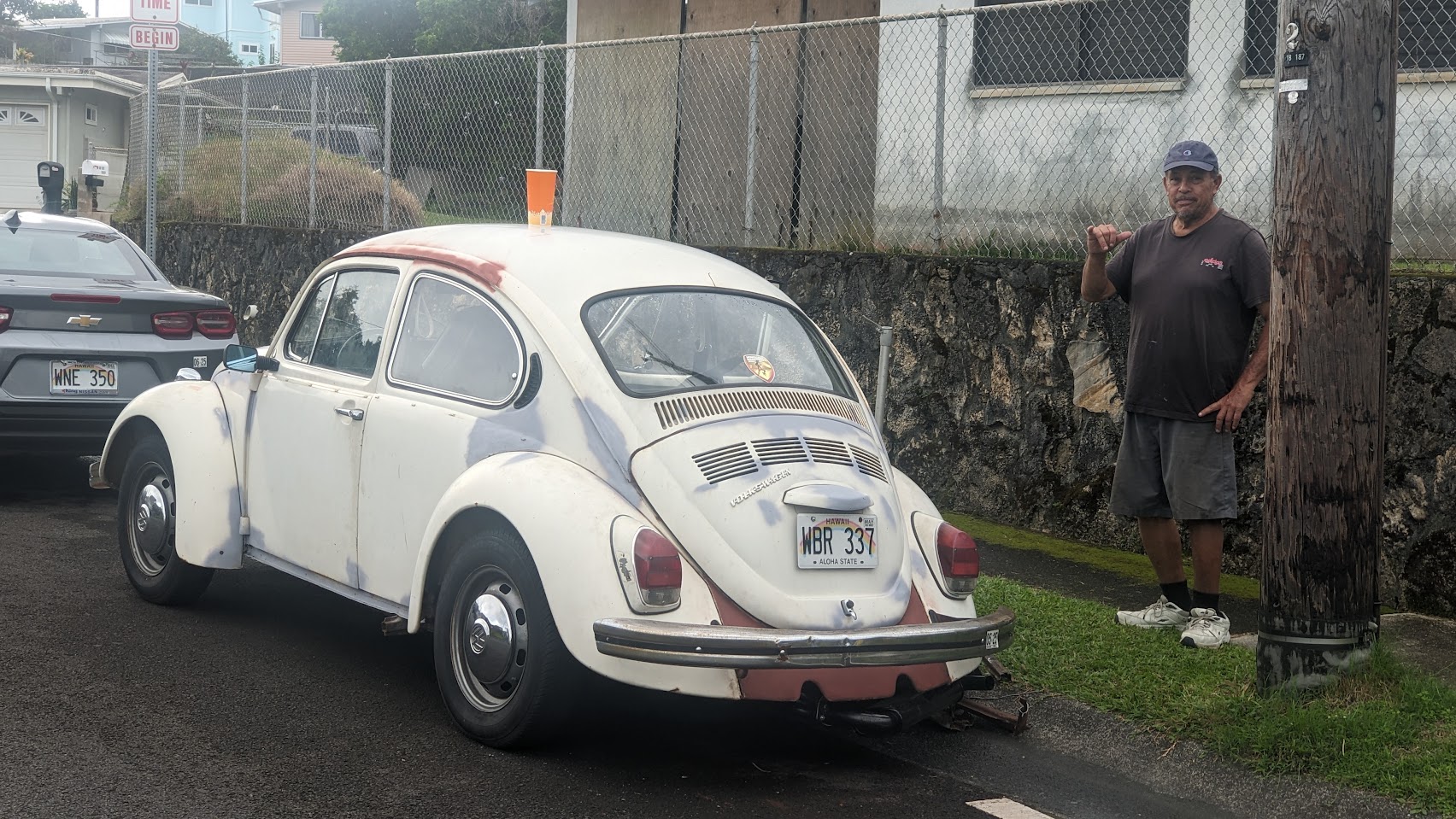

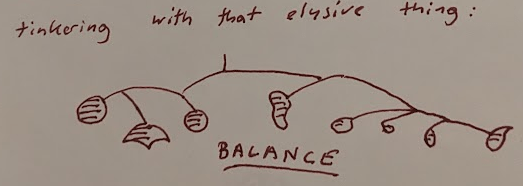
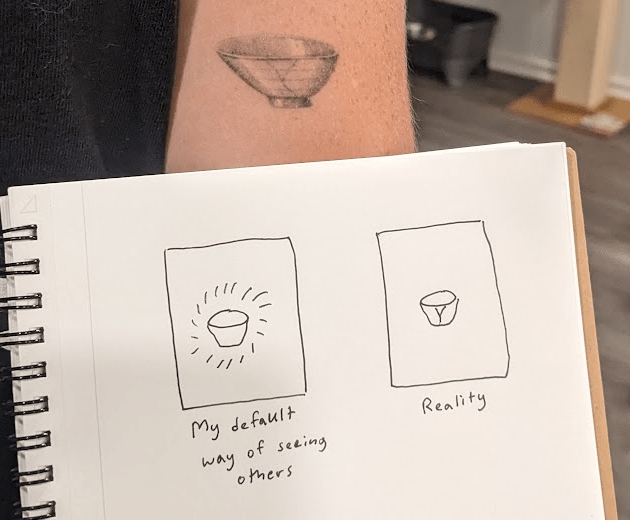
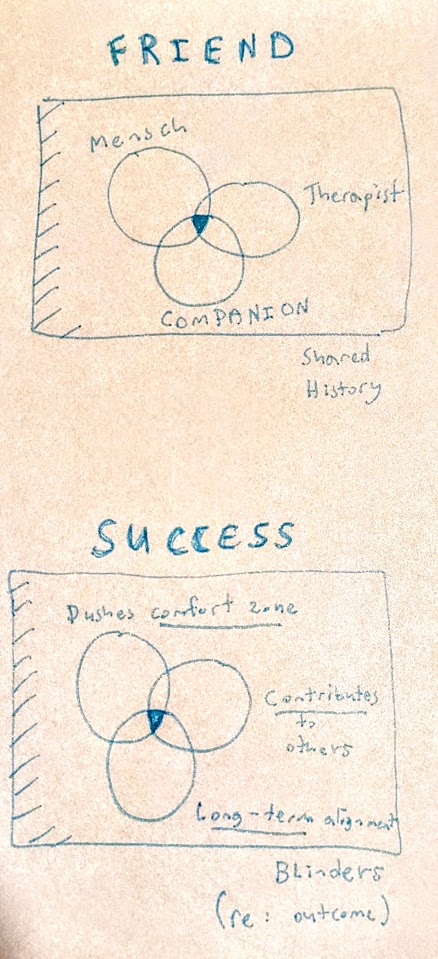

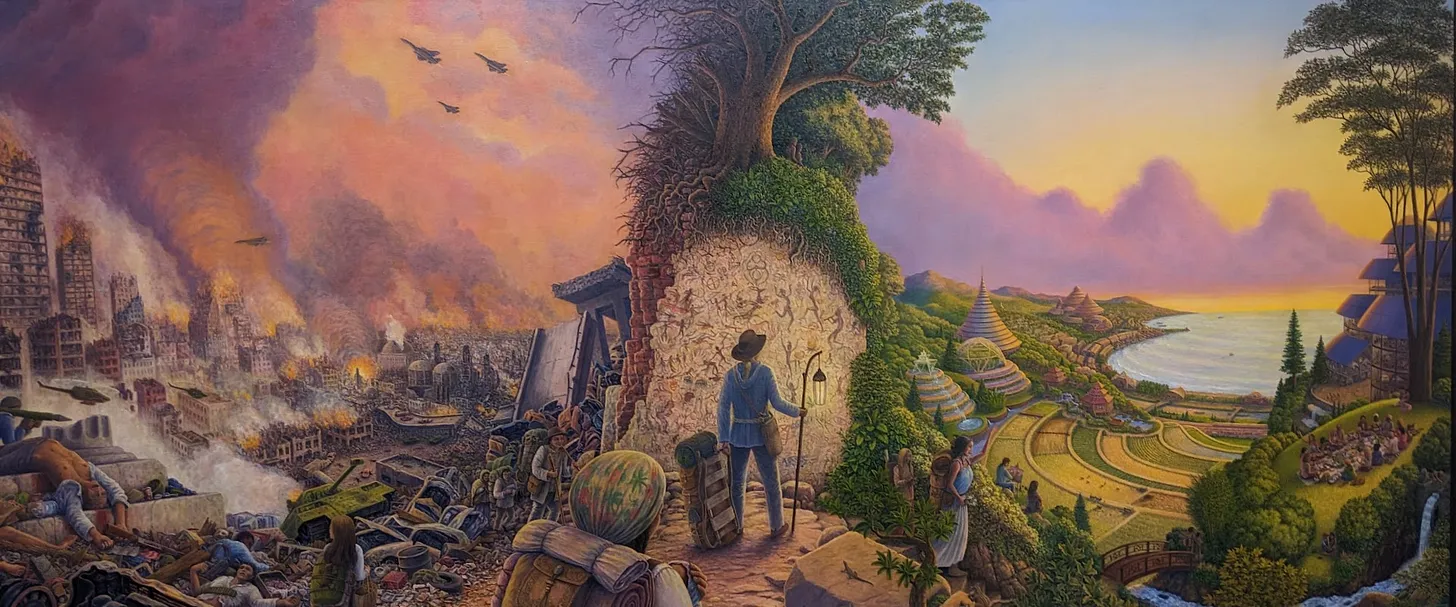


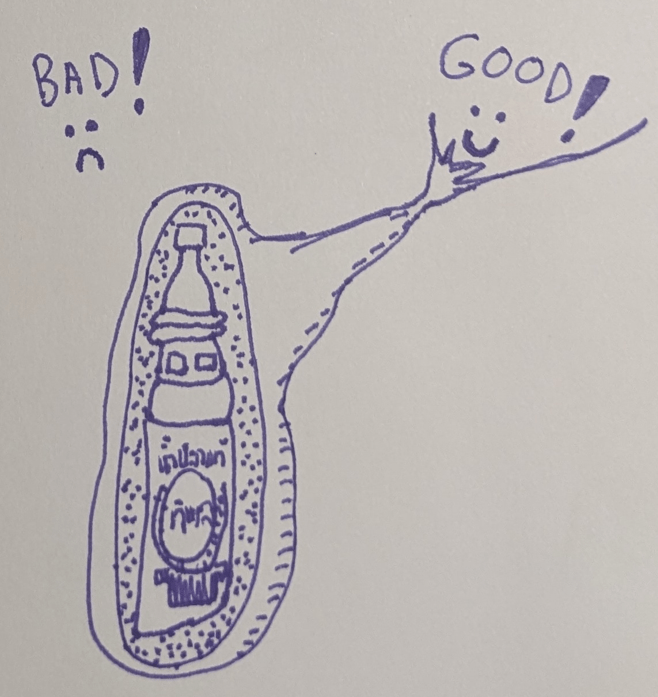

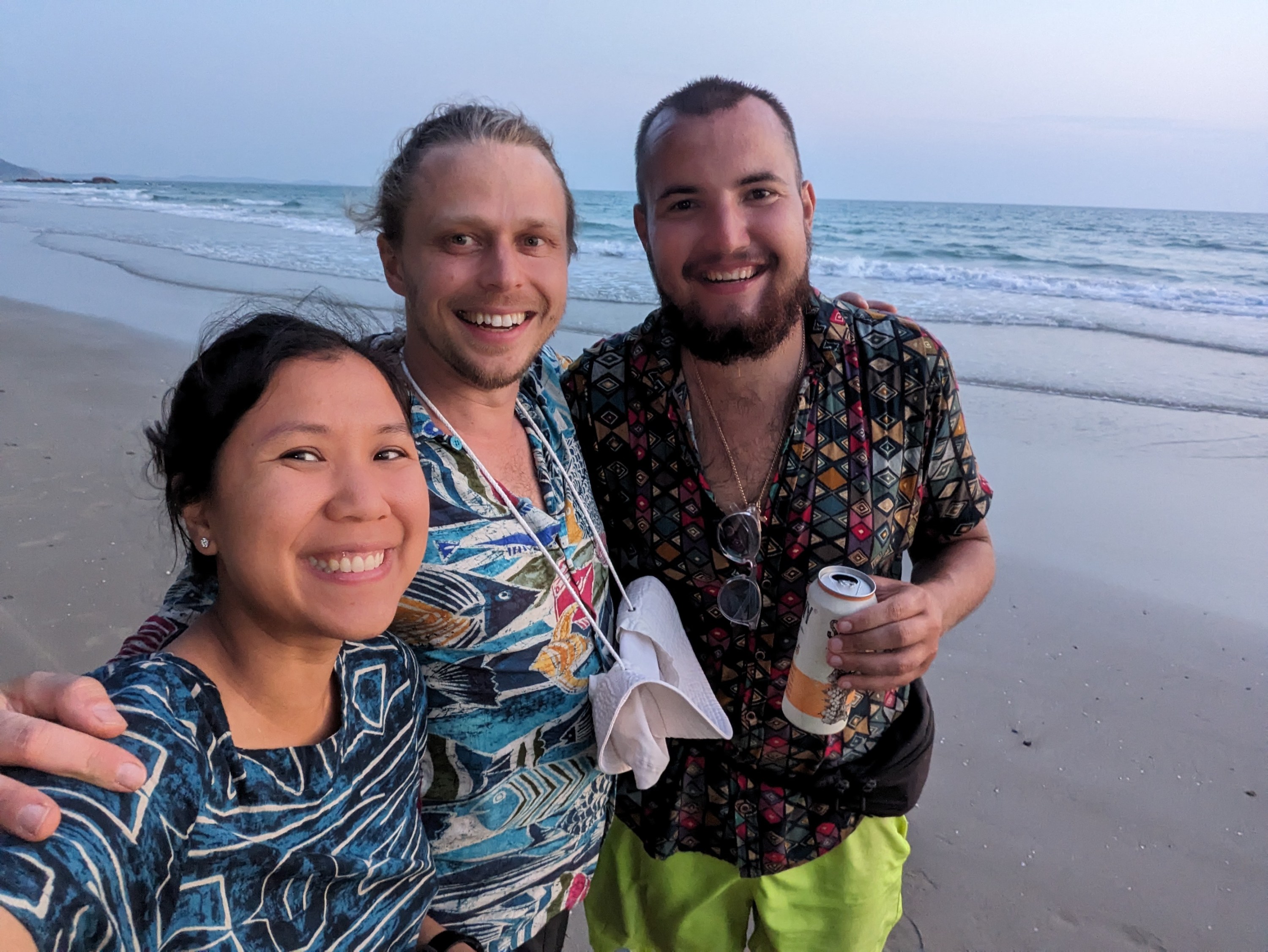

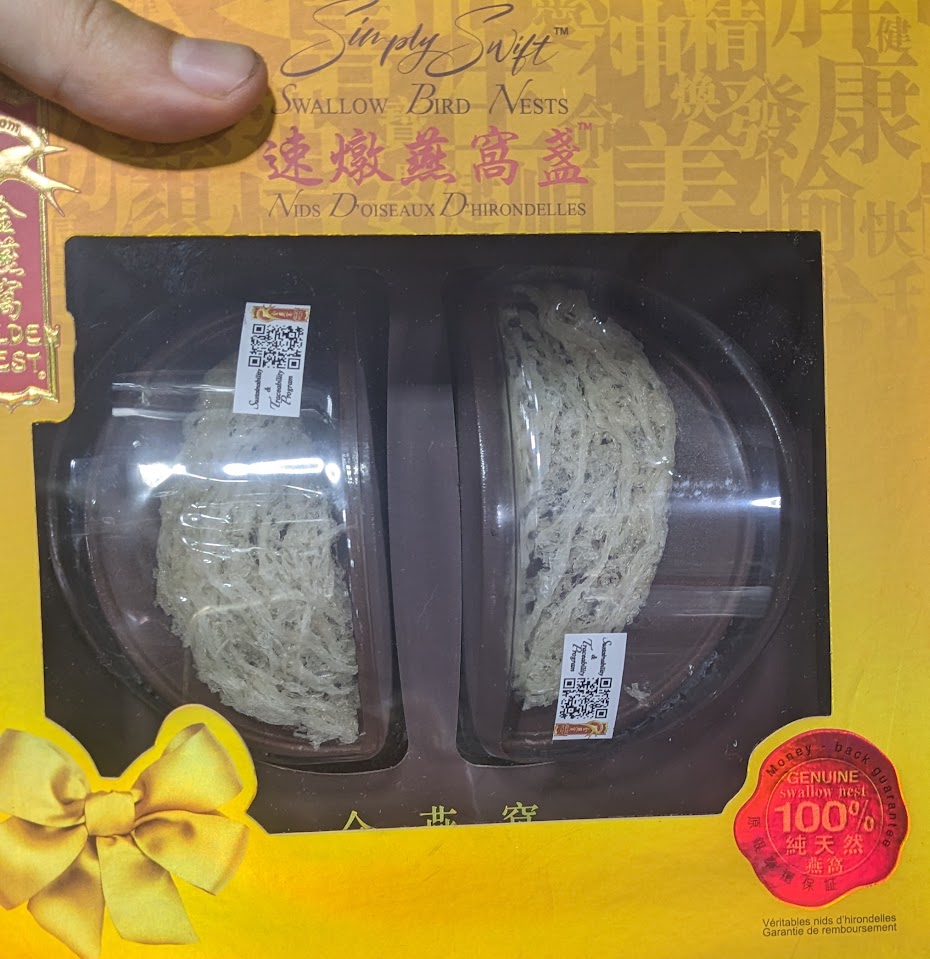
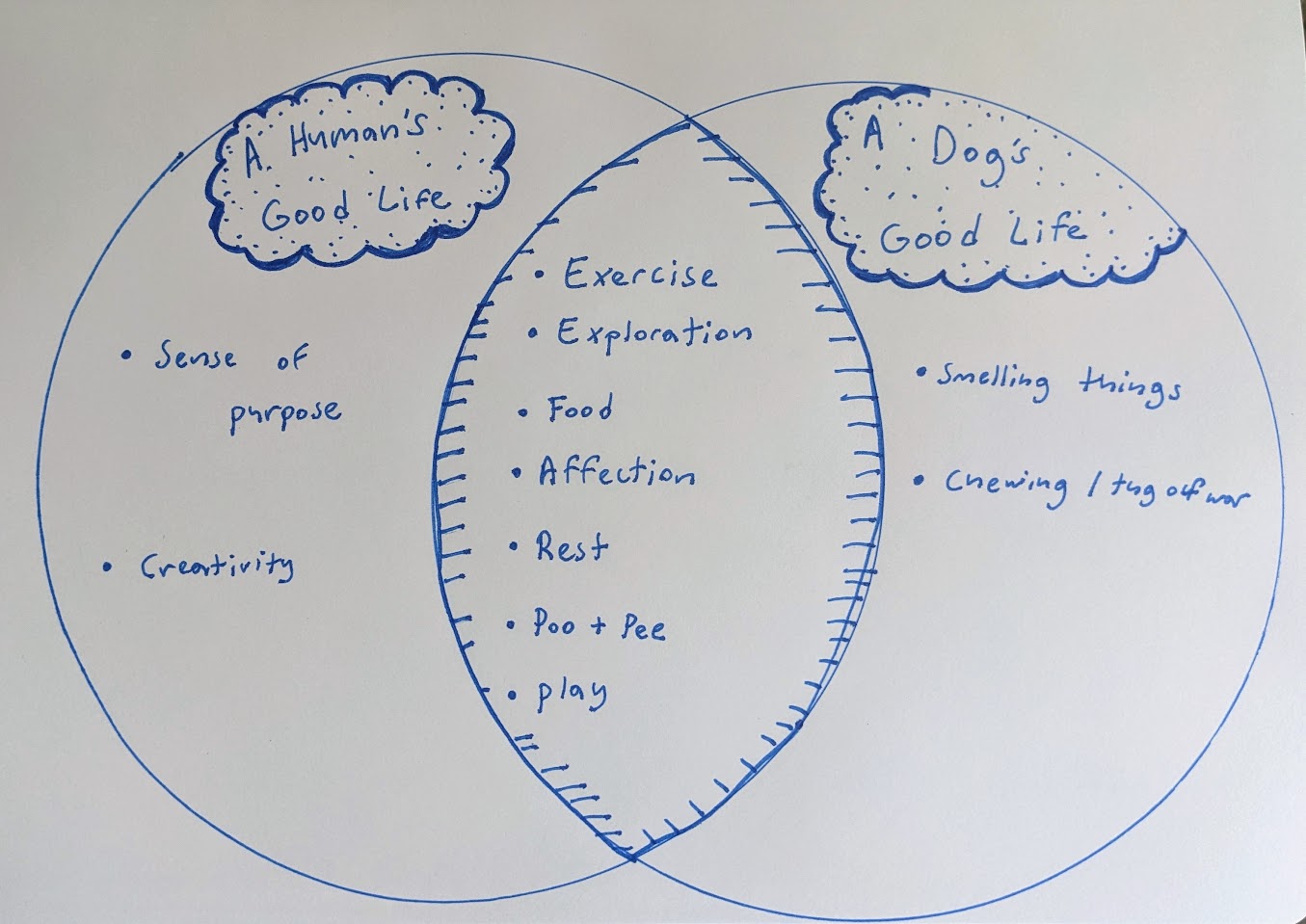

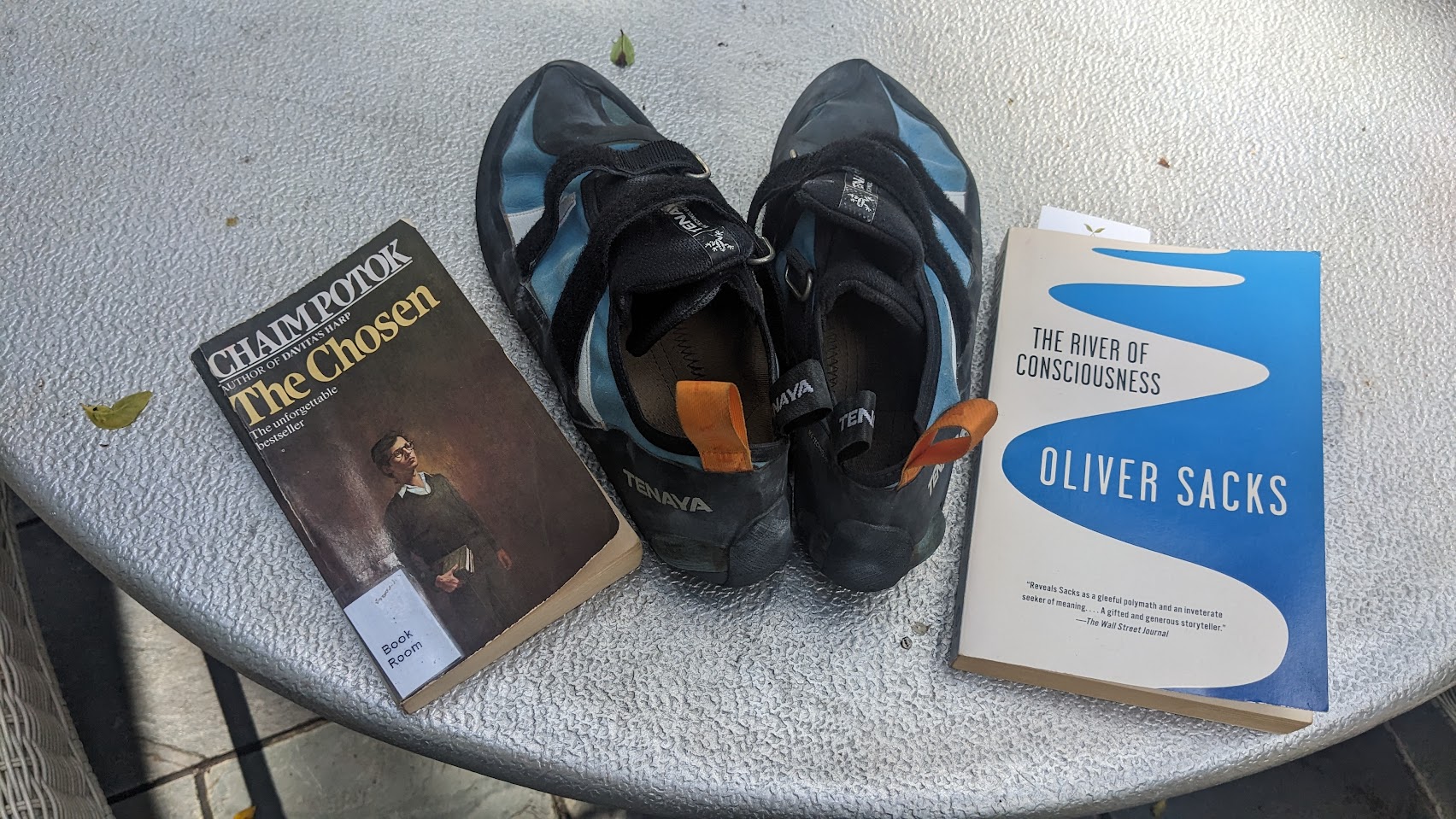



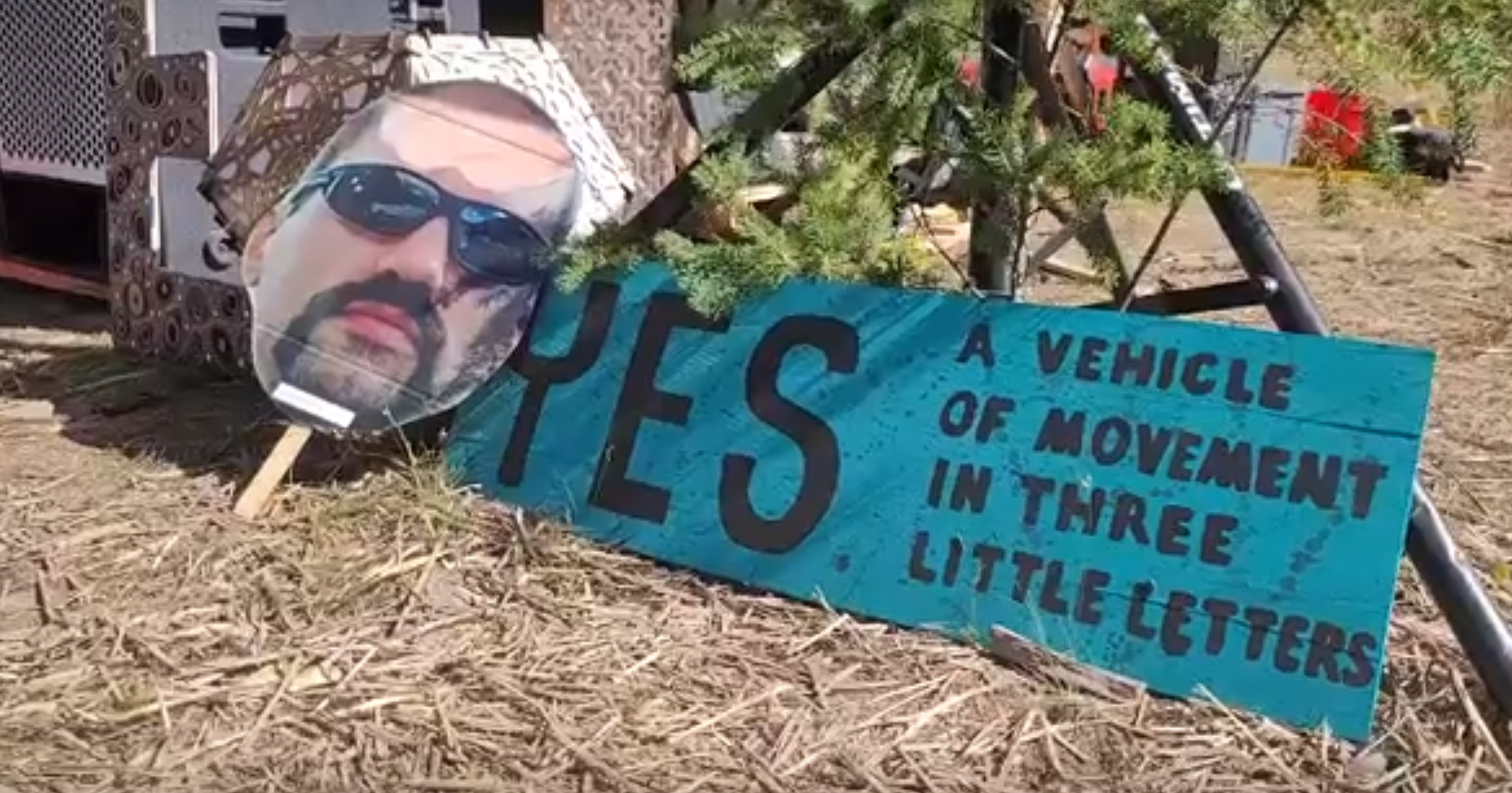

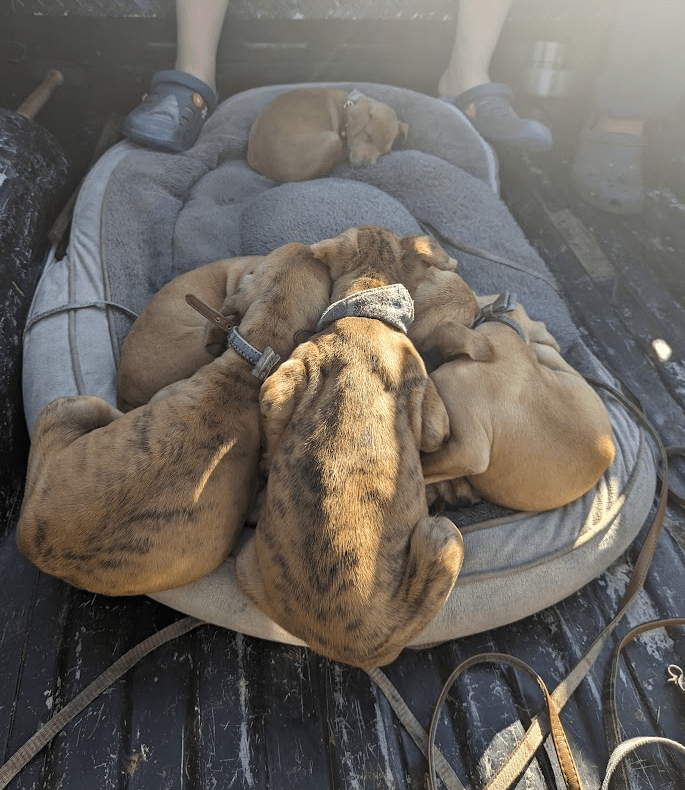

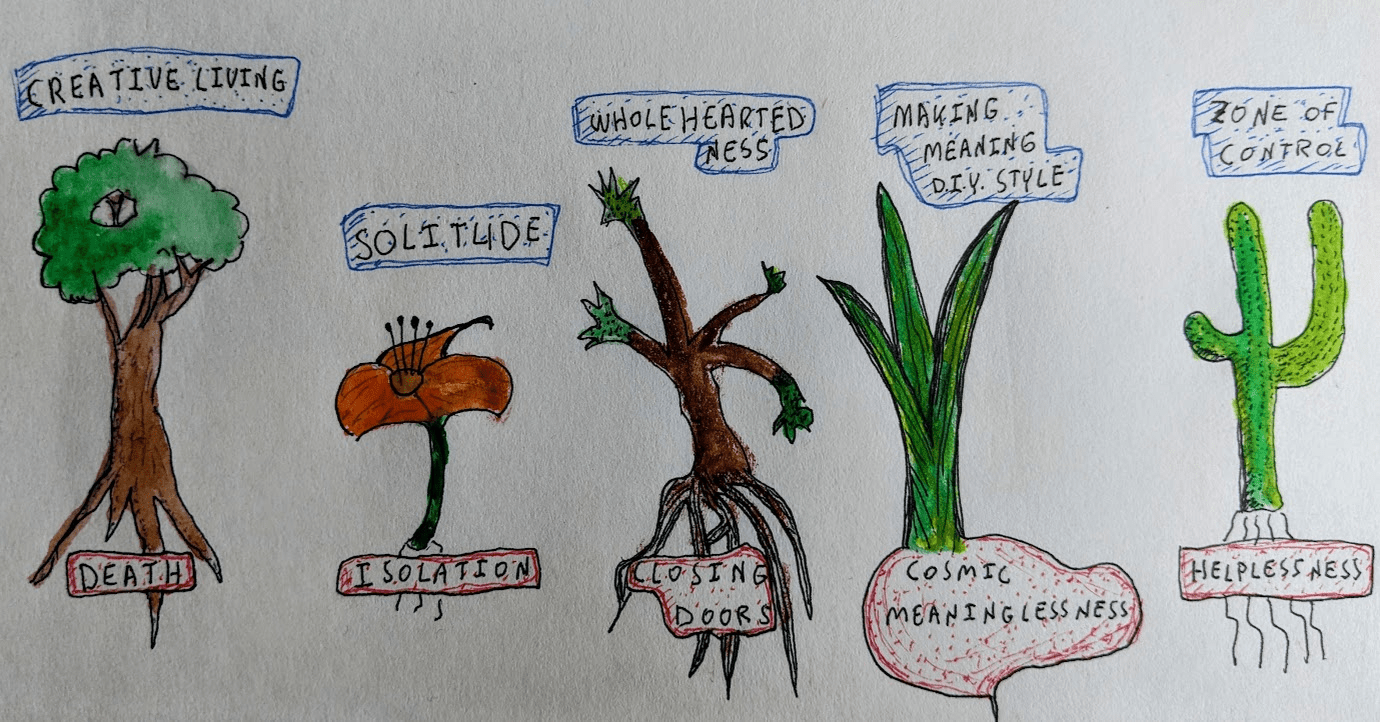


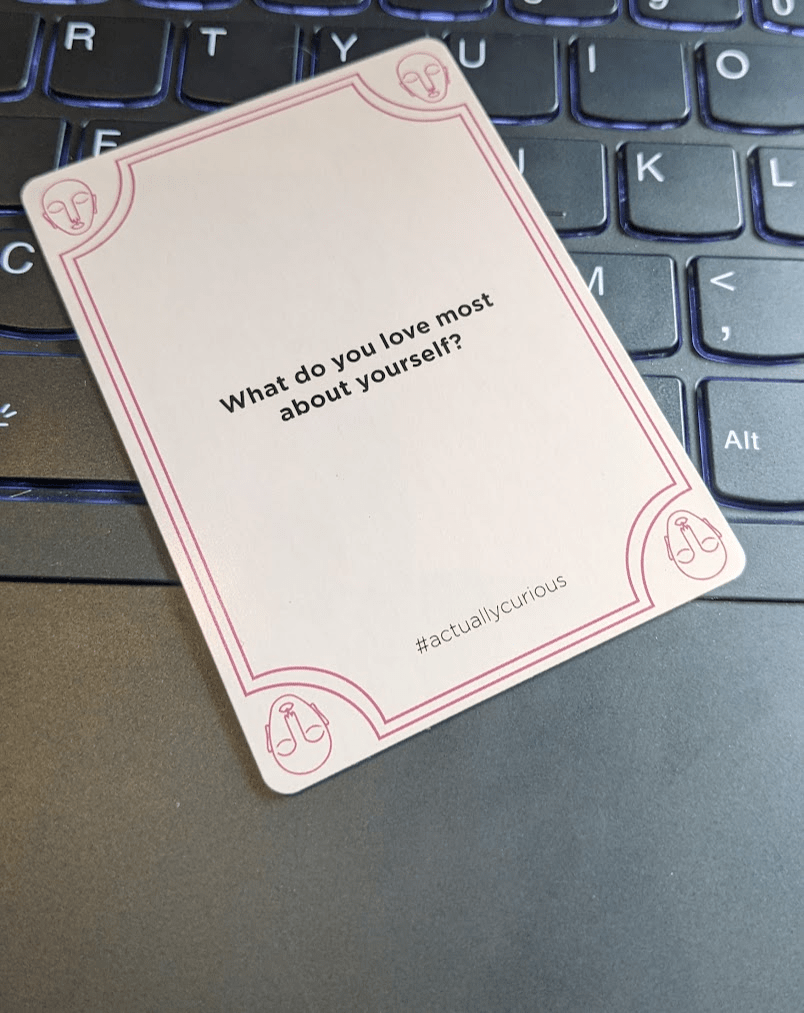



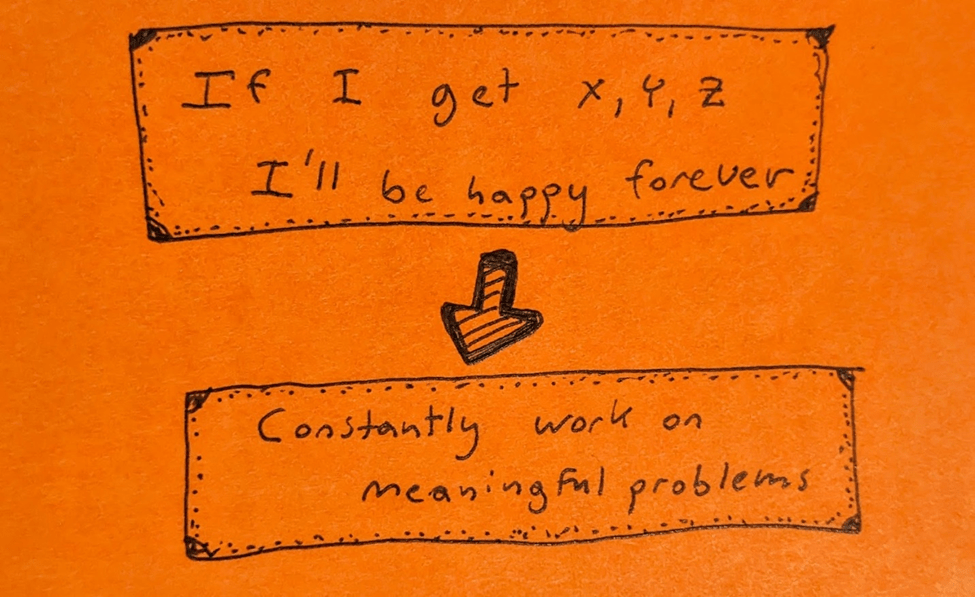

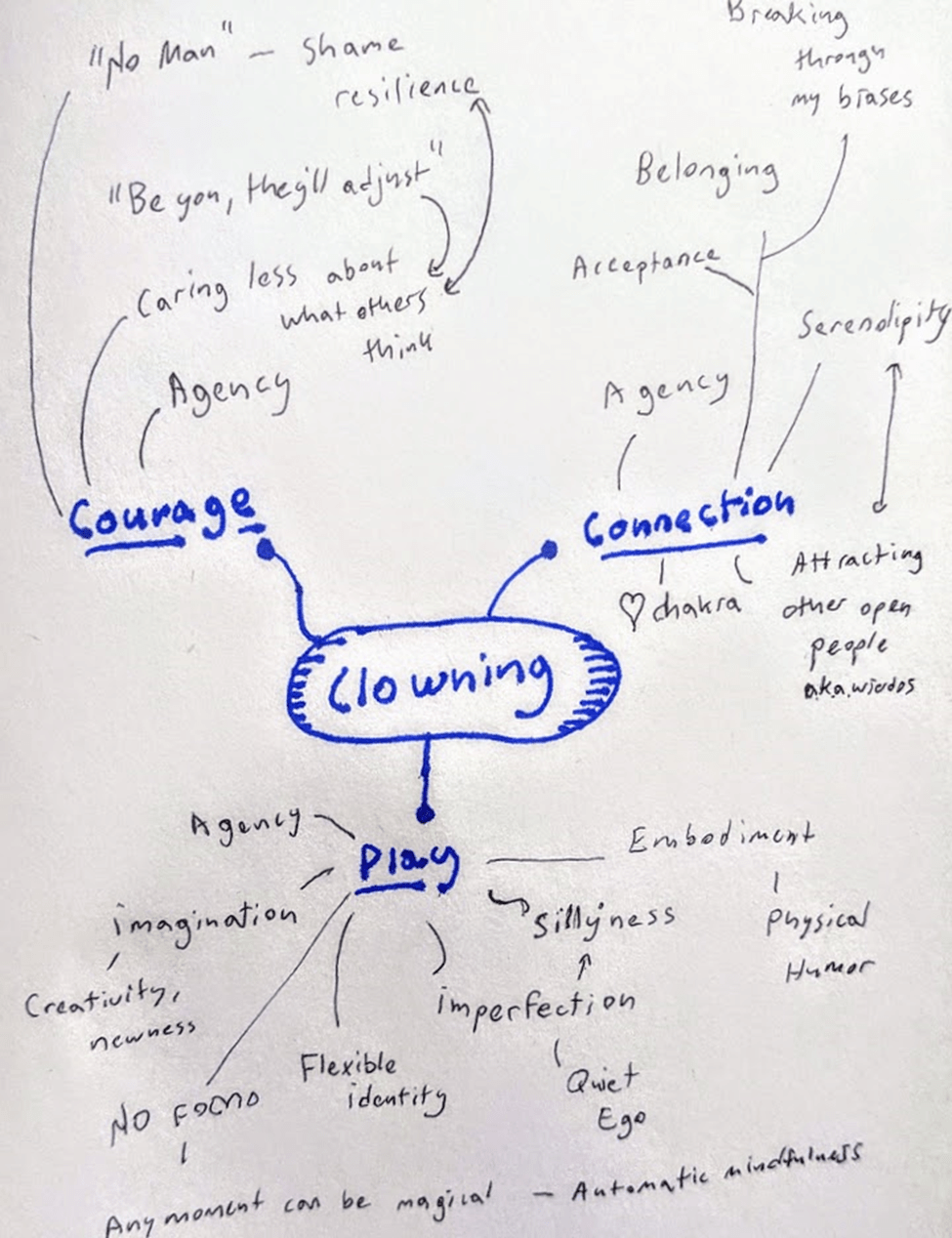

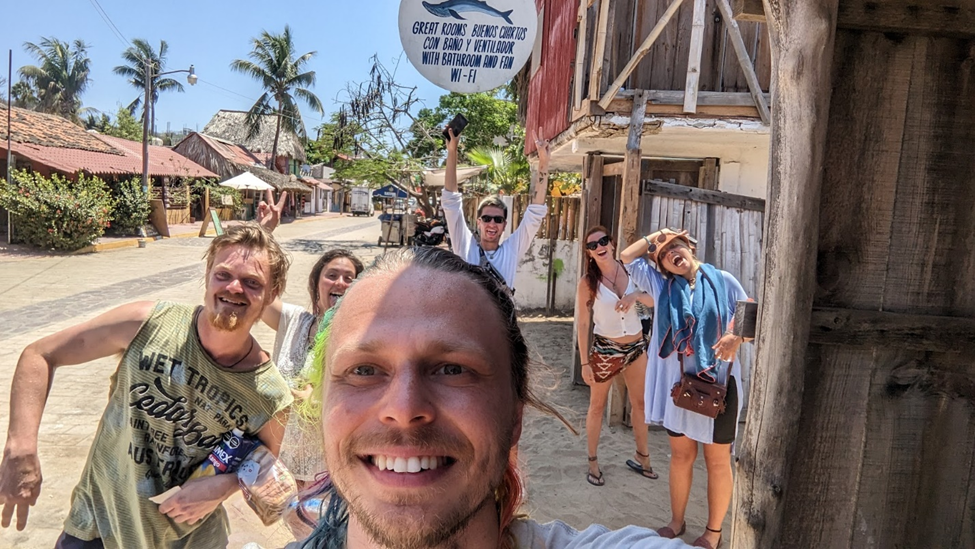

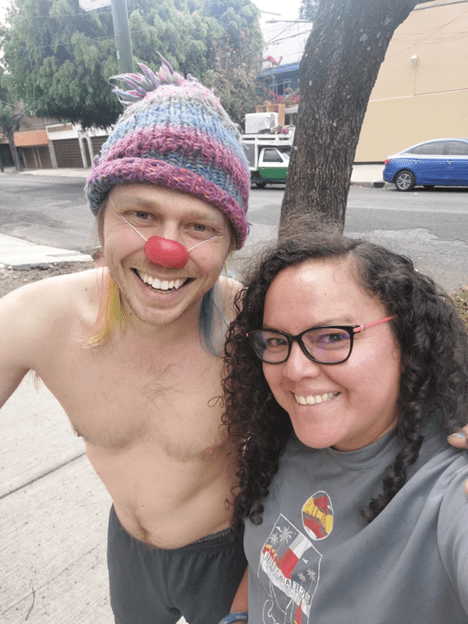
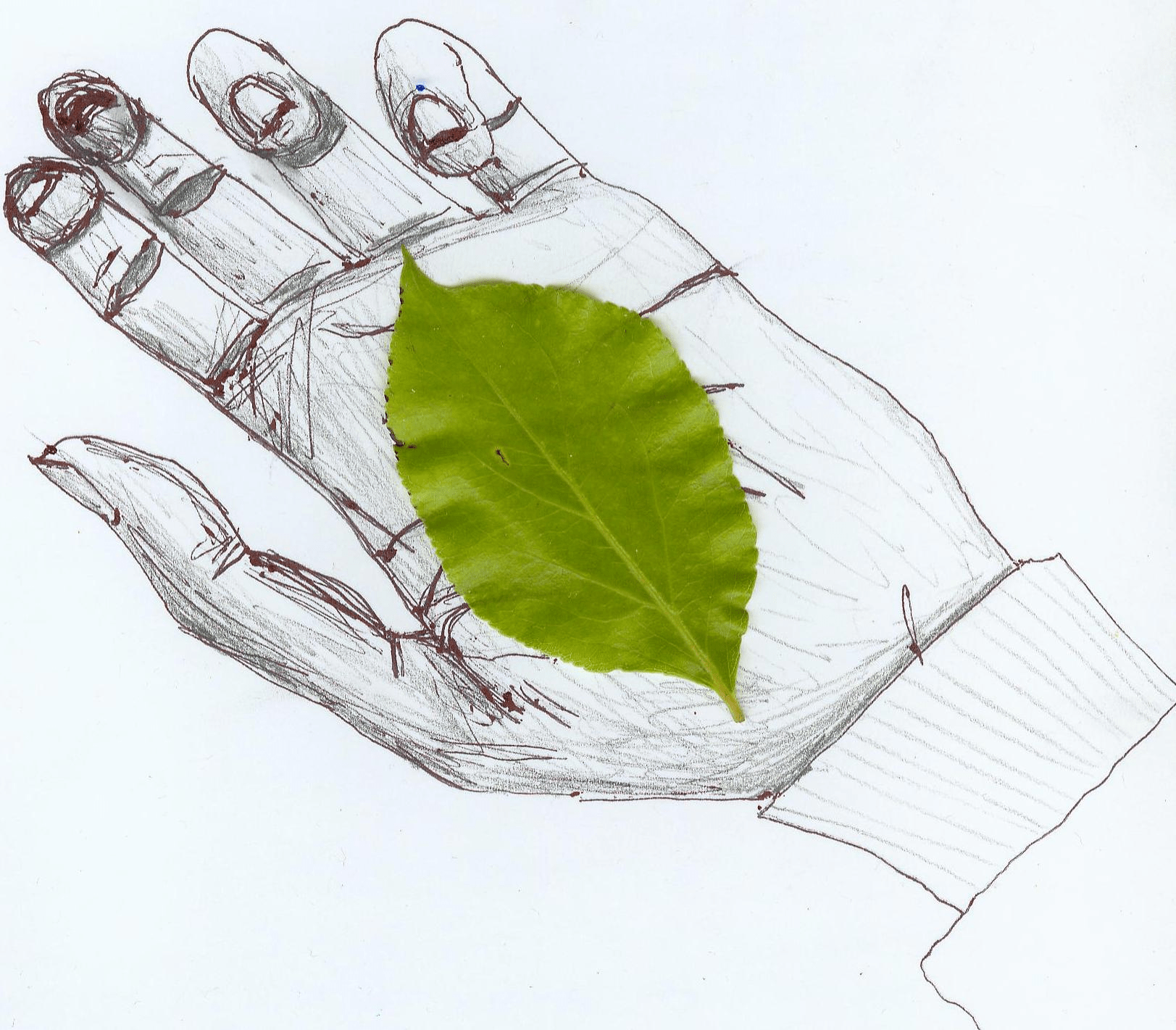

 danscreativeoulet